
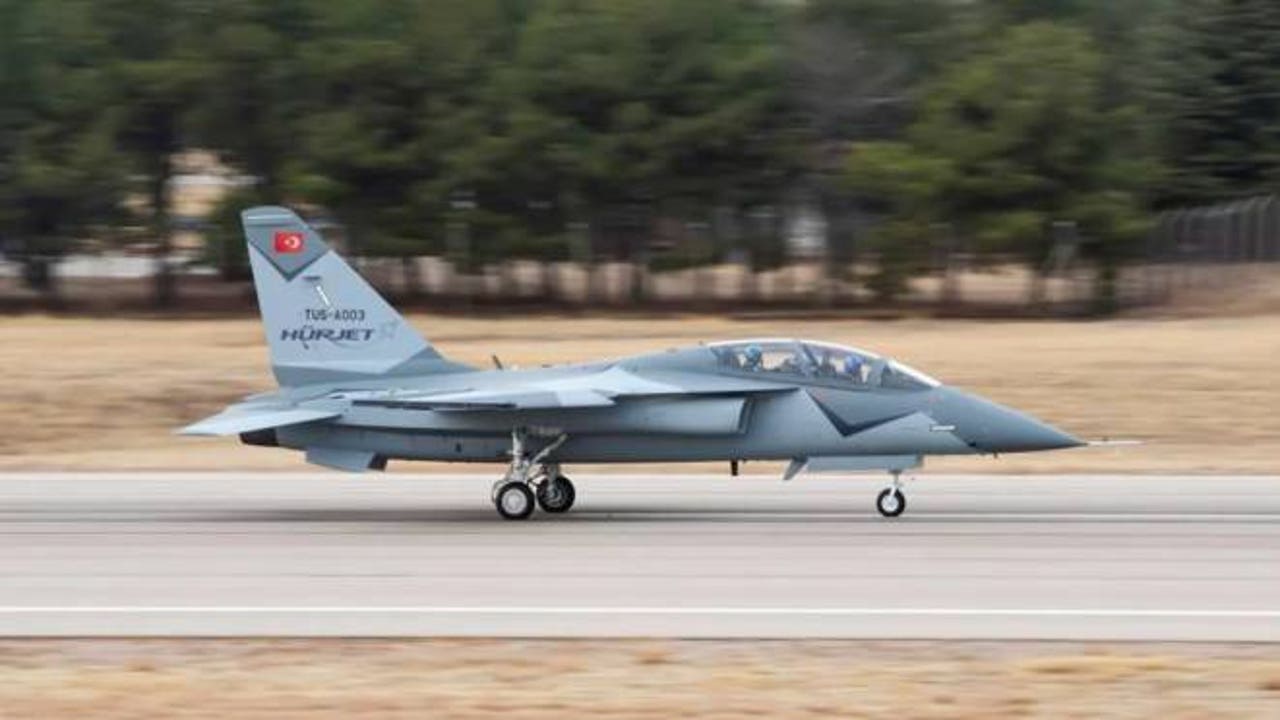
Spain is preparing to replace the F-5M American, which for more than half a century has served to train fighter pilots in advanced phases of their training, for the Turkish-made fighter Hürjetwhose first deliveries will take place in 2028. In the BOE of last September 24, it is indicated that they will be acquired until 45 of these light attack and training aircraft Turkish Aerospace (TA). The program Advanced Integrated Flight Teaching System (ITS-C, Integrated Training System – Combat), valued at about 1 billion euroswill include national customization, ground simulators and a service plan 30 years based on Talavera la Real (Badajoz).
This program will be articulated through a Temporary Union of Companies (UTE) between TA and Airbus Defense and Space Spainwhich will act as national coordinator and main contractor. The Hürjet aircraft structures will be manufactured in Türkiye and subsequently transferred to Spain for conversion and adaptation to national requirements, including the integration of avionics, systems and equipment developed by the Spanish industry.
He F-5M has served as advanced trainer in Spain since the 70s. Designated AE.9 in the Air Force, it has received various modernizations and useful life extensions, including improvements in avionics. However, availability and obsolescence problems have become evident in recent years. The fleet, made up of some 19 aircraftoperates exclusively in the Wing 23 of Talavera la Real. Despite having provided cost-effective supersonic training for decades, Its design based on technology from the 60s limits its usefulness for the transition to fourth and fifth generation fighters.
The Hürjet is a supersonic advanced training and light combat aircraft which made its first flight on April 25, 2023. The Turkish fighter has a length of approximately 13.6 metersspan of 9.8m and a height close to 4.1 meters. It is designed to offer great maneuverability, adapting to different speeds and altitudes and carrying a payload of around 3,400kgwith multiple weapon attachment points that allow you to integrate air-to-air and air-to-ground missiles, guided and conventional bombsand external pods or modules for training (that simulate sensors or weapons systems) u observation (including cameras, infrared or laser sensors to identify targets), as well as on-board training systems and modern avionics.
The program benefits from the approval of the US Congress to export the engine General Electric F404whose production and maintenance is carried out by the Turkish company TEI.
The Hürjet can reach a maximum speed of Mach 1.2a service ceiling of about 13,700 meters and is driven by a F404-GE-102 engine with approximately 7,700 kg thrust. It has fly-by-wire digital controls, multifunction screens in cabin and a integrated onboard training system.
Its great flight capacity in different conditions makes it suitable for training combat pilots, with low operating and maintenance costs and the ability to carry various ammunition, allowing its use in light combat, acrobatic patrol or Red Air aggressor missions (when simulating adversary tactics, maneuvers and combat configurations).
The F-5M has a length of approximately 14.45 meterswingspan of about 8.13m and height of 4.06 meters. Their usual weapons include two M39A2 20mm internal cannons and usually operates with air-to-air missile launchers (usually AIM-9 Sidewinder) and various pylons under the wings and fuselage for bombs, rockets and external tanks, with a mission load capacity close to the 3,100–3,200 kgdepending on the configuration.
Compared to the F-5M, the Hürjet offers a much more modern training environment. Its avionics, digital flight controls and compatibility with advanced weapons bring it in line with the current and future fighter technologies. The integrated system STI-Cwhich combines aircraft and ground means, will allow a formation impossible to achieve with the F-5M.
For Spain, the introduction of the Hürjet represents the step from maintaining a platform inherited from the US to operate a system developed jointly with Türkiyewith extensive national industrial participation. It represents a generational leap in the training of combat pilots, aligned with NATO standards and adapted to the new generation aircraft that Spanish aviators will fly.