
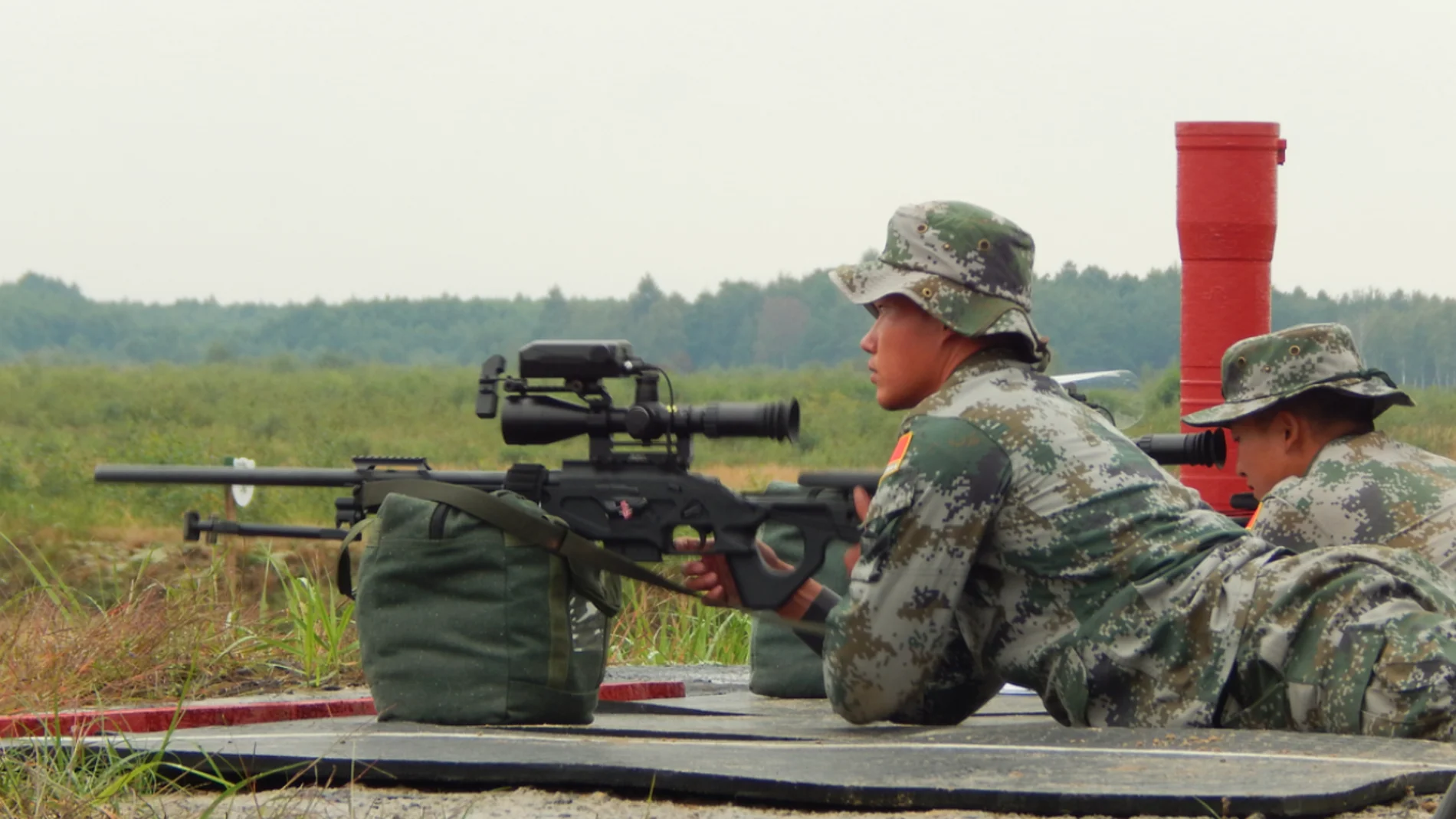
In the world of extreme precision, every meter counts. Getting it right at 800 meters is not the same as getting it right at 1,500. From there, distances stop being a matter of aiming and become a physical problem: gravity, wind, temperature, air density… even the rotation of the Earth begins to matter. For example, The Earth curves approximately 8 centimeters for every kilometer in a straight line. Therefore, from certain distances, the difference is enormous and the precision much more complex.
Thus, when a new system promises to push these limits, it is advisable to look at it carefully, but also with caution. That is what is happening with the latest development presented by the Chinese military industry. According to local mediadefense companies of the country They are working on a large-caliber rifle designed for shooting at extremely long distanceswithin the category known as anti-material, intended for equipment targets rather than human targets.
This is not a conventional rifle designed only for human targets, but rather a weapon designed to neutralize equipment, sensors or light vehicles at long distances. The system uses 14.5 millimeter ammunition, a caliber considerably larger than that of the most common sniper rifles. To understand the difference, just remember that many military precision rifles use 7.62 mm cartridges or, in heavier models, 12.7 mm. The jump is not trivial: it involves more energy, greater potential range and also a significant increase in the technical demands of the shot.
The figures that accompany this development are striking, but it is worth putting them in context. In previous tests, a Chinese rifle like the CS/LR24 would have hit targets at about 3,017 meters. Some sources mention the possibility that new Chinese systems may approach or slightly exceed these figures, with estimates that are around 3,500 meters in test conditions: five consecutive shots at the same target.
He CS/LR24 It is a large-caliber precision rifle within the anti-material category, designed for very long-range shooting. against both human and light equipment targets. It is characterized by a long (more than 60 centimeters) and heavy barrel (over 6 kilos in total) that maximizes ballistic stability, a muzzle brake system to mitigate the strong recoil associated with its high-energy ammunition, and a configuration optimized for shooting from a fixed position using a bipod or support.
It integrates high magnification optics and can operate in conjunction with external ballistic calculation and environmental measurement systems, allowing you to adjust the trajectory of the projectile taking into account variables such as wind, temperature and atmospheric pressurereaching distances of the order of three kilometers in tests. It is a more than considerable distance, in line with the longest shots documented in real conflicts. In fact, the most recent confirmed record, attributed to a Ukrainian sniper, from the Pryvid unit, is around 4,000 meters.
However, there is currently no detailed independent verification that confirms these results described by Chinese media in operational scenarios. And that nuance is key. Because hitting a target under controlled conditions, with measured wind, static target and multiple attempts, is not the same as doing so in a real environment. At these distances, a small variation in wind speed can deflect the projectile by several meters. The bullet can remain in the air for seconds, describing an arc trajectory in which every variable counts.
In that sense, Chinese development is not so much an absolute break as a continuation of a clear trend: the search for extreme precision through the combination of power and technology. The latest generation rifles no longer depend solely on the shooter. They incorporate advanced ballistic systems, environmental sensors, high-precision optics and even digital assistance to calculate trajectories in real time. The modern sniper operates, in many cases, as a node within a larger technological system.
Hitting targets more than three kilometers away is already an extraordinary feat. Overcoming this barrier in a consistent, verifiable way and in real conditions remains one of the greatest challenges of modern ballistics. And, as is often the case in military technology, between what is advertised and what can actually be reproduced on the battlefield there is often a distance… difficult to measure.