
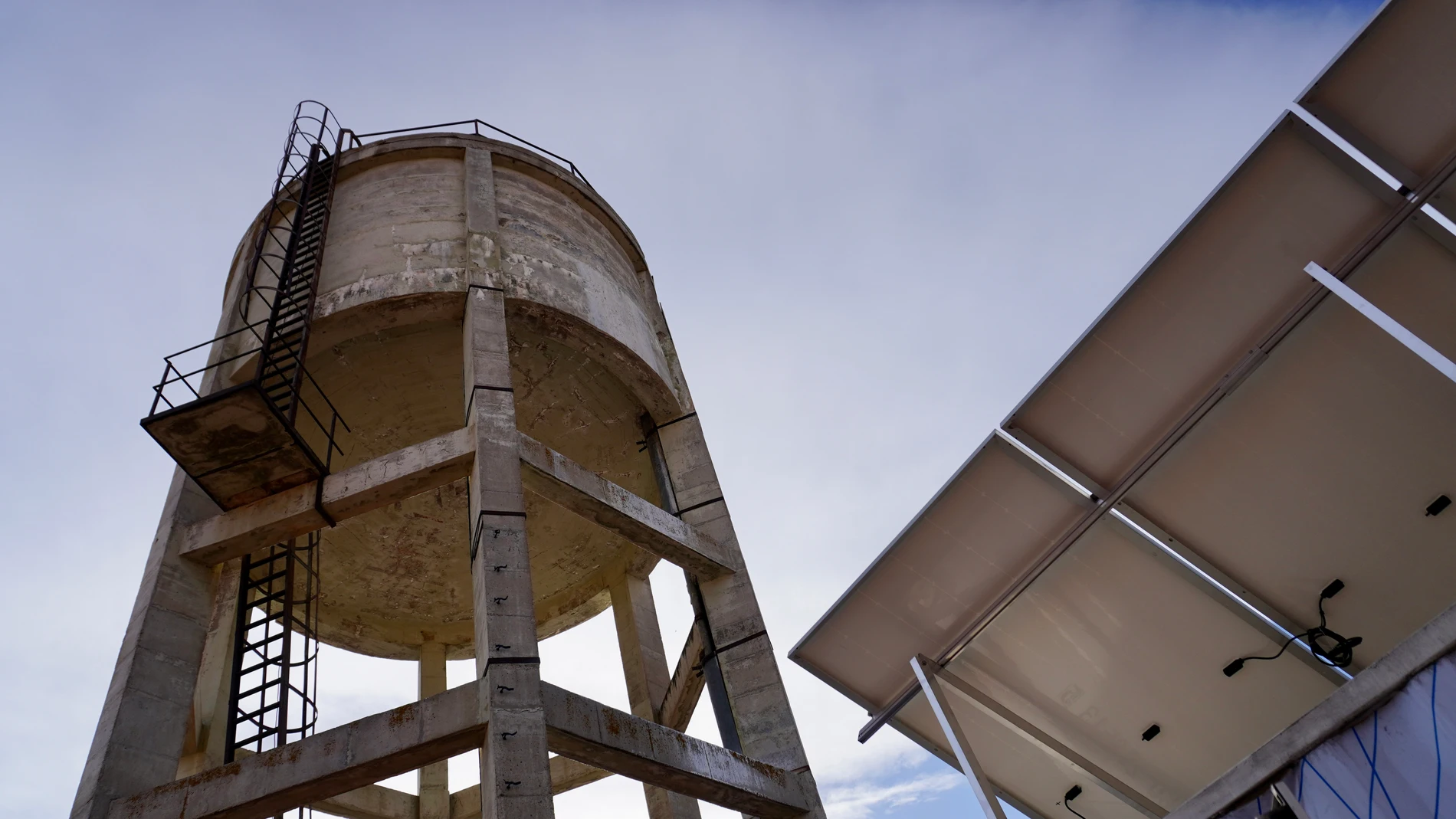
Tiñosillos, a municipality of barely 800 inhabitants, has gone from being another example of rural water problems to sharing the water vanguard with Singapore, a world leader in water management and a pioneer in the regeneration of wastewater to make it drinkable. That a town of this size can benefit from cutting-edge technologies today is a reality thanks to the GestEAUr Project, promoted by Aqualia and financed by the European Interreg SUDOE program.
The case of Tiñosillos is an example of how science can improve the quality of life and the development of rural communities by facing one of the most recurring problems in Spain: nitrate contamination in drinking water. Innovation can also turn small towns into leading and reference places.
One of the big problems that has been managed to combat in this town of Avila is nitrates in the water. These are compounds derived mainly from the intensive use of agricultural fertilizers and their presence in water for human consumption can have negative consequences for health and the environment. In fact, 257 Spanish municipalities exceeded the legal limit of 50 mg/l in 2023, leaving more than 220,000 people without access to drinking water, according to data from the Ministry of Health.
The La Moraña region, in Ávila, where Tiñosillos is located, is eminently agricultural, which is why it has historically suffered from this problem. The overexploitation of aquifers and the use of phytosanitary products in crops and vegetation areas have increased the concentration of nitrates and pesticides in the water. Until recently, Tiñosillos lived this reality because it depended on a treatment plant based on the use of resins that, although effective in removing nitrates, required frequent visits to the tank to replenish salt, necessary to regenerate the resins when they are no longer effective.
Technology inspired by nature
The situation has changed radically with the launch, in October 2024, of the biomimetic reverse osmosis demonstration plant. “A technology inspired by nature, which uses membranes with aquaporins – proteins present in various organisms such as animals, plants and bacteria, and are crucial for maintaining cellular water balance -, which act by forming channels for water in the membranes and facilitate osmosis in the treatment,” explains Matías Rivadulla, Project Manager of Aqualia’s Innovation and Technology Department. Furthermore, with this system, the expert continues, “the water is filtered at a lower working pressure, which increases energy efficiency, reduces expenses and makes this solution viable for a town of 800 inhabitants.”
The arrival of biomimetic reverse osmosis brings with it other improvements in the management of the town’s drinking water. Sergio Galindo, head of Aqualia Service in Tiñosillos, details that the new technology: “has made it possible to automate and reduce costs in a process that previously required more reagents, salt in this case. Now, in addition to stopping using it, we also prevent the brine from affecting the municipal wastewater purification, and it is not necessary to go to the facility so often to replenish it.” In addition, the plant is energy self-sufficient thanks to a system of photovoltaic panels and battery storage, so it works without connection to the electrical grid.
Miriam Tena, researcher at Aqualia’s Innovation and Technology Department, explains: «With the GestEAUr Project we want to provide alternative and sustainable solutions to the entire integral water cycle, from purification to purification. In Tiñosillos, and in the entire La Moraña region, concern about nitrates is historical and, with the new facility, which has been operating for a year, we are achieving elimination percentages of 98%, which allows us to obtain very good quality water,” Tena clarifies.
The plant not only removes nitrates, it can also reduce other unwanted compounds, such as pesticides. Additionally, and in collaboration with the University of Castilla-La Mancha, Aqualia is working on a chlorine-free disinfection system, which will represent a decisive advance in the health safety of water, especially in rural areas.
Tena explains that “the objective is that these plants can be installed in rural areas. With the solar panels and batteries, the system is completely autonomous. And he points out that in Aqualia there are only three facilities with battery energy storage: “in Badajoz, Jerez de la Frontera and Tiñosillos, the latter being the largest and the one that facilitates the most savings.”
The plant is transportable and can be quickly commissioned in any rural area, making it a flexible and scalable solution.
The impact on local management
The improvement that the new system translates into economic savings, a greater health guarantee and a much lower environmental impact. The municipal service has gone from a more expensive and less efficient management to a sustainable and replicable model.
This membrane technology, as the experts explain, “is unique in the world: there are only ten references, one of them in Singapore, which is a world reference in water management.” The result is water of the highest quality, which also meets the new European regulations on water quality, network efficiency, reduction of pollutants and waste management, as well as energy savings in purification of between 15 and 20% compared to conventional membranes. On the other hand, Aqualia experts also emphasize the fact that “this is not an experiment. With an investment of 2.5 million euros, this solution provides total scalability for small towns, and responds to all regulations at an affordable cost for residents. “It is a commitment to society and to the rural environment.”
The Tiñosillos plant thus becomes an example of how biomimetics can inspire technological solutions of great impact.