
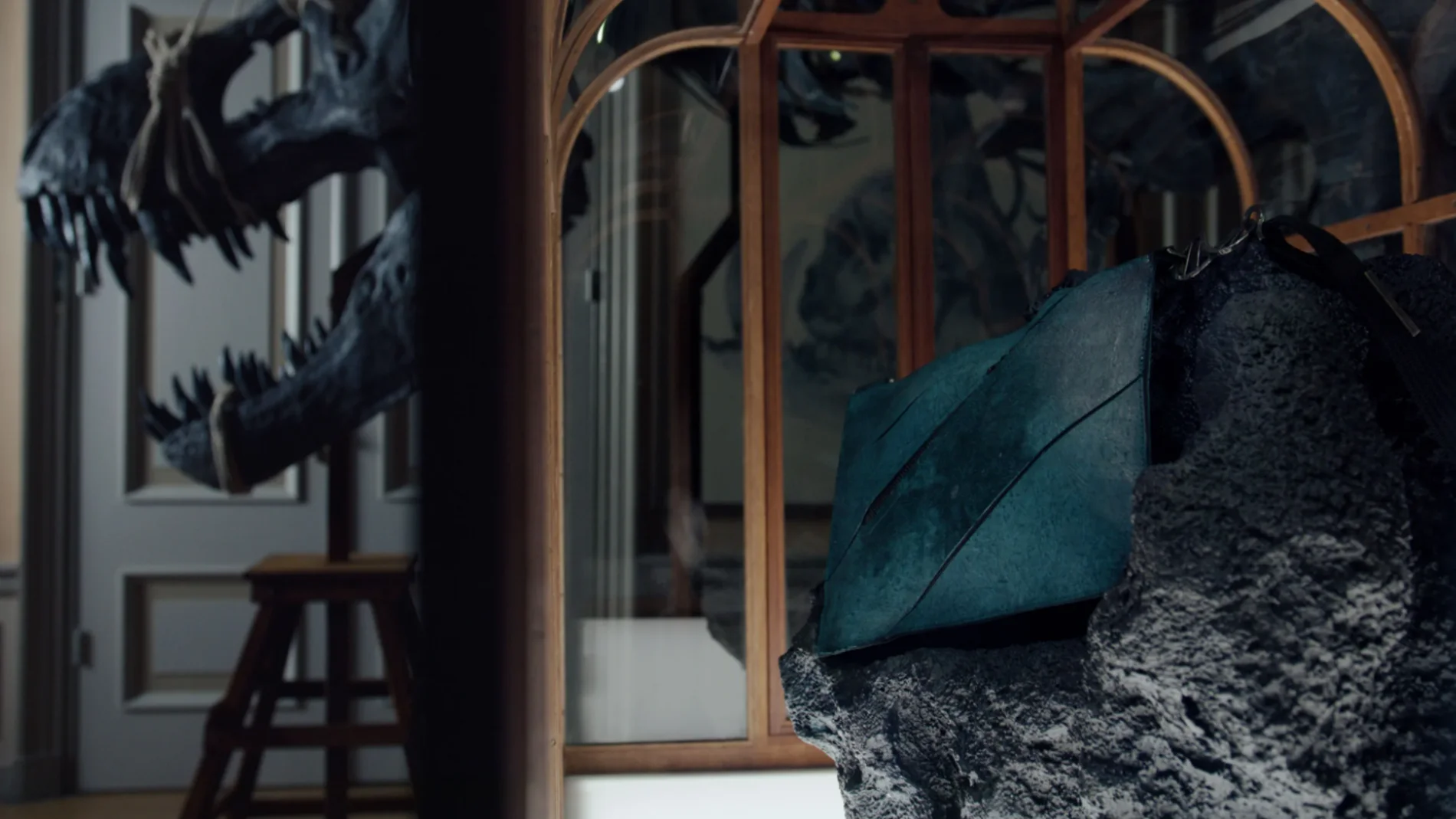
There are ideas that seem designed for a film script. And in this case it would be the film that would cross Jurassic Park with The Devil Wears Prada: when fashion and genetics come together. And the result, in this case, is a bag made with leather. Tyrannosaurus rex is one of them. A team of scientists, designers and creatives presented in Amsterdam what they describe as the first product made with “T.rex leather”: a luxury piece that, more than an accessoryworks as a statement about how far biotechnology is coming.
The project was born from a collaboration between the creative agency VML, the genomic engineering company The Organoid Company and the biotechnology firm Lab-Grown Leather Ltd.. Its objective was not to recreate a dinosaur, not even its skin, but use fragments of biological information from the past to make an entirely new material. The result materialized in a bag designed by the Enfin Levé brand, presented as a unique, almost museum-like piece.
Obviously there is a trick and the key is in one word: collagen. This is the main structural component of traditional leather, and also one of the few biomolecules that, under exceptional conditions, can leave traces in ancient fossils. From collagen fragments found in dinosaur remainsscientists reconstructed a “plausible” sequence of what that protein would have looked like millions of years ago. That sequence is translated into synthetic DNA, which is introduced into living cells so that they produce collagen in the laboratory.
From there, the process becomes almost artisanal: The cells generate a structure that imitates that of leather, without the need for animal skin or traditional chemical processes of tanning. According to its creators, the resulting material is biodegradable, repairable and traceable, and is produced without animal sacrifice or deforestation.
“This project – explains Thomas Mitchell, director of The Organoid Company – demonstrates how genomic and protein engineering can create entirely new classes of biomaterials. By reconstructing and optimizing ancient protein sequences, we have engineered T.rex leather inspired by prehistoric biology and cloned it into a custom-designed cell line. “It is a bold example of how synthetic biology extends beyond medicine into sustainable materials innovation.”
So far, the story seems impeccable: a fusion between deep past and cutting-edge technology that promises to redefine luxury. But as soon as you scratch it a little, the cracks appear. The reality is that there is no DNA Tyrannosaurus rex. Genetic material degrades over time, and recovered dinosaur fragments are incomplete and extremely rare. What scientists have It is not a “T.rex genome”, but loose pieces, especially proteins such as collagen, which must be reconstructed through inferences. In this sense, calling this material “T.rex leather” is more of a narrative than a literal description.
And yet, therein lies the most fascinating part of the project. Not in whether the bag is really “dinosaur”, but in what it represents: a new way of manufacturing materials inspired by biology, without depending directly on current living organisms. It is, in a way, an inverted archaeology. Instead of excavating the past to understand it, it is reconstructed to design the future.
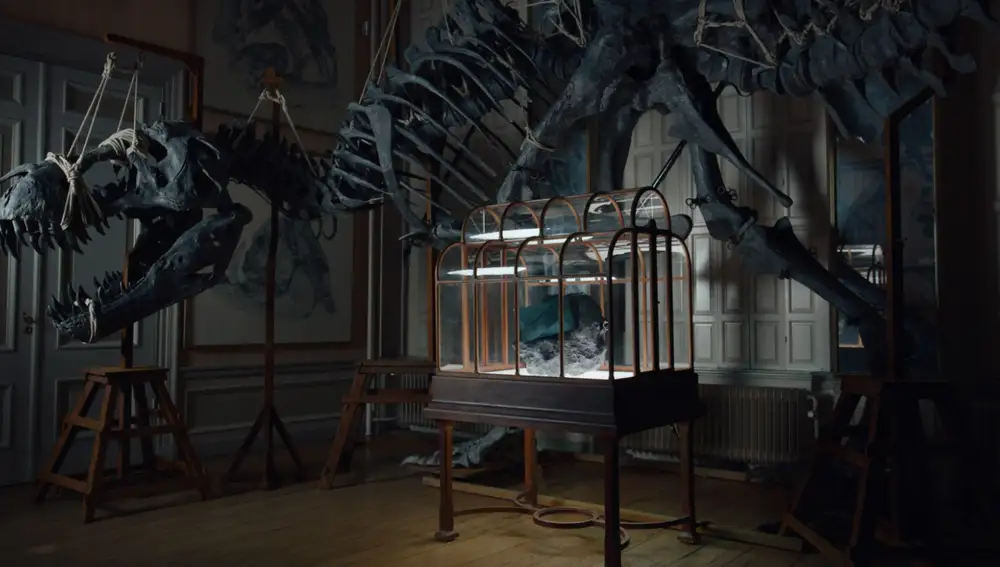
The bag, exhibited at the Art Zoo Museum in Amsterdam next to the replica of a T.rex skeletonresults in a hybrid object: half scientific experiment, part marketing piece and part contemporary art. After its display, it will be auctioned as a unique object, with a price that likely reflects both its rarity and its history.
But beyond the headline, the underlying question is another. If today we can recreate proteins from extinct organisms to make materials, What prevents us tomorrow from designing completely new fabrics, with properties that do not exist in nature today? Stronger, lighter, more sustainable. Perhaps the true value of this bag is not in its supposed connection with the Cretaceous, but in that it points a direction: that of a biotechnology that no longer limits itself to imitating life, but begins to rewrite it.
And in that future, perhaps luxury will not consist of the rare or the scarce, but rather the improbable: carrying on your shoulder something that, in a certain way, began to exist 66 million years ago… although only now do we know how to imagine it.