
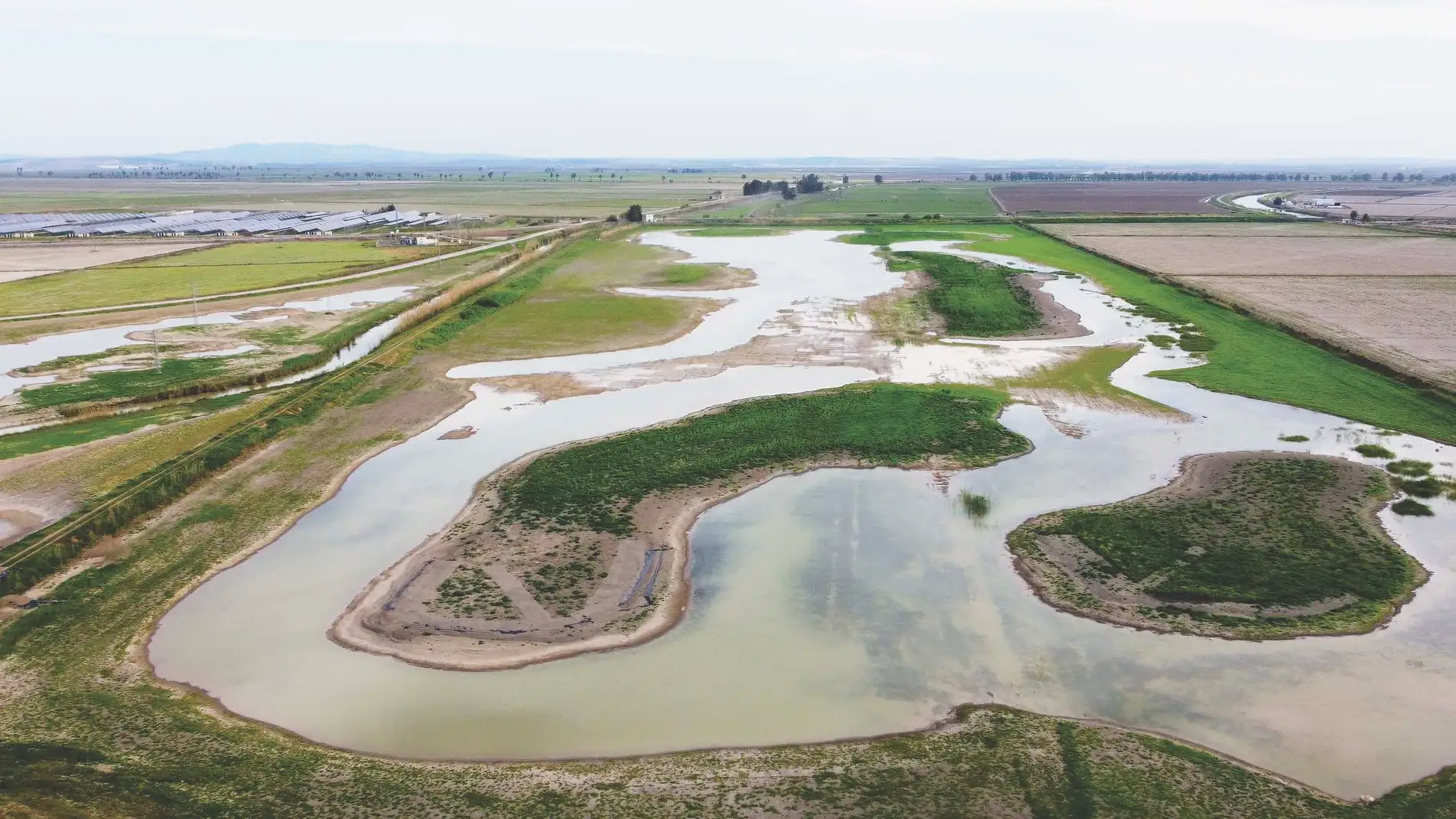
“I live for wild ducks,” commented Beltrán Ceballos while observing a bird with his binoculars, a black stork in flight above the Reboso Sur wetland. Your company, Cinclus, and himself, have worked here for three years, moving earth and adapting this 53-hectare wetland in the Brazo del Este Natural Park until it becomes a restored area with a permanent sheet of water and islands for flamingos or moritos to nest. This same week this conservation project that they have carried out was presented to society WWF together with Ikea Spain and that has had the collaboration and understanding of the rice farmers in this area 40 km from Seville, the state and local administrations and the Guadalquivir Hydrographic Confederation. An alliance that was highlighted during the presentation event by Catalina García Carrasco, Minister of Sustainability and Environment of the Junta de Andalucía, and Alejandro Rodríguez, Water Commissioner of the Guadalquivir Hydrographic Confederation.
This is one of the four actions carried out under the umbrella of the Allen Plan (yes, like the key), launched by Ikea and thanks to which they are being restored four areas here, in an environment that is also fundamental for the well-being of Doñana. But it is not only about conserve biodiversity, but also to take advantage of the benefits of wetlands; one of the most important for the south of the Peninsula is to improve the resilience against periods of prolonged drought. «64% of wetlands are in decline», recalled Teresa Gil, head of the WWF water program. Meanwhile, the Confederation pointed out how the relationship with these areas, dried up for years and which now claim their own role in the fight against climate change, conservation and also local development, is changing. Precisely, one of the objectives of these projects is to create new green economy opportunities for its inhabitants, with initiatives based on tourism and nature.
In total, work has been done on the recovery of almost 400 hectares. In Peñuelas (Moguer), the forest affected by the 2017 fire has been restored. In El Rocío, 29 hours of native riverside vegetation have been recovered; another 6 hectares of riparian forest in the Don Gil stream; and 80 hectares in the Cerrado Garrido marshes (Aznalcázar, Seville), in addition to this space in the Brazo del Este, located between Utrera, La Puebla del Río and Las Cabezas de San Juan.
And what is a Swedish company doing in Doñana? Beyond their interest in financing environmental and social programs, the Scandinavian world has its own history here: “At the International Ornithological Congress in Helsinki, in 1957, Valverde introduced himself and spoke about Doñana,” explains Antonio Lucio, president of WWF Spain. That was the germ of the park, «one of the largest ecological reserves on the continent, which has repercussions far to the north. Without Doñana we would not have many ecosystems in other places in Europe”said Carl Aaby, CEO of IKEA in Spain.