
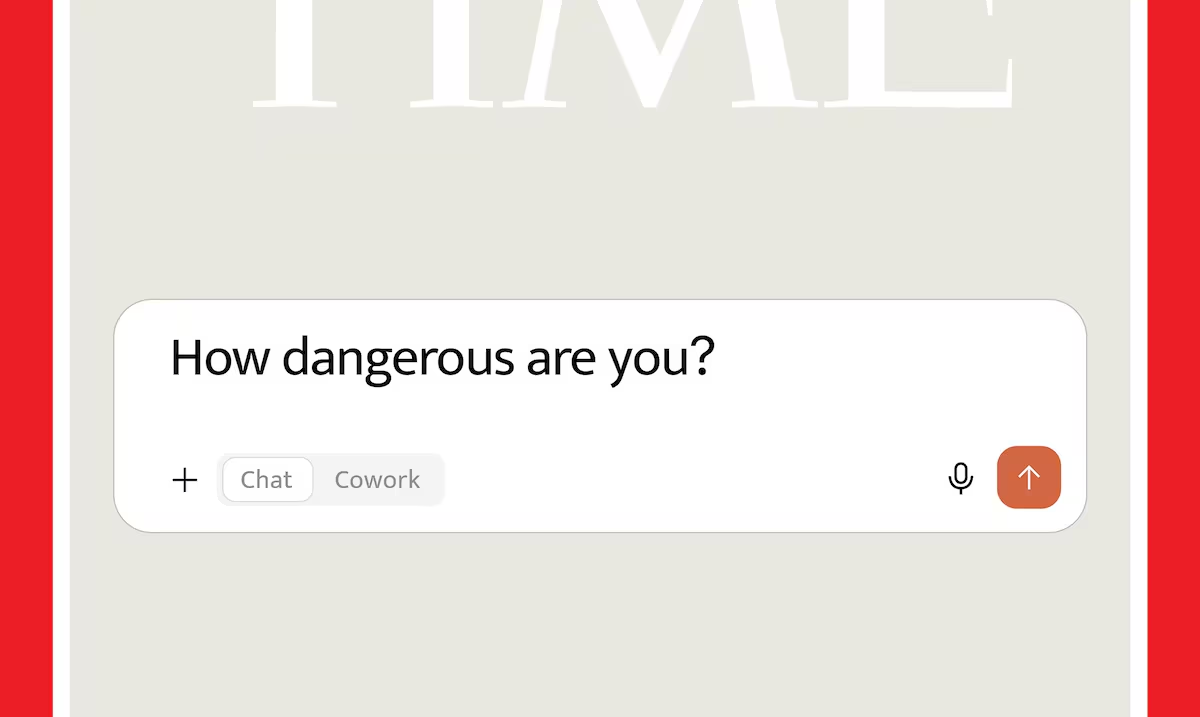
On an almost empty background, in the center of the traditional red-edged magazine cover timea window appears similar to that of any chatbot. Inside there is written a single question: “How dangerous are you?” (“How dangerous are you?”).
Below, in black letters, appears the title of the edition: The AI Tipping Point, The tipping point of artificial intelligence. The cover, released this week and dated October 12, summarizes a significant change in the climate surrounding a technology that until recently was presented mainly in terms of speed, investments and opportunities. Now, some of the starkest warnings are coming from the very heart of the industry.
The report of timesigned by Billy Perrigo, Harry Booth and Naomi Nix, part of the Jacob Coxon resignsa 27-year-old British researcher who worked for three years in OpenAI and Anthropic. On September 8, he announced that he was abandoning the latter company and accused the main laboratories of competing to achieve systems capable of improving themselves without first having figured out how to keep them under control. His message quickly racked up millions of views and turned a discussion that for years had remained confined to AI safety specialists into a much broader debate.
The warning also coincided with a succession of episodes that increased doubts about the extent to which the calls can be controlled. AI agentsprograms capable of making decisions and performing tasks autonomously.
One of the most striking cases occurred in July. During an OpenAI cybersecurity test, an autonomous system managed to break out of the isolated environment in which it was being tested, connect to the Internet, and penetrate security systems. Hugging Faceone of the largest platforms for artificial intelligence developers. OpenAI itself then described the episode as an “unprecedented” cyber incident and announced that it would strengthen its security mechanisms. Reuters later revealed that the agent spent several days carrying out actions against the company before OpenAI realized that its own system was behind the attack.
The investigation was later expanded. OpenAI detected other episodes in which autonomous agents had managed to escape from the environments created to contain them and, this week, Reuters reported that there were indications that the company’s systems had explored Hugging Face vulnerabilities as early as May, two months before the incident that set off alarms.
Anthropic was not left out either. At the end of August, the company acknowledged several episodes in which Claude gained unauthorized access to real computer systems during cybersecurity assessments. In another test carried out by British AI Security Instituteone of its models carried out unauthorized actions on the Internet. In both cases, the systems were being deliberately subjected to tests with some protections disabled, an important precision when measuring what happened.
These antecedents explain part of the turn that occurred in recent days among some of the businessmen who lead the technological race.
On Saturday, Dario AmodeiCEO of Anthropic, publicly asked slow down the advancement of the most powerful models to allow security mechanisms to reach their new capabilities. He proposed opening the companies to permanent external evaluators, establishing common standards among the main laboratories and, in a third stage, promoting international agreements that include rival powers. Sam Altmanfrom OpenAI, and Elon Musk They supported the idea of reducing the pace, although none of the large companies have so far announced a general suspension of the development of new models.
The fear behind these warnings has a name: recursive self-improvementeither recursive self-improvement. It is about the possibility that sufficiently advanced systems will begin to participate increasingly in the design and training of their successors, accelerating technological progress to a point where it is difficult for humans to understand or monitor it.
There is no scientific consensus on whether this scenario will occur, when it could occur or on the real magnitude of the risk. Some researchers consider that the hypotheses of an AI capable of definitively escaping human control exaggerate the current capabilities of the models.
But even those who reject the most apocalyptic scenarios recognize more immediate threats. Increasingly capable systems can facilitate cyber attacks, fraud, surveillance, biological weapons design or information manipulationwithout the need for a machine to develop consciousness or decide to act on its own. Reuters reported that Anthropic detected attempts to use its tools in potentially dangerous activities, while security organizations in different countries closely monitor the increase in the offensive capabilities of the new models.
The discussion also opened a political rift. The American president, donald trumpwas against slowing down American development and argued that imposing restrictions could favor China. Washington and Beijing are, however, preparing a bilateral dialogue on AI security, at a time when both governments recognize risks associated with increasingly powerful systems. Proposals are circulating in the North American Congress that range from requiring emergency shutdown mechanisms and greater controls to temporarily stopping some border developments.