
The European Public Prosecutor’s Office (EPPO) accelerates with the open investigation for alleged fraud with contracts to modernize high speed in Spain. Investigation sources confirm to LA RAZÓN that the record on November 6 has been especially useful in these open proceedings to clarify whether European funds were misappropriated with at least three contracts related to the maintenance of high-speed tracks on the Madrid-Seville line.
The community entity sent the Central Operational Unit (UCO) of the Civil Guard to the headquarters of Adif and also the Court of Accounts and the State Railway Safety Agency to collect information related to the investigations. These were initiated ex officio by the European Prosecutor’s Office after verifying that part of the contracts under suspicion could threaten the financial interests of the European Union (EU). Specifically, a possible subsidy fraud and embezzlement of European funds.
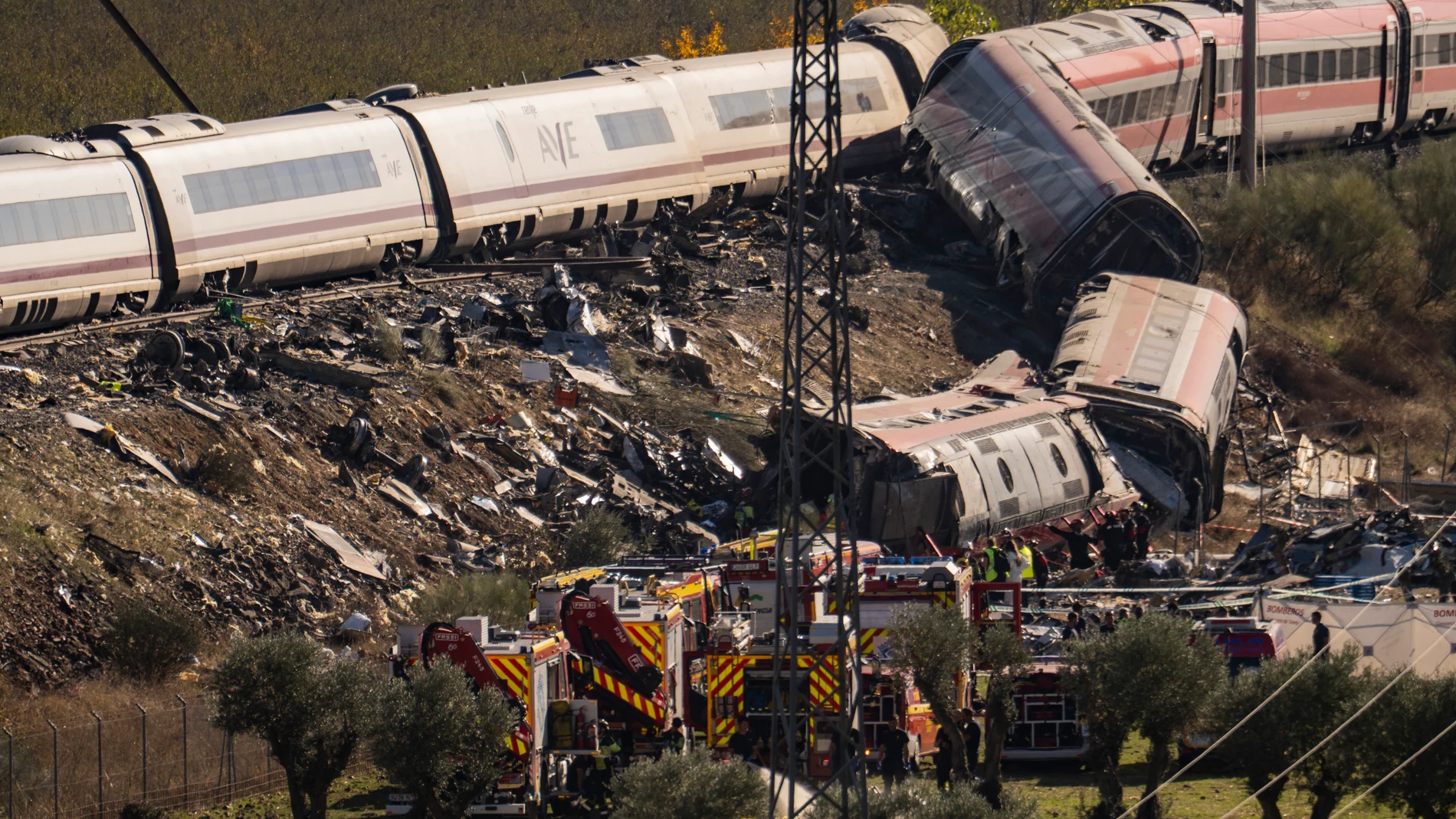
The cause arose after the train accident in Urda (Toledo) on October 28, in which 69 people lost their lives and another 200 were injured. The objective is to clarify whether there have been any irregularities in relation to the renovation works, security improvement and signaling of the works on the damaged line.
Three contracts under suspicion
At the moment there are no investigations in the case and no arrests, but, in parallel with last week’s searches, additional proceedings have also been agreed upon. They are related to the items destined to implement the European Railway Traffic Management System (ERTMS). Precisely, the Urda accident revealed the shortcomings of the German LZB signaling system, which has become obsolete after more than three decades in force. In this case, the EPPO delegates are investigating whether the fall of the line in Urda, which caused the fatal accident, is a consequence of the lack of investment of the funds that Brussels has been allocated to modernize the line, both from the Next Generation package and from the European Regional Development Fund (ERDF).
Of the three contracts under suspicion, one stands out that was awarded on March 16, 2020, just 48 hours after the Government decreed the state of alarm due to the pandemic health alert. The works were financed, in part, by the Feder fund and were awarded to a joint venture made up of Ferrovial, Contratas y Ventas (Convensa), Agrupación Guinovart Obras y Servicios Hispania and Azvi; The latter group was involved in the “Koldo case” for alleged rigging of public works.
The contract was awarded for 21 million euros for the renewal of 63 detours of the Madrid-Seville line. The action took place in the municipal areas of Los Gavilanes (Madrid); Yeles, Mora and Urda (Toledo); Malagón, Calatrava and Ciudad Real; Conquest and Villanueva (Córdoba); and Guadajoz (Seville). In addition, four devices were replaced on the Adamuz section, where the first of the high-speed fatal accidents occurred so far this year.
Adif, responsible for the renewal
The specifications for said award determined that the Madrid-Seville line had been in operation for “more than 25 years with heavy passenger traffic” and that, in order for it to continue operating with all its features, it was considered necessary to carry out maintenance tasks; among them, the renewal of leaks and detours due to the state of the materials. Likewise, the need to change the devices installed between 1991 and 1992 for other “more modern and efficient” ones was stressed and pointed out that Adif assumed these works “as usual.”administrator who is responsible for constructionthe maintenance, administration and operation of railway lines.
The other two Adif tenders went to the company Thales Spain GRP. lThe first was awarded in September 2021 for 93.8 million and was intended to renew the LZB system, while the second was awarded for 21.5 million to renew the track circuits (including the La Sagra-Toledo branch).
Added to all this is that on June 24, 2024, the European Commission approved funds worth more than 110 million euros from the Feder Fund to renew the Madrid-Seville railway line. These are injections that point directly to Adif and that led to a requirement for key documentation that causes a qualitative leap in the proceedings followed by the European Prosecutor’s Office.