
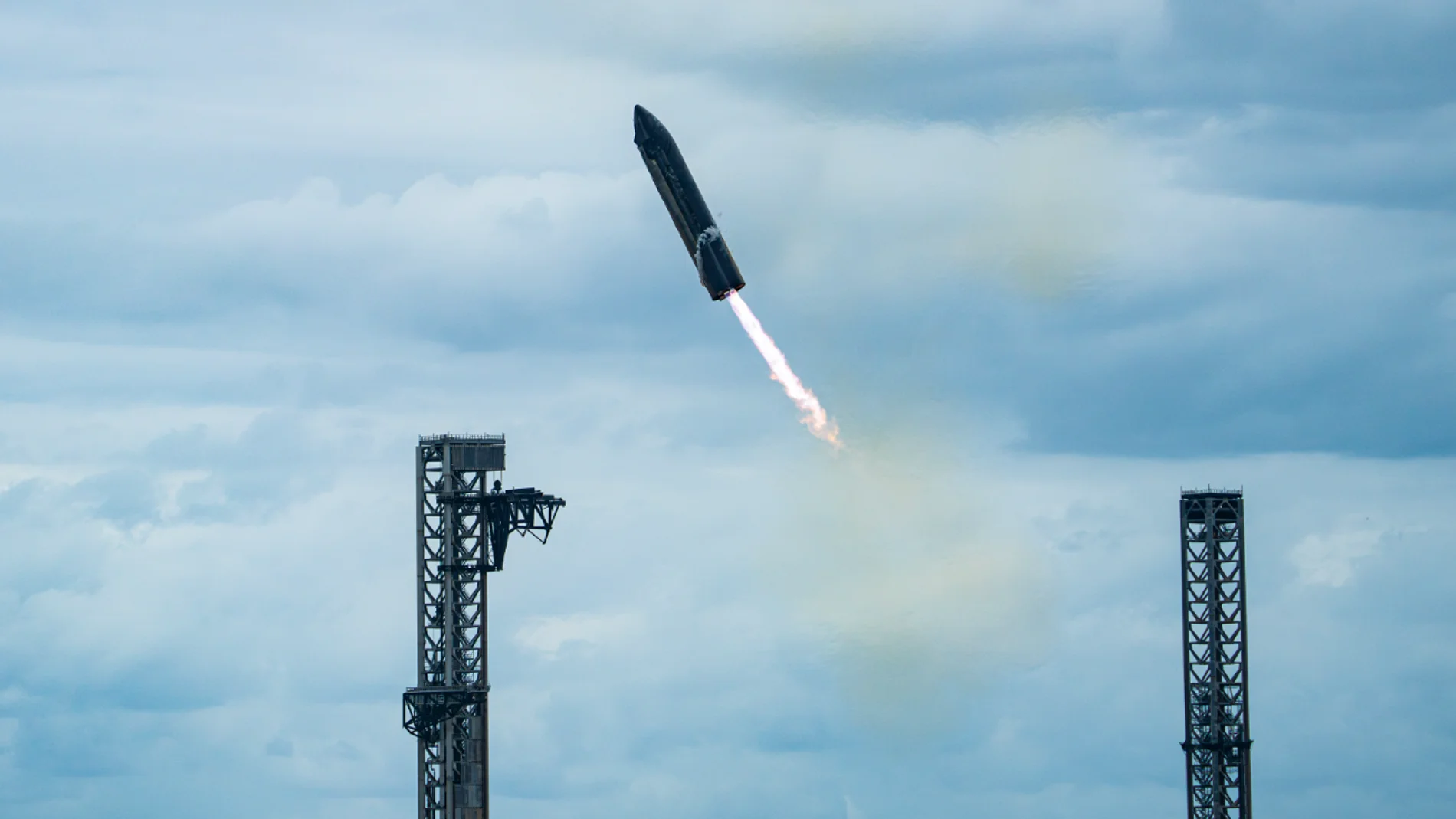
For almost seven decades, reaching space has had an inevitable price: leaving behind part of the vehicle that took us there. Rockets detach from their stages, propellants fall into the ocean, and ships that reach orbit often end up as space junk or burn up in the atmosphere. SpaceX has been trying to change that story for years. And this Saturday it has managed to write one of its most important chapters: for the first time, the superior Starship ship has returned from Earth orbit and has been trapped by the mechanical arms of the tower from which it had taken off.
The maneuver occurred at Starbase, Texas, after a mission of approximately 22 and a half hours. The ship, identified as Ship 42, It descended onto the platform and fired its Raptor engines to slow down, move upright, and approach the tower.. Two structures located at the top were hooked to the enormous metal arms, known as chopsticks (chopsticks), which held it in the air without having to deploy landing legs.
The scene represents an extraordinary advance for Elon Musk’s program. Until now, SpaceX had managed to capture the Super Heavy booster three times, but had never carried out the same operation with the ship that travels to orbit. And that is precisely the most complicated part. As the booster returns a few minutes after launch, the upper spacecraft must survive the orbital speed, the extreme heating of reentry, and a much more demanding landing maneuver.
Starship’s 15th mission had begun on Friday, November 13. The set, made up of the Super Heavy booster and the Starship spacecraft, took off from Texas at 22:47 GMT. Just six and a half minutes later, both stages separated. The Super Heavy was to return to the tower, but had to cancel the maneuver and ended up landing in the Gulf of Mexico, where it met its “end.”
The preliminary explanation arrived the next day. According to SpaceX, a low fuel mass alarm would have caused the booster to prematurely interrupt its braking maneuver. The guidance system then detected that the vehicle was not in the appropriate position to return to the tower and ordered the capture to be aborted. The company continues to investigate the cause of the incident. The upper ship, however, was able to continue its mission.
Once in space, Ship 42 reached an orbit about 260 kilometers high and deployed 26 Starlink V3 satellites. Each will contribute approximately one terabit per second of capacity to SpaceX’s internet network (this is the capacity of each satellite, not the speed they users will receive). It was also an important test for the rocket itself: this is the second time that Starship has managed to place satellites in orbit, after flight 14.
But the main challenge would come many hours later. To return to Texas, the ship had to overcome one of the most extreme conditions that a space vehicle can face: atmospheric reentry. At around 28,000 kilometers per hour, the friction with the layers of air generates temperatures capable of destroying practically any conventional structure. Starship relies on a heat shield made up of hundreds of ceramic tiles that absorb and dissipate much of that energy.
Precisely, one of the objectives of the flight was to verify the improvements introduced in that protection. SpaceX had reinforced the areas most vulnerable to tile loss and modified some of its joints to reduce heating of the steel structure. Three of the Starlink satellites deployed during the mission incorporated cameras intended to photograph the heat shield from the outside.. The images, together with those obtained from the ground, made it possible to evaluate their condition before authorizing their return.
After completing the planned checks, Starship turned on one of its engines for about ten seconds to leave its orbital path and begin its descent. The ship passed through the atmosphere enveloped in plasma and appeared over the Texas facility. Next, It turned on its engines again to position itself vertically and reduce its speed until it was suspended between the arms of the tower.
The result is historic, but it is advisable not to confuse recovery with reuse. SpaceX has managed to recover the ship, although it has yet to demonstrate that it can fly again without subjecting it to lengthy inspection and repair operations. The heat shield continues to be one of the great challenges to ensure that the tiles withstand successive missions with minimal maintenance.
Musk’s ambition is for Starship to be able to operate with a frequency and maintenance costs more similar to those of a commercial airliner. The ultimate goal is not limited to transporting satellites either. NASA has selected this ship to take astronauts to the lunar surface within the Artemis program. To achieve this, SpaceX will still have to solve another of its great challenges: demonstrate that several ships can transfer fuel in orbit, an essential operation to have the necessary energy to travel to the Moon.
Flight 15 has not managed to recover both halves of the rocket, but it has shown that the most difficult part of orbital return is no longer a promise. For the first time, a Starship has returned from space and has remained suspended in the same tower from which it had departed. The next step will be to get the two parties back together and then take off again. Only then The idea of a completely reusable orbital rocket will begin to become a reality.