
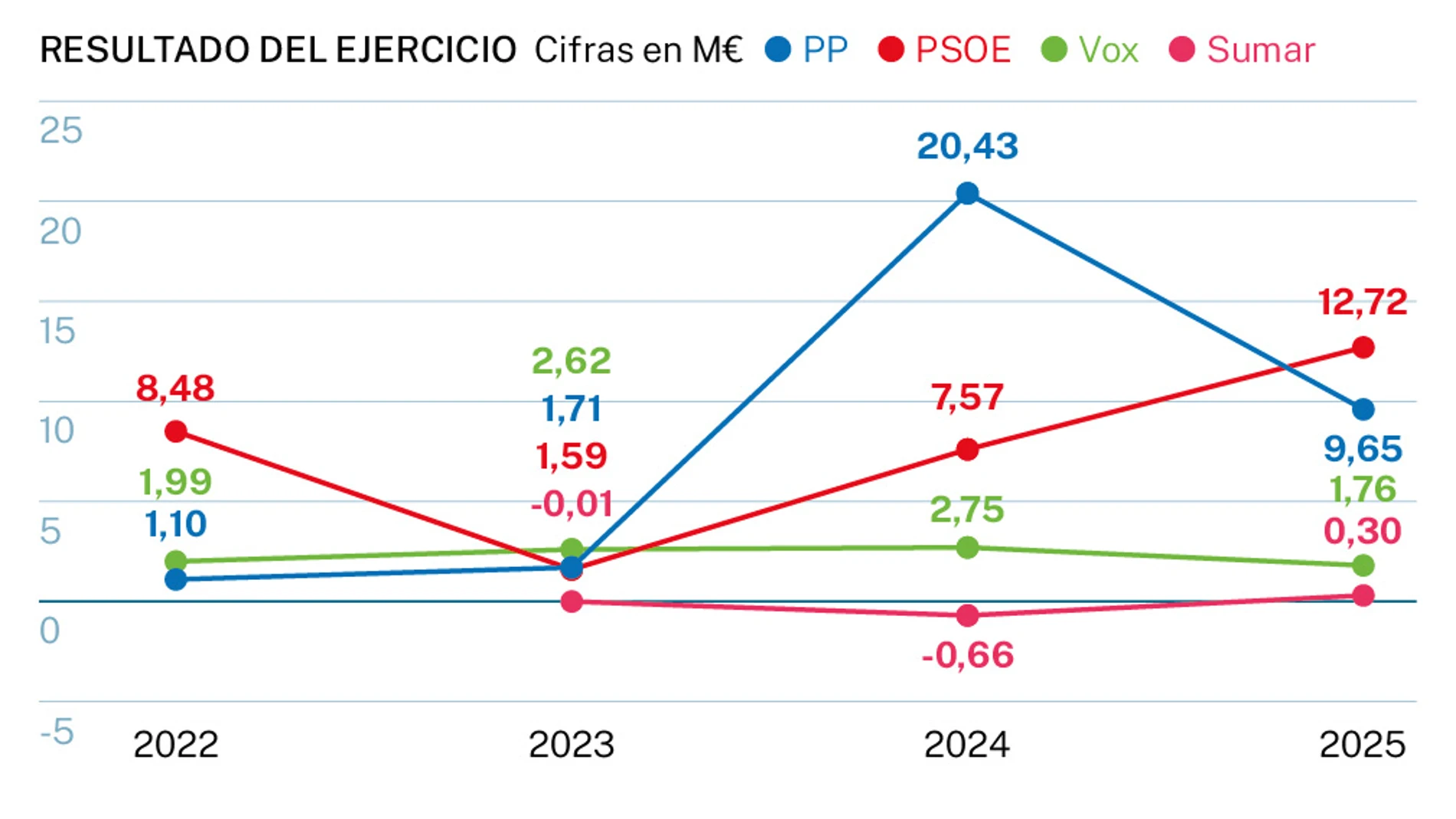
It is more than evident that the PSOE is not going through its best moment. The crisis unleashed in Ceuta and the Government’s management has raised the level of wear and tear on a party that, throughout this last legislature, was already experiencing a notable concatenation of political controversies, corruption scandals – including the judicial investigation, still under secrecy, by the National Court into alleged illegal financing – and successive electoral defeats, losing territorial power every time the polls are opened. However, none of this appears to have had a direct effect on the party’s accounts. Rather, on the contrary: the PSOE is the political formation that is in the best economic position.
Pedro Sánchez’s party closed the 2025 financial year with a surplus (more income than expenses) of 12.7 million euros. It did so, in part, thanks to income from private and public sources that exceeded 72.7 million euros. And it is the training that earns the most money through these channels and the one that ended the year the best.
LA RAZÓN has made a comparative analysis of the annual accounts of the four main parties (PP, PSOE, Vox and Sumar), to observe the differences between them and their evolution. The last ones available are those from last year, which have been published throughout this summer because the formations are obliged to post them on their website.
If politics were a business, it would be a profitable one. The four main parties obtained last year a surplus of 24.4 million euros. The most striking thing is that the PSOE, despite having lost territorial power, represents more than half of that surplus, with 12.7 million. This is, furthermore, an increase of 5.2 million compared to 2024 and 11.1 million compared to 2023. That year, of general elections, the balance had been 1.6 million euros.
They are followed well behind by the PP (with a surplus of 9.6 million euros, 3 less than the PSOE) and Vox (1.6 million, 11 less than the socialists). The PP has fallen noticeably compared to the 20.4 million surplus it registered in 2024 and Vox has fallen slightly, from the 2.7 million of the previous year. Sumar is the party with the worst data, with a surplus of 295,735 euros, but at least it is no longer in the red. The 2024 financial year closed with more than half a million euros in deficit.
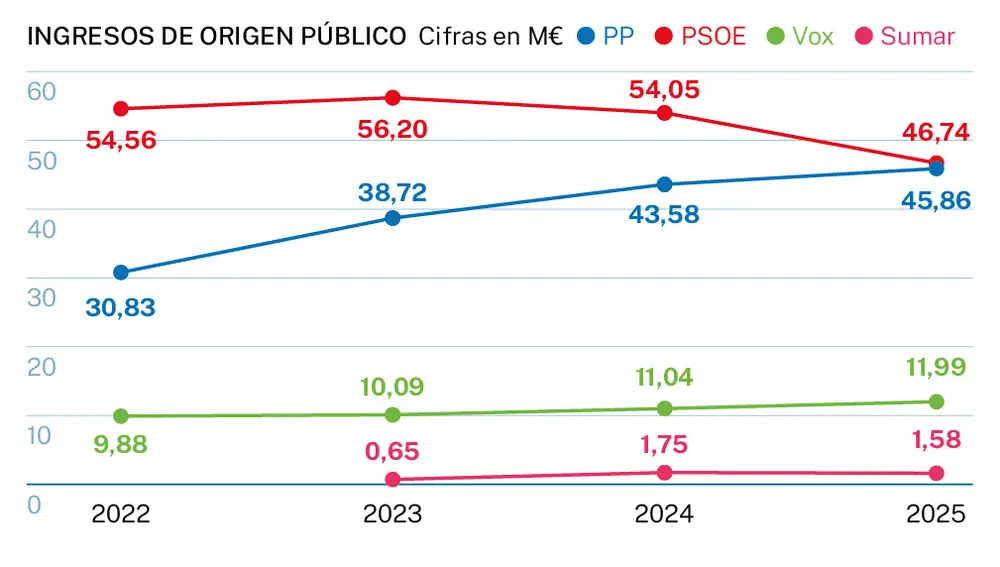
As has been explained, much of the money that the PSOE receives, as a political party, comes from public and private financing. In total, received 46.7 million euros of public money. It is striking, because it received more than the PP (45.9 million) despite the fact that the popular ones have more representation in the regional parliaments and in Congress, at the same time that they have had better electoral results, which is why they have received more financing.
It is also striking that Vox recorded the largest amount of public financing in its history last year, 12 million euros. Santiago Abascal’s party, since its inception, has been openly against public money going to political parties. In fact, the party’s economic program specifies that they are committed to eliminating this public financing. This discourse is contradictory not only with entering public funds, but with entering more each year. The party explains, however, that they have to do so to compete on equal terms with the rest of the formations.
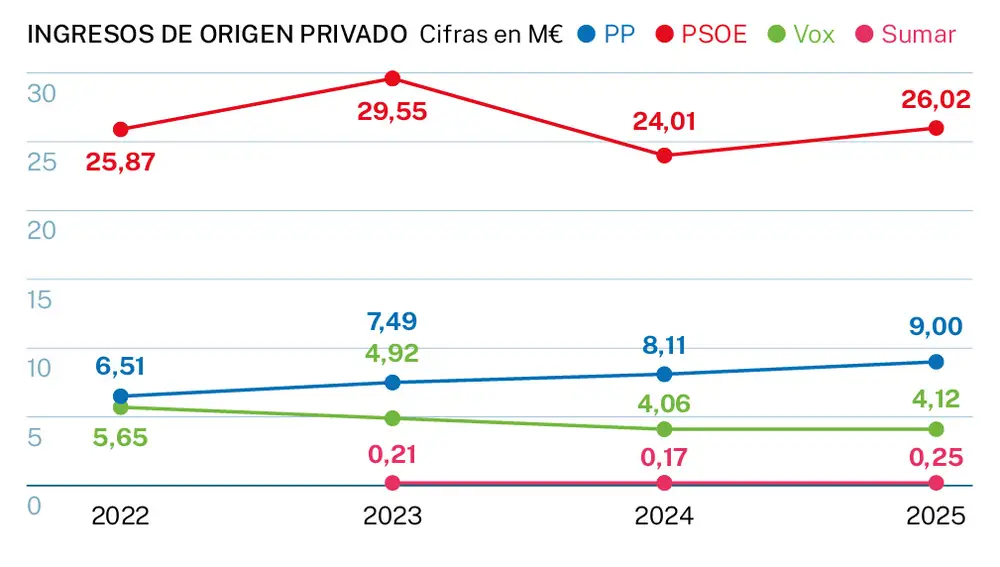
Regarding income from private sources, the PSOE once again stands out from the others. Not only is it the one that receives the most, but it is also the one that grows the most. Since the 2023 elections, the PP has obtained stable income between 7 and 8 million euros. Something similar has happened with Vox, which has remained around 4 million. The PSOE, however, has gone from earning 24 million to 26, two more.
This means that The socialists have received almost three times more money than the PP and six times more than Vox. And it goes further: it is 104 times more than the 248,459 euros that Sumar earned in 2025 through this means. Most of this money, in all cases, comes from membership fees and the money allocated from their salaries by public officials. But there are also donations from individuals. The PSOE received 9.6 million under this concept, a figure considerably higher than the 2.7 of the PP and the 95,702 of Vox. Sumar is the only formation that has not received money from donations.
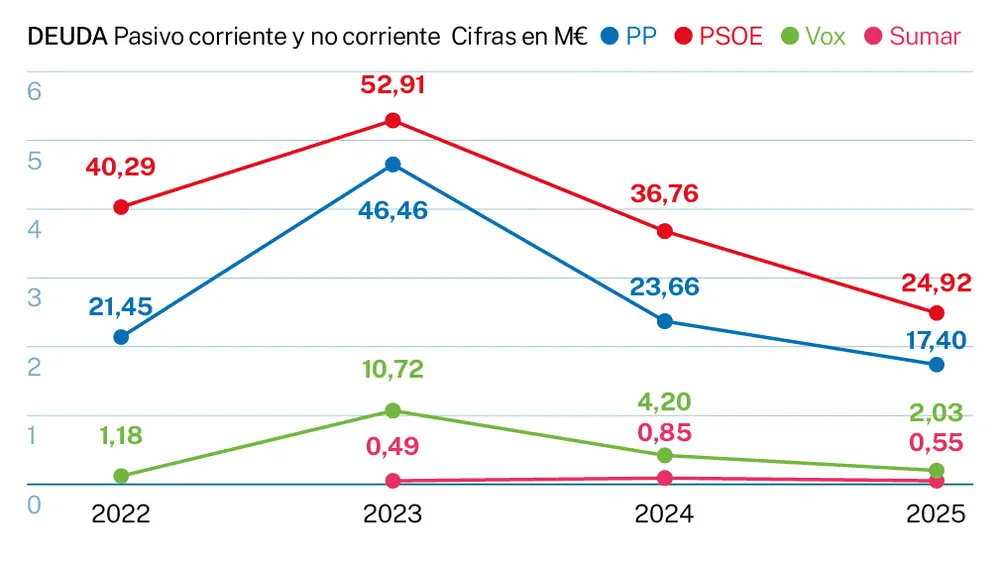
In the annual accounts, it is also interesting to see which parties have more or less debt. On this front, the PSOE wins again with current and non-current liabilities of 24.9 million. The next most in debt is the PP, with 17.4 million, and is followed by Vox, with 2 million. Yolanda Díaz’s formation is the one with the most healthy accounts, since It only accumulates a debt of 545,472.69 euros. Regardless of the total amount, all parties have managed to reduce their debt from 2024 to 2025, probably because the hangover from the 2023 elections is now behind them.
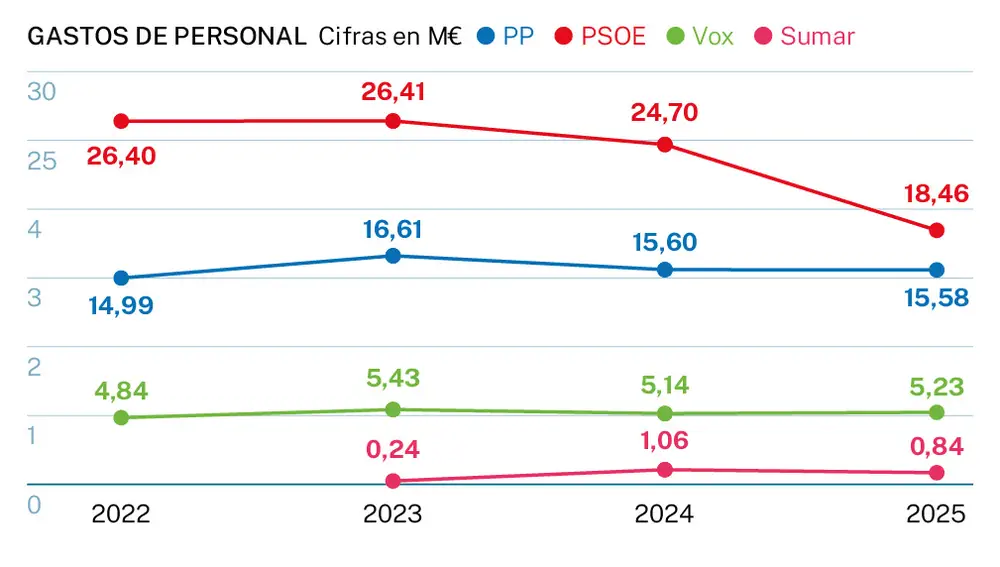
And regarding the personnel expenses section, the socialists are once again the ones who spend the most. They invest 18.4 million in salaries, although far from the 24.7 million they spent in the previous year. There you can see that there has been a cut in personnel or that they receive lower remuneration for their activity. PP and Vox have remained stable, with 15.5 million and 5.2 million respectively, and Sumar has reduced these expenses to just half a million.