
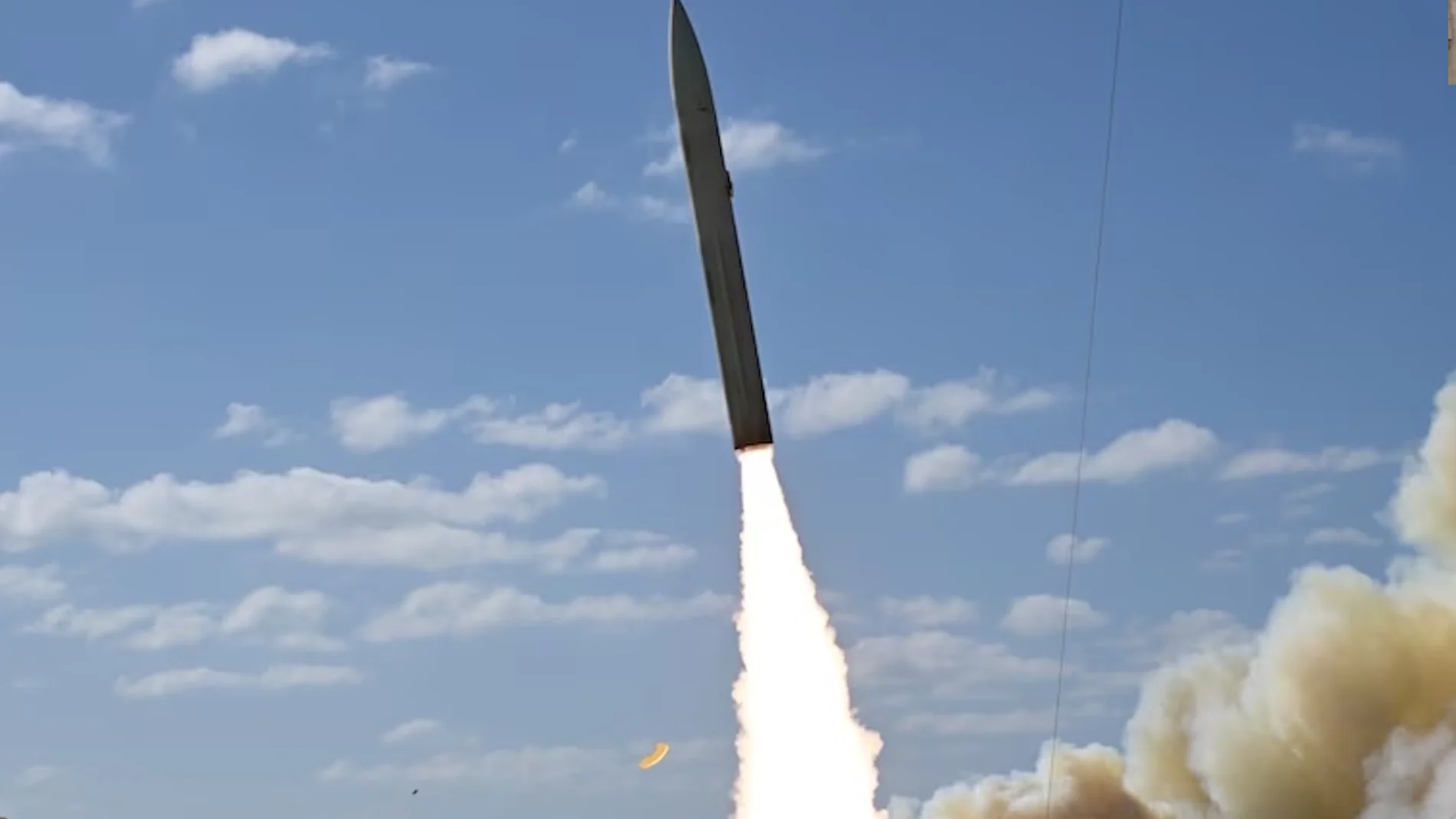
If the idea is to define it quickly, the Dark Eagle hypersonic missile It is a system designed to strike before the opponent can even understand what is happening. But the reality is much more complex. And soon we will be able to verify it.
Behind that name lies the Long-Range Hypersonic Weapon, the first land-based hypersonic missile that the United States Army is about to fully deploy. After years of technical delays and failed tests, the Pentagon has given the green light for its entry into service, with the first batteries scheduled for completion in 2026, a long-awaited strategic milestone.
The key to Dark Eagle is not just his speed, but how he uses it. Unlike traditional ballistic missiles, it follows a profile known as “boost-glide.” First, a solid-fuel rocket propels it out of the atmosphere; after, releases hypersonic glider vehicle that re-enters and glides at speeds exceeding Mach 5 (almost 6,200 km/h) while maneuvering towards its target.
That seemingly technical detail changes everything. Because it doesn’t just fly fast: it flies unpredictably. Current anti-missile systems are designed to intercept more or less predictable ballistic trajectories. A hypersonic glider, on the other hand, can alter its route in mid-flight, drastically reducing the chances of being intercepted.
In terms of reach, the figures place Dark Eagle in the range of 2,700 to 3,000 kilometersallowing it to hit strategic targets at long range without the need for air or naval platforms. And it does so from mobile land launchers, mounted on tactical trucks, capable of deploying, firing and changing position in a matter of minutes.
This mobility is not a logistical detail, but a tactical advantage: it makes the system a difficult target to locate and destroy. In its standard configuration, a battery includes several launchers with multiple missiles, together with command and control vehicles, forming an autonomous unit ready to operate in different scenarios.
Another distinctive element is its load. Unlike many hypersonic systems developed by Russia or China, the Pentagon has insisted that Dark Eagle will carry exclusively conventional warheads. Its destructive capacity does not depend on nuclear explosives, but on the kinetic energy generated by impact at extreme speeds, enough to destroy critical infrastructure or fortified targets.
This approach responds to a delicate strategic logic: having a weapon capable of penetrating advanced defenses without crossing the nuclear threshold. In theory, it offers a middle option between conventional deterrence and atomic escalation. In practice, however, it opens up new uncertainties. Because for an early warning system, Distinguishing between a conventional hypersonic missile and a nuclear one may simply be impossible.
The approval of its use in upcoming missions, particularly in Indo-Pacific scenarios, reflects that tension. In fact, the statement speaks precisely about that region: “The Dark Eagle Battery, based at Joint Base Lewis-McChord in the Pacific Northwest, will soon receive its first operational LRHW missiles.””.
Dark Eagle is designed to neutralize advanced defense systems, command centers or key infrastructure in the early phases of a conflict, especially in environments where access is heavily restricted by networks of enemy missiles and radars. In that sense, more than an isolated weapon, it is part of a doctrine: that of striking first, quickly and with surgical precision, opening “corridors” for other forces. A kind of technological key to force doors that until now remained closed.
But as with almost all military innovations, its development also It is a symptom of a broader career. The United States is late to the hypersonic field compared to Russia and China, which have already deployed similar systems. Dark Eagle is an attempt to redefine balance. And its first forays will be this year.