
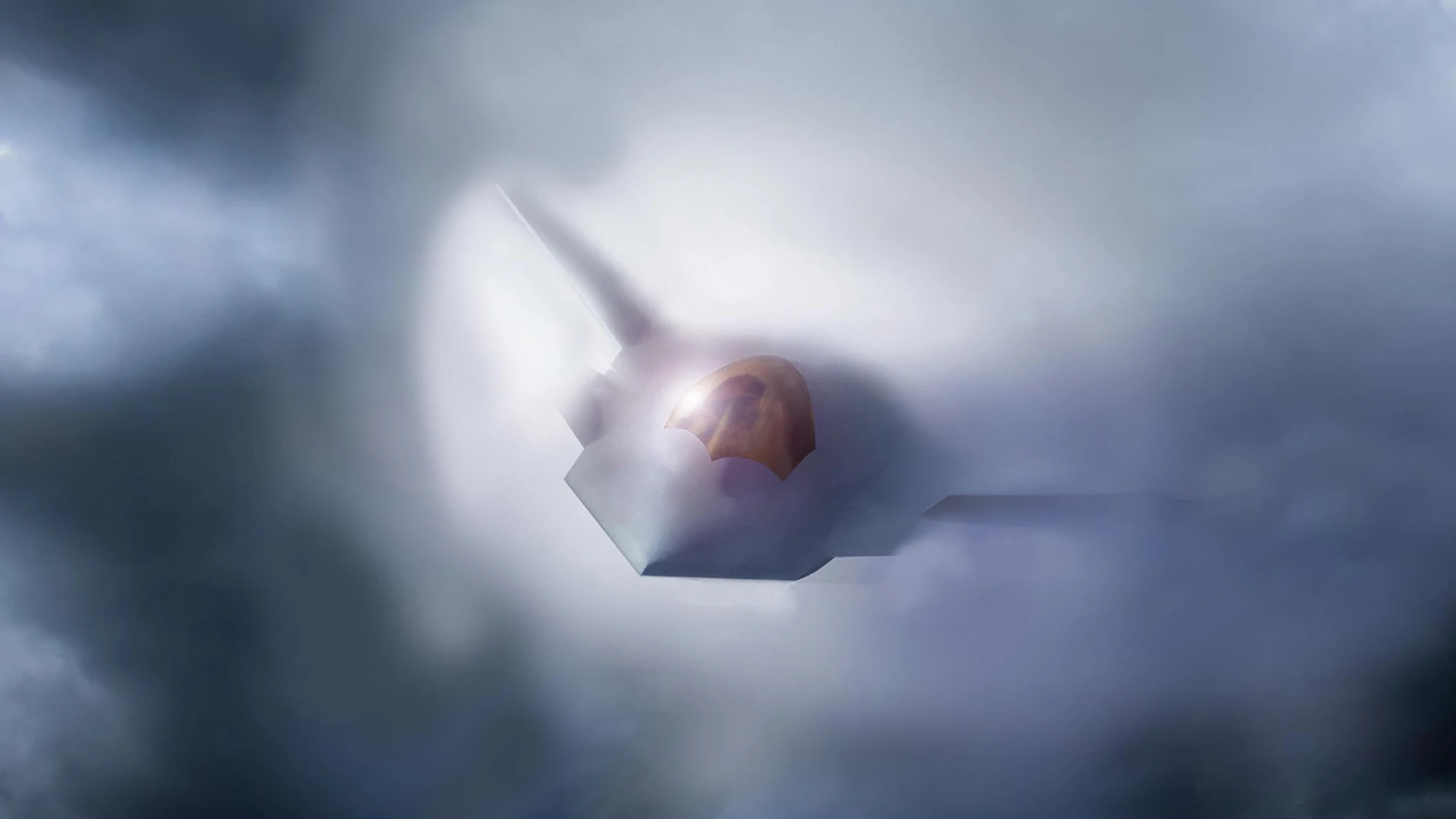
The calendar of F-47 advances faster than engines designed to take advantage of its full capabilities. The United States Air Force maintains the objective of making the first flight of the new fighter Boeing in 2028but the definitive promoters of the program NGAP will not be ready for integration until around 2030. This gap could force the initial use of a provisional engine, reports Army Recognition.
The F-47 will be the main element of the program Next Generation Air Dominanceknown as NGAD. It is not only a new aircraft intended to replace the F-22 Raptorbut of a family of connected systems. Collaborative combat drones, new sensors and communications and command systems designed to operate in highly defended airspace will operate alongside the manned fighter.
Boeing received the contract to develop the United States’ first sixth-generation fighter in March 2025 after beating Lockheed Martin. Much of the program remains secret, but the Air Force has assured that the F-47 will have more range, more advanced stealth, will require less maintenance and will be able to perform missions more frequently than current fighters. He has also indicated that he will be able to overcome Mach 2some 2,450 km/hand will have a combat radius of more 1,850 kilometers. The United States plans to acquire at least 185 units.
The problem is in the propulsion
The Air Force develops the program in parallel Next Generation Adaptive Propulsioneither NGAPto obtain a new generation of adaptive cycle engines. GE Aerospace works in the XA102 and Pratt & Whitney develops the XA103two designs that still need to be built and pass an extensive ground testing campaign.
Adaptive engines can modify its operation and internal air flow according to the needs of the flight. The system can prioritize thrust during combat or reduce consumption while cruising. It should also provide more electricity and cooling capacity to power radars, electronic warfare equipment, computers and future weapons systems. These benefits They are essential to increase the range and sustain the high energy needs of a sixth generation fighter.
Budget constraints have delayed NGAP about three years. The Air Force now estimates that the engines will be ready to begin integration activities in 2030, while the first F-47 should take off two years earlier. It has not been confirmed which propellant that aircraft will use or whether it will be a model currently in service, a modified version or an early unit of the NGAP itself that is not yet the final configuration.
The use of a temporary engine would allow maintain the aircraft’s schedule without waiting for all the propulsion technology to mature. Boeing could begin evaluating aerodynamics, airframe, flight controls, avionics, sensors and mission software. Separating the two programs would reduce the number of completely new systems that must be tested at the same time and would make it easier to identify problems that appear during the first flights.
Military aviation has precedents for this strategy. Some fighters have entered service with engines that were later replaced or upgraded when more capable powerplants became available. He F-14 Tomcatfor example, began his career with the problematic Pratt & Whitney TF30 and received years later the General Electric F110 in the versions F-14B and F-14D.
A solution not without risks
Subsequent installation of the final engine could require modify the air intakes, cooling systems, control software and internal layout of the aircraft. Boeing would also have to repeat part of the tests to verify that the new configuration retains its performance and stealth characteristics.
Pratt & Whitney hopes to test the XA103 ground demonstrator later this decade. GE Aerospace is also preparing the XA102 for a full demonstration. The Air Force intends for NGAP technologies to be available for integration in 2030although it has not yet awarded the production of a definitive engine nor has it specified when it will begin to equip the F-47. The first flight is still planned for 2028 and the exact date of entry into service remains unconfirmed..