
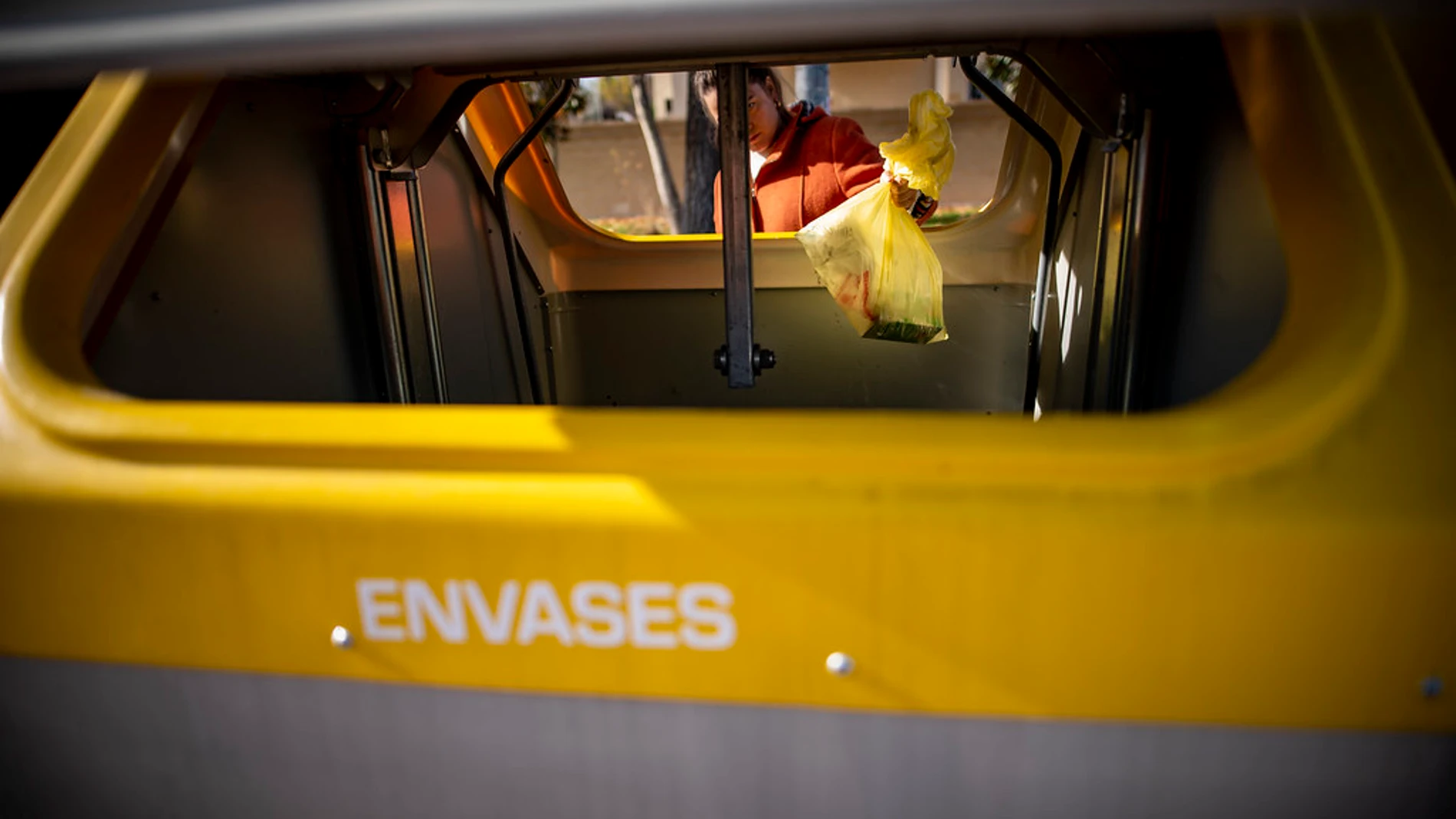
An empty water bottle on the kitchen counter that ends up in the yellow container on any Spanish street. It is an everyday image that barely deserves a few seconds of our daily attention and, however, behind each container a machinery is deployed that remains practically invisible to those who live in the cities. What if one of the most important infrastructures of a sustainable city was precisely the one that we barely see? On the occasion of World Cities Daywhich is celebrated every October 31, this question invites us to look beyond smart buildings, green areas and new mobility models to ask ourselves what makes it possible for a city to manage its packaging waste.
Should we consider it impossible for the circular economy to be successfully applied to cities? At a time when more than 50% of the world’s population is urban and when more than 60% of resource use derives from large citiessome may think so. Achieving zero waste is complex, and doing so involves coordinating a system that involves everything from the neighbor who separates an empty soda can in his kitchen to the recycler who manages to convert it into raw material to manufacture another product.
“It all begins when the citizen buys a product that is packaged on the shelf, in a supermarket, in a store, in an establishment,” he explains. José Maldonado, Recycling Management Manager at Ecoembes. This product not only has a useful life while it remains in our hands. Your packaging can also have a future after being consumed, although to achieve it it needs to overcome a succession of stages that depend on each other.
The first stop on this tour is literally around the corner. In Spain, 48.4 million people have access to separate collection of packaging thanks to collaboration with more than 8,000 municipalities and an infrastructure of 681,730 containers distributed throughout the national territory. Of them, 416,359 are yellow, intended for plastic, metal, brik and wooden containers, while another 265,371 are blue, for paper and cardboard. During 2025 alone, more than 10,500 new yellow and blue containers will be added to public roads to bring recycling closer to citizens.
However, having containers alone does not guarantee recycling. “The first task of the citizen is super important. Because when you place the container in the correct container, everything works very well”says Maldonado. “A plastic bottle that ends up in the yellow container can go through a selection and recycling circuit that, if it meets the technical and health requirements, allows it to be converted again into another bottle.”
But if it ends up mixed with conventional waste, its possibilities of being used again, especially for food contact, are reduced due to safety and traceability requirements. “Casting it to yellow opens up many more possibilities,” Maldonado insists. The difference may seem insignificant compared to the magnitude of a city, but multiplied by millions of containers it is decisive..
From truck to plant: where the transformation begins
Once deposited in the corresponding container, the waste passes into the hands of public administrations, responsible for organizing its collection and initial treatment. Municipal trucks, or companies contracted to provide this service, transport them to selection plants. There begins one of the most technically complex operations of the entire process.
Conveyor belts, identification and separation units… The mechanical and technological systems organize them into different fractions, distinguishing between rigid and flexible plastics, different polymers, steel, aluminum or cartons. “Recycling is purifying,” summarizes Maldonado. “The contents of the yellow container are extraordinarily heterogeneous and, to take advantage of its materials, it is first essential to separate them as precisely as possible. For example, transparent PET bottles follow a different circuit than the rigid polyethylene containers used for detergents or fabric softeners. “Flexible bags and wrappers are grouped into another fraction, while steel and aluminum cans are classified separately.”
But the sorting plants are not the ones that recycle the packaging. Once grouped by materials and compressed into bales, they are delivered to recycling companies. In Spain there are 530 approvals of recyclers counted by Ecoembes at the end of 2025which subject the materials to new separation, crushing, washing and transformation processes. A bottle, for example, may be made primarily of PET, but also incorporates a cap and label made of different materials. It is necessary to properly treat all components to convert them into recycled materials intended to manufacture new packaging.
Who pays for all this machinery?
The infrastructure that enables this process does not maintain itself. Installing containers, putting trucks on the road, hiring workers, managing sorting plants and developing awareness campaigns requires a significant economic effort. And here another less visible, but equally necessary, link comes into play: companies that sell packaged products.
The legislation establishes that these companies must assume responsibility for the management of the packaging they put on the market when they become waste. It is the beginning of Extended Producer Responsibility (EPR)which is articulated through collective systems such as Ecoembes, known as SCRAP. Through them, companies provide financing to support the collection and treatment of packaging waste that they put on the market.
Thus, No participant can assume the operation of the system alone. Citizens separate, town councils organize collection, companies finance, plants select, recyclers transform and SCRAPs coordinate different parts of that chain. Each actor needs to trust that the next one will fulfill their role; Recycling is an exercise in shared responsibility in which each actor fulfills a specific function and depends on the performance of others for the system to work.
The great challenge: that nothing is lost along the way
The results allow us to gauge the importance of this collaboration. In 2025, more than 2.2 million tons of domestic and commercial packaging will be recycled through this system.according to the Ecoembes 2025 Sustainability Report. However, the transformation towards more circular cities still poses significant challenges. The existence of a collection network does not eliminate the difficulties associated with the mixing of materials, the presence of improper waste, the need to maintain the quality of recovered raw materials or the costs of industrial processes.
For Maldonado, one of the main challenges is precisely to make all the pieces fit together. “The great challenge is to assemble all of this,” he says, referring to the path that a container must travel from when it is placed in a container until it returns to the market. converted into a new raw material or product. Nor is it enough to collect increasingly larger quantities “if the materials later do not meet the necessary conditions to be used by recyclers.”
“The great challenge is to be able to make pure streams of material from something that is impure”he emphasizes. In recycling, each container can present a different combination of materials and each fraction requires specific solutions to obtain a quality and economically viable product.
Perhaps that is why the circular economy is, above all, an exercise in shared responsibility. Because a sustainable city is not defined only by the number of containers it installs or by the sophistication of its industrial plants, but also by its ability to connect all the actors involved in the management of resources.
The objective is that the bottle that someone placed in the yellow container can return to a supermarket, be converted into a new container or incorporated into another completely different product. Whoever buys it will probably not know the history of the trucks that transported it, the machines that separated its components or the people who made its transformation possible. But that is precisely how a circular city works: a chain of shared responsibilities that works so that what was waste yesterday can become a resource again tomorrow.