
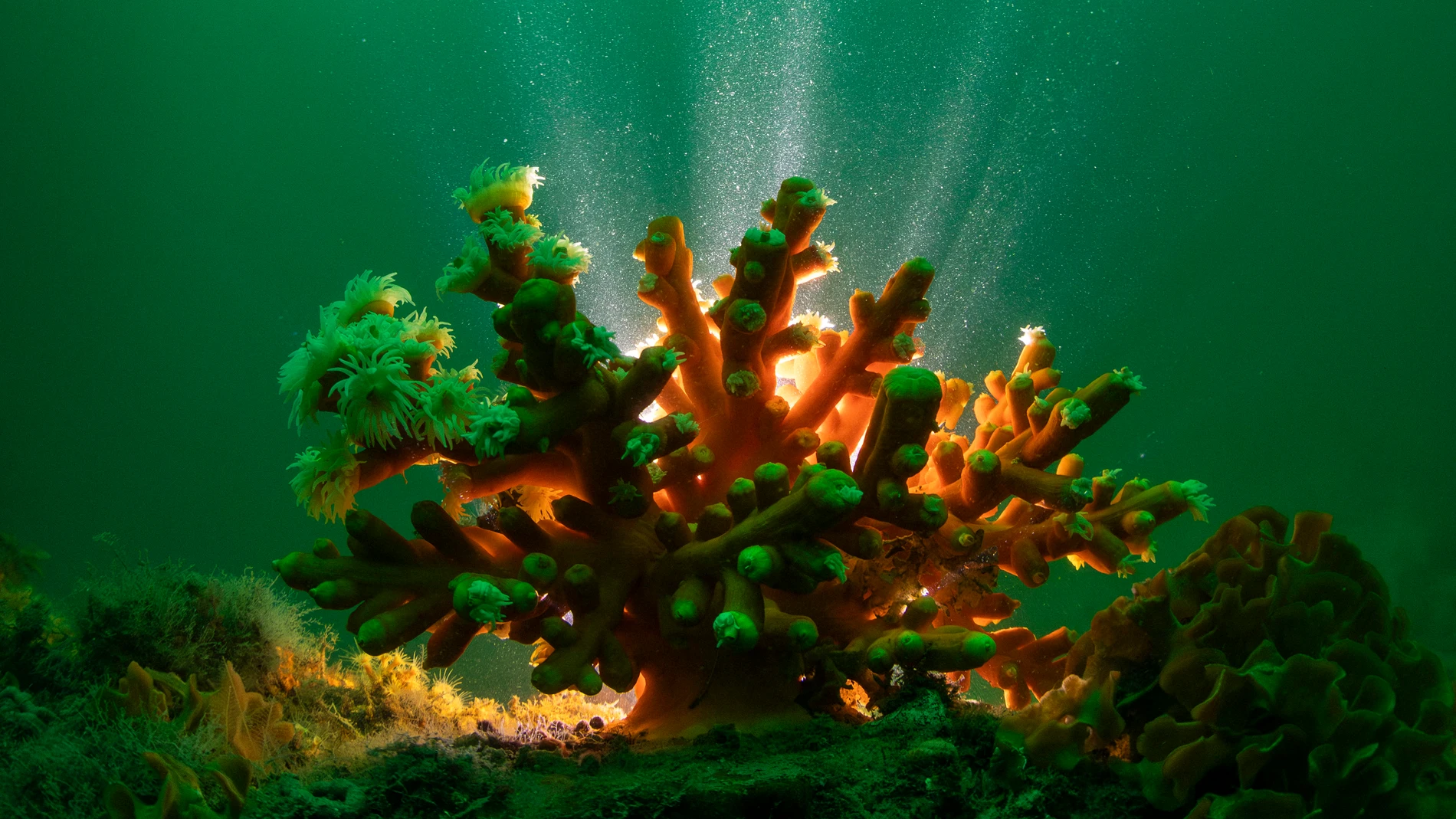
Marina Palacios, scientist and professional diver, is difficult to catch out of the water. His daily work since 2021 in Punta de la Mona (Granada) has a specific objective: to monitor the growth of candelabra corals and continue advancing in the conservation of this species.
That year, she and Zaida Parra founded the Coral Soul association and, together with Coral Guardian, they launched the Deep Core Project, an initiative with which they intended to restore and conserve “an endangered reef,” he explains.
The first time he dove into these waters hoping to find a coral garden, what he discovered was a seabed cluttered with abandoned tires, anchors, fishing lines and nets; all of them residues from the fishing activity and free anchoring that had developed in the area for decades. There were hardly any remains of dead coral.
The candelabra coral It has a characteristic yellow-orange color and, as its name indicates, its colonies stand like candelabras in the darkness. «It is one of the largest coral species in the Mediterranean. can be found up to 300 meters deep, which explains why it remains so little known. Among other things, we knew little about their reproductive behavior,” explains Palacios. However, the configuration of the seascape of this area has made it possible to access these corals and expand the science they hide. «We are lucky to have three underwater canyons that allow us to find this species at a shallower depth, between 28 and 50 meters. Although it is a considerable distance for conventional diving, it is accessible by technical diving. This has facilitated the development of this recovery project, which is a pioneer worldwide, because no one had recovered this species before,” explains Palacios. Technical diving allows them, thanks to a mixture of gases, descend to 50 meters deep and perform manual interventions.
Record a unique moment
Since 2021, His work has been constant and meticulous. In these years They have removed more than two tons of garbage, that caused wounds and necrosis in the corals, and have managed to rescape more than 780 and achieve a 90% survival rate.
The results obtained have the scientific support of the Spanish Institute of Oceanography (IEO-CSIC), the Scientific Center of Monaco and the universities of Seville, Cádiz and Algarve.
This meticulous daily work of observation and monitoring has now allowed them to achieve an unprecedented scientific milestone: recording the reproduction of a deep coral.
«To conserve corals it is necessary to know what is happening and know all its biological aspects. After these years of work, we have been able to document the curious mechanism they have to reproduce. It is something beautiful to observe, because a synchronized movement occurs: all the corals release the eggs and sperm into the water at the same time. Fertilization occurs externally. It is impressive, because incredible clouds form. Afterwards, a larva is born from the fertilized egg and attaches to the reef and gives rise to the first polyp, the first little animal. This grows until it forms a colony, because corals are colonial organisms: many invertebrates that live together, made up of numerous polyps,” says Palacios.
Coral nurseries
Recovery work on this species takes place in the so-called “underwater nurseries” in which they work in a quite artisanal way. The broken coral fragments are collected and moved to this area covered with metal structures that function as work tables. They have a latticed surface on which coral cuttings of different sizes and at different heights are distributed. In these structures, The corals’ wounds are treated and work is done to recover the colonies.
Armed with a Palacios toothbrush, she eliminates the necrotic parts and parasites of these colonies to promote their recovery and subsequent reintroduction into the reef. To fix them they use a non-toxic bioepoxy.
The corals recovered in the nurseries make it possible to restore the natural cover of the reef and promote the regeneration of the microhabitats necessary for the conservation of different species. In addition, the removal of waste also contributes to the regeneration of these essential habitats for the survival of fish and invertebrate species that inhabit this environment on the Granada coast.