
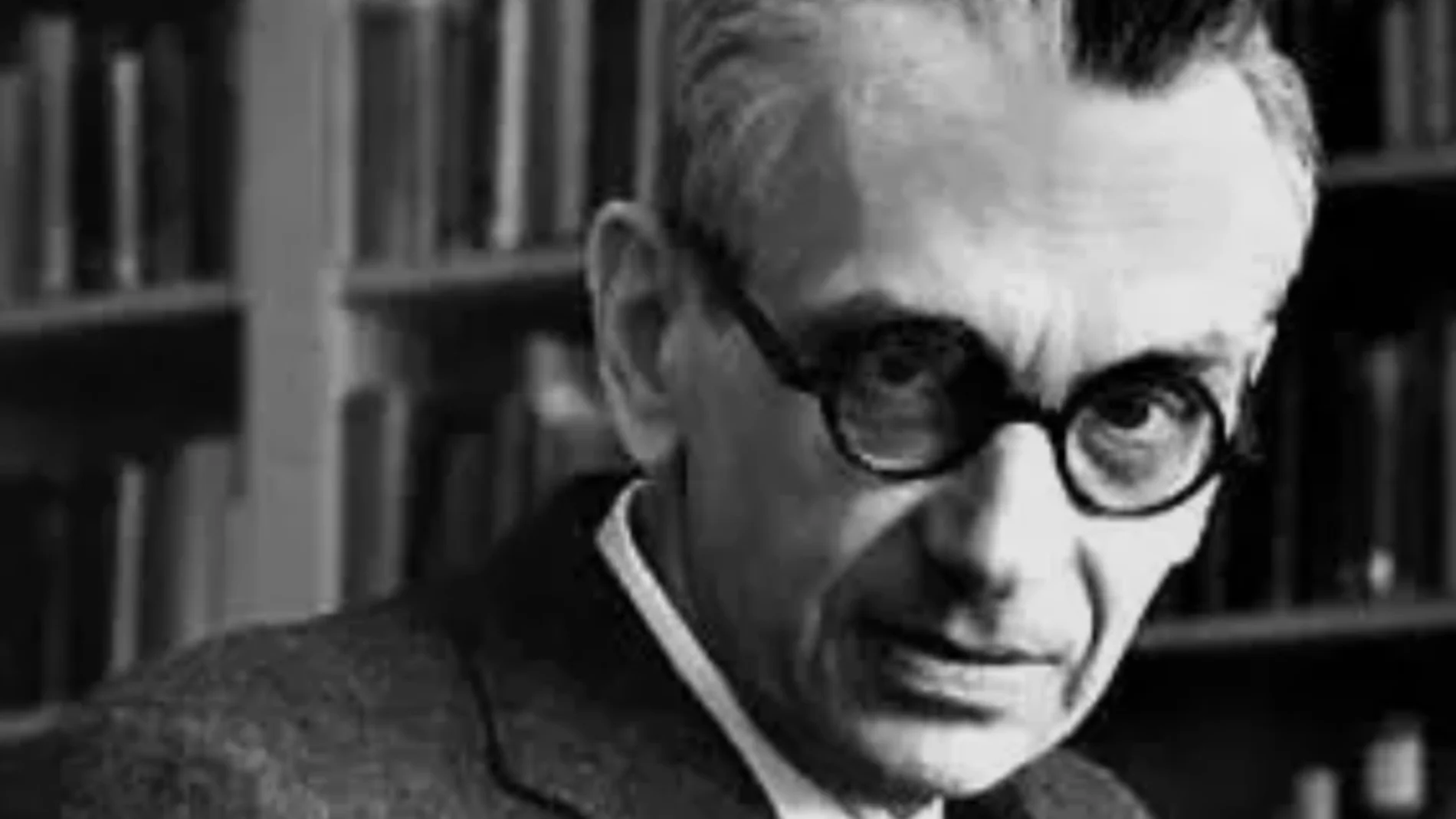
His name may not be in the popular imagination, but his achievements are. Kurt Godel He was the most influential logician and mathematician since Aristotle, a close friend of Albert Einstein and famous for having demonstrated that no formal system is capable of proving all of its own truths without falling into contradictions. Their Incompleteness theorems not only transformed philosophy and mathematicsbut they laid the theoretical foundations of modern computing and the very limits of artificial intelligence.
When he died in 1978, he left behind tens of thousands of writings in complex German shorthand, the Gabelsberger. an ancient German system of rapid writing created in 1834, based on fluid, cursive strokes where the thickness, slope or height of each line completely alters its meaning. To this we must add that eliminates silent letters, omits contextually deducible vowels, and uses special symbols for prefixes, suffixes, and highly frequently used words. And, if that were not enough, Gödel personalized it with his own abbreviations and logical symbols.
The problem is that the Gabelsberger It stopped being used in 1924 and there are no longer any experts who can decipher Gödel’s 16 notebooks that contained more than a thousand pages of mathematical and logical reasoning. Thus, for decades, Much of that material remained practically inaccessible. Now, an artificial intelligence has managed to open a window to that intellectual archive and bring hundreds of results to light.
The person in charge of the project is Jan von Plato, from the University of Helsinki, who since 2017 has been working on the recovery and study of the manuscripts. von PLato’s team had managed to make slow progress in transcribing and understanding the notebooks, but the pace was exhausting: approximately one page per week. In September of this year, von Plato decided to try a different strategy. Claude introduced his English transcriptions into the artificial intelligence model, along with books he had written about Gödel and specialized bibliography. The result surprised him. In just a few days, the system produced an explanation of about 650 pages and related ideas scattered throughout the entire file.
“I was astonished – von Plato admits in an interview -. In a couple of days, I was able to see a 650-page explanation of workbooks. You had to go through them page by page; it is, in essence, an impossible task for human beings. Humans read one page at a time and tend to forget things. It takes us a year to read about 50 pages. We simply are not able to retain in our minds all the parts that compose them. AI, on the other hand, can connect all the elements across a thousand pages. “He is able to perceive the entirety of Gödel’s writings as a unitary whole.”
The AI had identified dozens of anticipations of results that would not be known until the seventies and eighties, in addition to 14 lines of research in logic and foundations of mathematics that, according to the researcher, had not been developed. The system had found something that is especially difficult for a person who studies manuscripts of this nature: connect reasoning separated by hundreds of pages and reconstruct the intellectual architecture that unites them.
But Gödel’s ideas also had decisive consequences for computing. The formalization of logic and the concept of computability They helped lay the theoretical foundations on which Alan Turing would develop, in 1936, his model of the universal machine.one of the foundations of modern computing. Therefore, recovering your manuscripts does not simply mean finding old notes: it means exploring a still unknown part of the intellectual history that led to the digital age.
The investigation now opens another door. The notebooks analyzed contain more than a dozen topics that could give rise to new lines of work. AND Gödel’s archive is much larger: it includes writings on philosophy, physics, and cosmology that still await systematic study. Von Plato wants to address some of that material when he finishes the current mathematical research.
The paradox is extraordinary. A man who dedicated his life to studying the limits of what can be demonstrated through formal systems left thousands of pages that for decades were almost impossible to interpret. Now, a machine designed to process information has made it possible to find connections that escaped human reading. It has not replaced mathematicians: It has pointed out paths, formulated reconstructions and accelerated work that still requires judgment, knowledge and verification. But perhaps the most important thing is that Gödel, eight decades after writing those pages, still has things to teach us.