
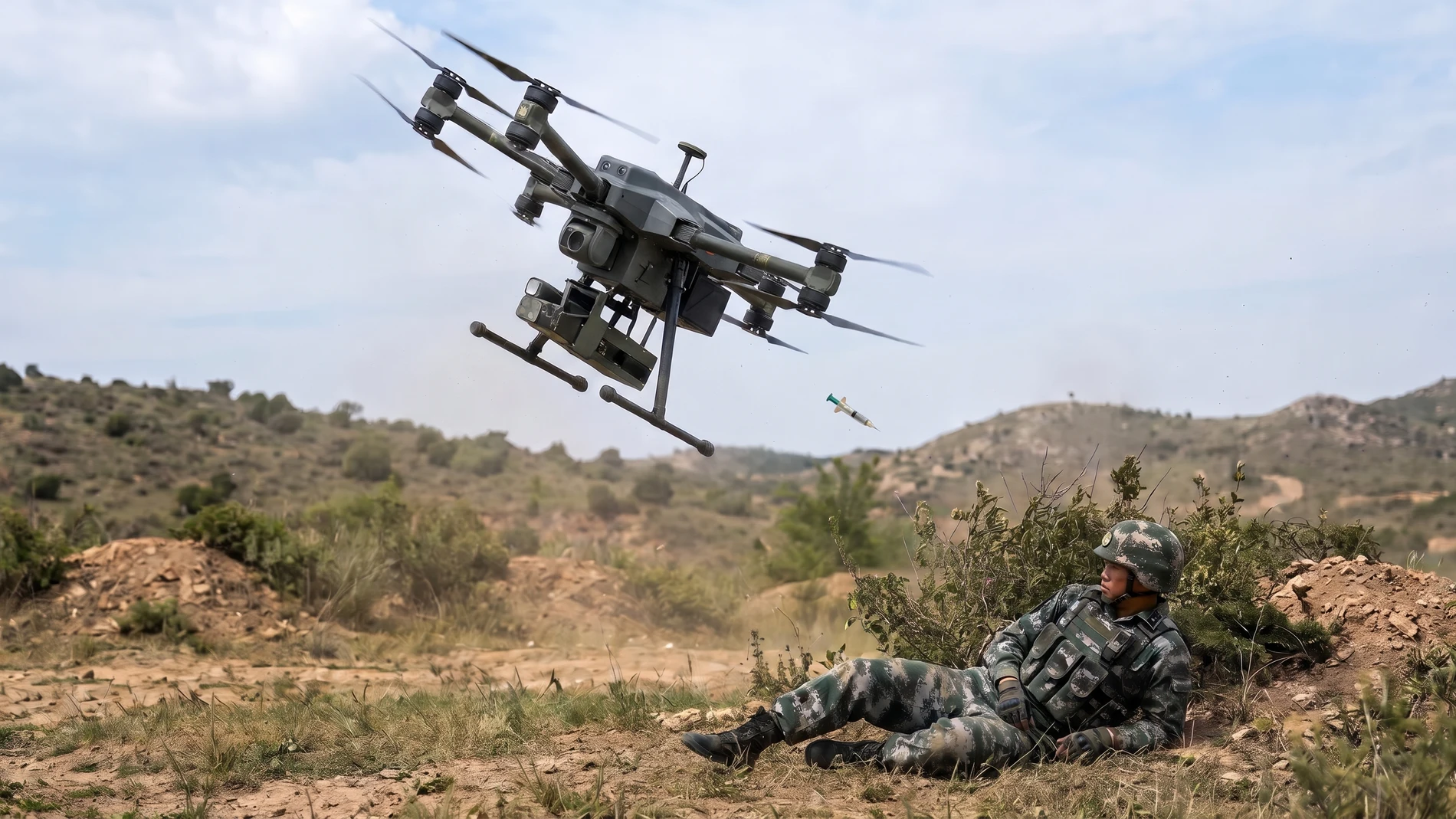
China has shown a drone capable of locating wounded soldiers and administer medications using darts fired from a distance. The idea is to provide first aid when danger or access difficulties prevent healthcare workers from reaching them, with the aim of gaining time until they are rescued.
The system has been developed by the Air Force Medical University China, according to a report broadcast on Wednesday by state television CCTV and reported by the Chinese newspaper Global Times. Wang Jianqirepresentative of the institution, presents it as the first drone of the country’s Armed Forces destined to search for and medically care for the wounded.
The footage shows an unmanned aircraft launching a dart-like projectile towards a soldier lying on the ground. This device allows inject the medication directly into the muscle without a health worker having to be next to the injured person.
‘Wherever our drone can fly, we will be able to administer emergency medications into the muscle of an injured person that can save their life’says Wang in the report. As he explains, this ability allows us to gain valuable time to continue with the treatment later.
The proposal seeks to facilitate medical care in wars where attacks are not limited to the front line, but also cause injuries in the rear. The military analyst Song Zhongping points out to Global Times that ‘one of the biggest problems of modern warfare is that it has blurred the concepts of front and rear’. The dispersion of the injured over larger areas complicates their location and forces medical teams to expose themselves to dangerous situations to treat them.
Medication administration can also facilitate subsequent evacuationas some soldiers need pain relief before they can be transferred. Song explains that stabilizing his condition is equally necessary if transport them using drones or other unmanned vehiclesto avoid complications during the journey.
However, attention through unmanned air and ground systems continues in an exploratory phaseaccording to Wang. One of the main pending challenges is to collect the wounded and put them on aircraft to evacuate them, something that Ukraine has recently proven viable.
Other Chinese military medical units are also testing these technologies, including the Hospital 967 of the Joint Logistics Support Force of the People’s Liberation Army. As reported in October by the newspaper of this military institution, the hospital organized an exercise with drones and robotic dogs.
During the drill, A drone with a thermal camera located people representing the injured, while small cargo drones and robotic dogs delivered medical supplies to inaccessible areas for conventional vehicles. The robots also entered narrow passages and transmitted information about the victims and their surroundings.
Song also raises possible civil applications against landslides, sunken roads or floods. In these situations, drones could deliver medicine to isolated people and reduce rescue teams’ exposure to danger.