
The standard particle physics model is, in a nutshell, the instruction manual of everything we see. Its two great virtues are to classify the matter (describes the 12 fundamental particles that are the elementary bricks of the universe) and Explain three of the fundamental forces of the cosmos: electromagnetic, weak nuclear and strong nuclear.
But it also has limits. For example, does not explain gravity, dark matter or dark energy. In this way, for almost a century, the goal of scientists is to find a theory at all that explains what the standard model does not achieve. And now we could be closer thanks to a simulation.
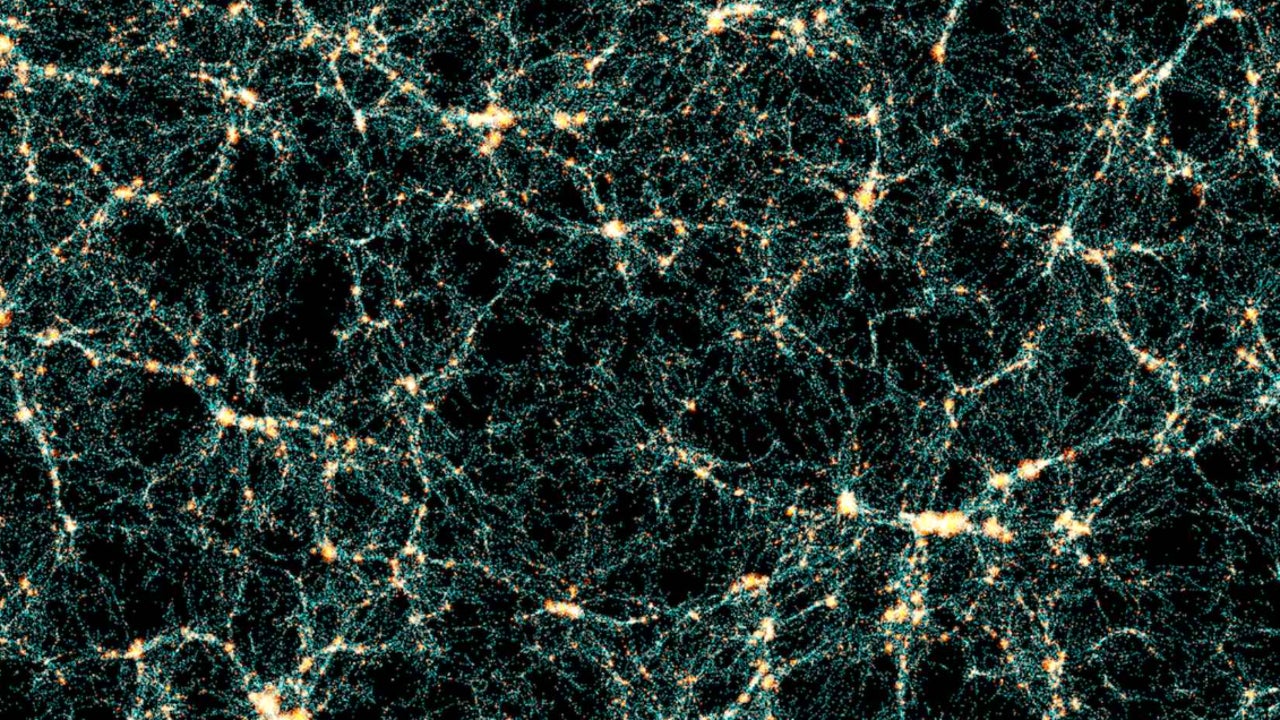
The Euclid consortium, the international group that manages the Euclid Space Telescope of the European Space Agency, has just published the most complete simulation of the universe. Thanks to her she has achieved Cartography the amazing figure of 3.4 billion galaxies and tracks the gravitational interactions of more than 4 billion particles.
Called Flagship 2, the simulation is based on an algorithm designed by astrophysicist Joachim Stadel, from the University of Zurich (UZH). In 2019, Stadel used the Piz Daint supercomputer (at that time the most powerful third in the world) for Execute the calculation, thus creating a virtual model of the exceptionally detailed universe.
“These simulations They are crucial to prepare the analysis of Euclid data”The astrophysicist Julian Adamek, of the UZH, one of those responsible for the project, declared in a statement.
Since 2023, the Euclid space telescope has mapped billions of galaxies throughout the universe, studying the distribution of energy and dark matter. The spacecraft will eventually scan approximately one third of the night sky. Given the project scale, Euclid produces huge amounts of data, and simulations such as Flagship 2 help to accelerate processing times.
While the team anticipates that Euclid’s observations will coincide closely with the predictions of the simulation, there are probably surprises. Flagship 2 is based on the standard cosmological model, which is what we currently know about the composition of the universe.
But missions like Euclid are designed to challenge our current knowledge. “We see signs of cracks in the standard model -Joachim Stadel adds, also part of the project -. Euclid will bring us another step to the understanding of the mysterious kingdom of dark energy. ”
The team is particularly excited to study the mystery of dark energy, the force that drives the expansion of the universe. As it is in the standard cosmological model, dark energy is simply a constant. But Euclid’s observations, which will go up to 10 billion years ago, could reveal different characteristics.
“We can see how the universe expanded at that time and measure if this constant remained really constant”, Concludes Adamek.