
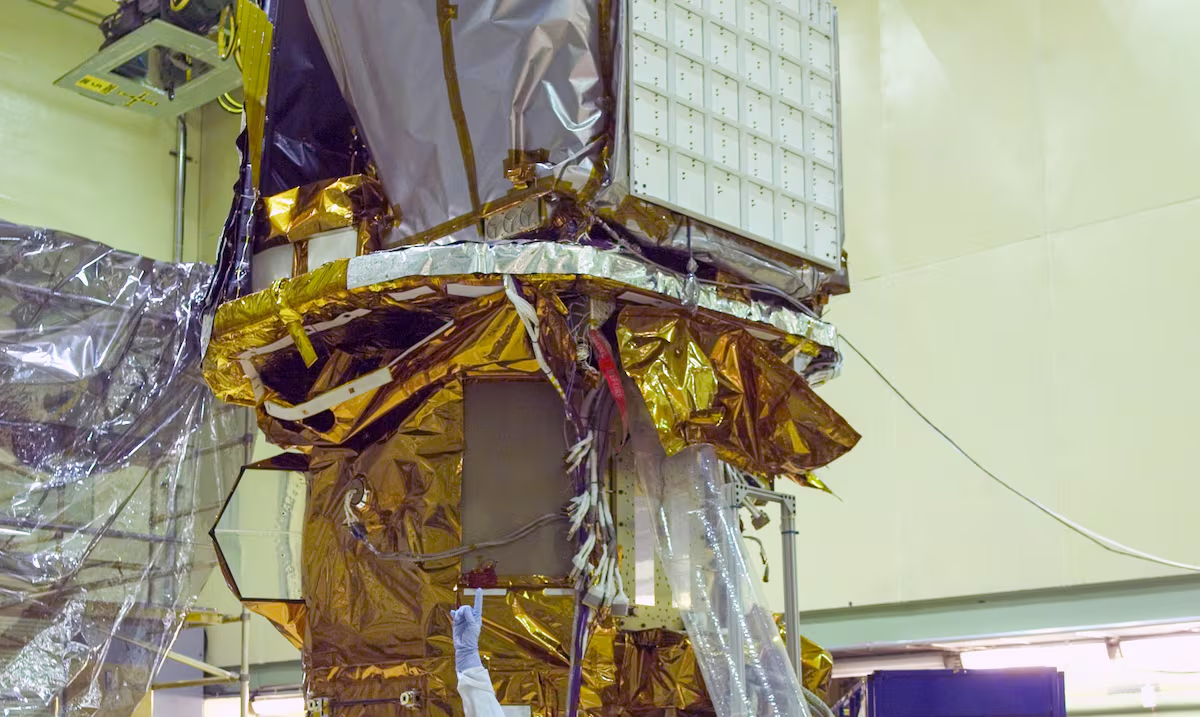
He Swift space telescope will fall uncontrollably to Earth in the “coming weeks”, without causing damage, after concluding its almost 22-year mission, during which it studied the largest explosions in the universe, the US space agency announced. POT.
The observatory made its last observation on October 20, when it was already flying at less than 275 kilometers high, where air resistance prevents it from keeping the telescopes fixed on a target, NASA explained in a statement.
NASA confirmed in August that re-entry will be uncontrolled and that most of the telescope will disintegrate in the atmosphere, although some pieces may survive. However, the agency considers it unlikely that the fragments will cause harm to people.
Because its orbit is inclined with respect to the equator, debris can only fall in a strip of the planet that extends from the center of Mexico to much of South America and large ocean areas, according to NASA.
The fall became inevitable in August, when NASA and the American company Katalyst Space gave up on their LINK robotic spacecraft, launched in July, capturing the telescope and pushing it up.
Launched in November 2004 for a two-year mission, Swift observed more than 2,000 gamma-ray bursts, the most powerful explosions in the cosmos, and more than 1,400 supernovae, and its data informed about 7,000 scientific papers, according to the space agency.
“Swift had to detect and locate gamma ray bursts, communicate its position to other observatories and then rotate its telescopes to capture the location before its glow went out. It normally took about a minute,” the mission’s principal investigator, Bradley Cenko, detailed in the statement.
That speed allowed it to capture in 2005, for the first time, the glow of a short burst, lasting only 0.03 seconds, which supported the theory that these explosions are born from the merger of two neutron stars.
The telescope leaves a public archive of about 12 terabytes, with more than 1.5 million images, and NASA is looking for ways to cover its ability to react quickly to cosmic phenomena with other missions.