
The situation is tense. A few days ago Reuters published that China is considering limiting the export of key equipment for manufacturing solar panels, a measure that would directly impact the United States, which depends on this technology for its local production. Although in principle it is benefiting American companies such as First Solar on the stock market, which has increased its value, such a measure may threaten the plans of companies like Tesla to build new factories. «The measure comes at a time when the rivalry between China and the United States has extended to the race to produce space computing powered by solar panels, a strategic sector for Elon Musk. Other technology companies such as Google or Amazon are investing in storage systems to meet the growing energy demand of AI,” says the agency.
The great factory of the world
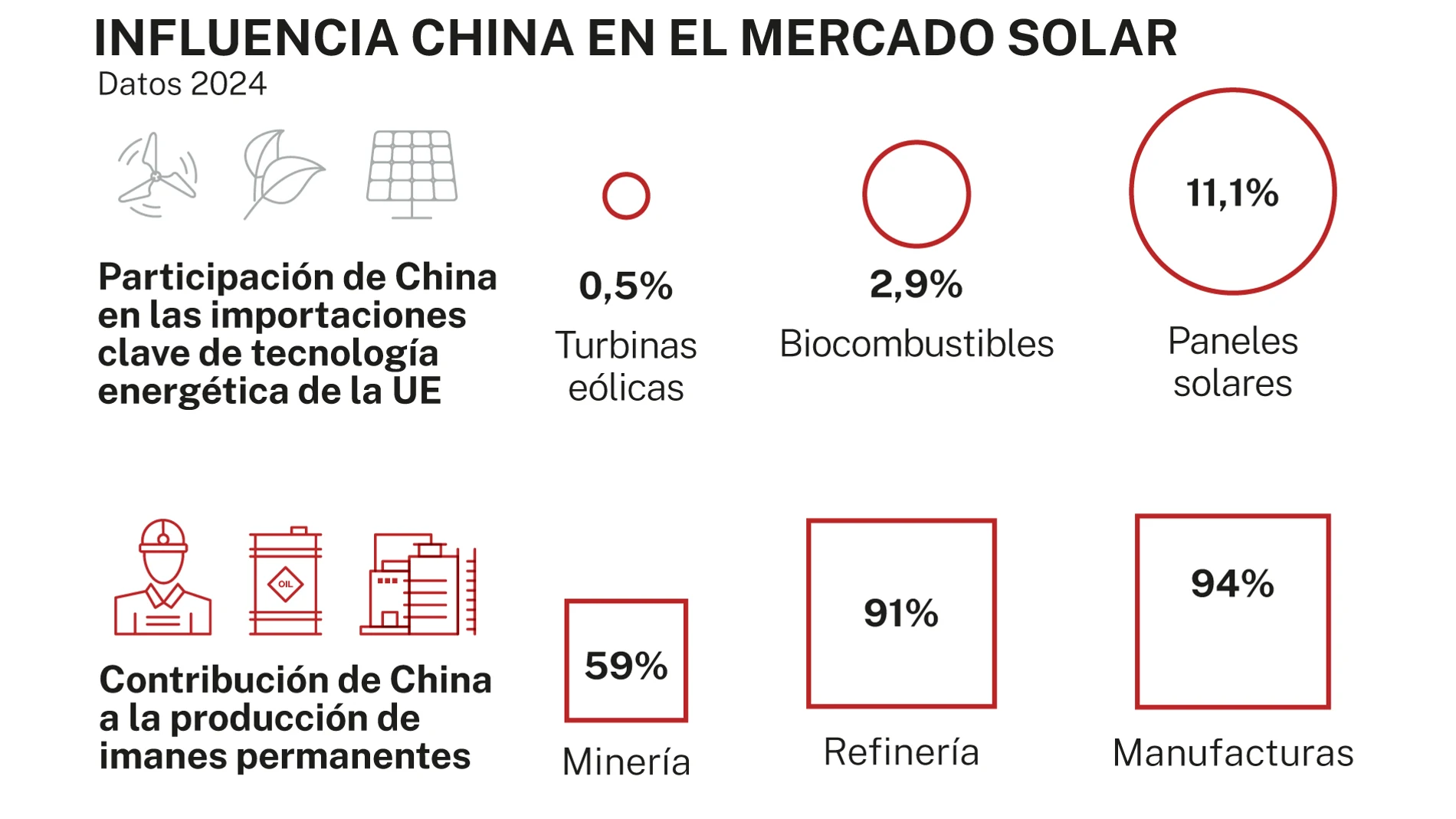
China manufactures 85% of the world’s solar components, home to 10 of the largest suppliers of solar cell manufacturing equipment. In addition, in 2023 it controlled 98% of the world’s production of wafers for solar panels and, in 2024, 70% of global wind turbines. «Companies like Huawei and Sungrow concentrated 55% of global shipments of solar inverters»says a recent report by the European Union Institute for Security Studies (EUISS). «China is the undisputed leader in the photovoltaic market. The US has tried to minimize its dependence – we have seen it with tariffs – but China controls manufacturing and has the know-how, so the US, although it has an industry that it has been developing, will be harmed by these measures,” says Sihame Messaouidi, CEO of DPV Energy, a solar technology distribution company based in Valencia.
For its part, China depends on the oil that passes through Hormuz. Despite the commitment to the ecological transition (Xi Jinping has committed to reducing the country’s emissions between 7 and 10% by 2035 and plans to install some 3,600 GW of solar and wind power by 2030 to minimize its fossil dependence), today the presence in the mix of renewable energy does not exceed 6%. Rubén Osuna Guerrero, director of the Department of Economic Theory and Mathematical Economics at the UNED, clarifies that «China’s main energy source is domestic, and it is coal: 62%. But it depends on oil by 20%. And that 20% is very important because transportation and a good part of Chinese industry depend on it. Of that volume, 70% is imported and 50% passes through the Strait of Hormuz. China has tried to develop long-term strategies, such as establishing oil pipelines with Russia or Central Asian countries, and “Tries to promote renewables (6%) and nuclear (which already occupies 3% of the mix)”says.
These veiled, and in some cases unconfirmed, threats can be interpreted as forms of pressure. China draws muscle from its strong side: manufacturing dominance and its access to strategic raw materials in the renewable transition and in the technological race, such as rare earths or silver. The US wants Beijing to “come on stage” and put pressure on Iran in the negotiations before unblocking the strait.
More expensive panels
The war opens a new chapter in an already bitter confrontation (in a recent press conference, a spokesperson for China’s Ministry of Foreign Affairs warned that the blockade would “only aggravate the situation”). In 2025, China has already threatened to cut off the supply of silver and has changed the licenses for exports, something that is already being noticed in the price of silver. Solar panels: «they have become 30% more expensive since the beginning of the year. China has withdrawn some export subsidies for modules and batteries as well and that, in part, explains the price rise. There are also changes in production. In recent years, especially since 2021, we have had a worldwide boom in installations. Manufacturers have been increasing their production capacity every year; some even duplicated it. The problem is that now the market does not absorb as much, there is overstock, Prices have been falling for two years and since January China has begun to reduce its production capacity to limit losses. There are large manufacturers that are listed and this year they must give positive results; “They cannot have two years of losses,” says Messaouidi.
The director of DPV Energy also points out to the increase in aluminum prices and freight, affected by “a higher cost of fuel but also of insurance, because their risk premium has increased. Since the attacks in the Red Sea by the Houthis a year ago, shipping companies have stopped using the Suez Canal. The new war with Iran maintains the route through the Cape of Good Hope, a longer and more expensive journey that is causing price increases, from 2,000 dollars a month and a half ago to about 4,000 per freight.
Sectors such as renewables or technology follow the tug-of-war between both powers and the situation in Hormuz; Some consequences are visible: solar panels or more expensive materials such as silver and rare earths and oil as a weapon of pressure. What can happen? Well, everything depends on the meeting and what happens in the conflict, but Rubén Osuna adds some details: “China has a very elderly population that has been decreasing since 2022. Its internal demand is not growing. The government has tried to ensure the growth of its economy through public investment, especially in construction, limiting imports and increasing exports. China is the world’s manufacturing power. 30-35% of world production (machinery, electronics, components…) and 15% of exports are theirs. It depends a lot on foreign markets. If there is a collapse in world trade, you will have economic and social problems. It can threaten to cut supplies, but it needs to sell abroad and the US is a big market. Just as the United States is looking for alternatives to rare earths, China is looking for alternatives to the North American market. Not to mention the connection that China has with the American debt: “The United States went into debt because it spent more than it produced and from there it is understood that it wanted to impose tariffs,” the professor clarifies.
Dependent transition
The European energy transition also depends heavily on China. According to the already mentioned report of the EU Institute for Security Studies entitled “The Dragon in the Grid: Limiting China’s influence in Europe’s energy system”, the Asian giant also has a presence among the system operators and in the connectivity of the equipment, and alerts that The EU must make decarbonization compatible with a risk reduction strategy vis-à-vis Beijing. «It is one thing to reduce energy imports and another to reduce strategic dependence on whoever supplies you energy. “Europe will depend less on oil-producing countries, but becomes more dependent on Chinese battery or solar panel suppliers,” says Osuna.
Renewables before coal
►The seventh annual edition of the Global Electricity Review by Ember (a group of electrical experts from around the world) has just been published, stating that renewables in 2025 covered 33% of generation, surpassing coal for the first time in a hundred years. “The unprecedented growth of the solar sector caused sources of clean electricity to grow fast enough to meet all new electricity demand in 2025, preventing a surge in fossil fuel generation. This was the first year since 2020 in which there was no increase in fossil electricity generation and only the fifth year without an increase so far this century. “The rapid expansion of solar generation is occurring more frequently alongside the deployment of battery storage,” this report says.