
What came first, the sound or the smell? The answer depends on what we mean by each thing, but if we talk about physics, sound wins by a landslide. In the early universe there were already pressure waves traveling through that hot plasma, long before there were noses capable of recognizing a molecule. The aroma of coffee had to wait a lot longer. AND, Millions of years later, we still bring together both things every morning: the noise of a grinder and the smell of freshly ground grains.
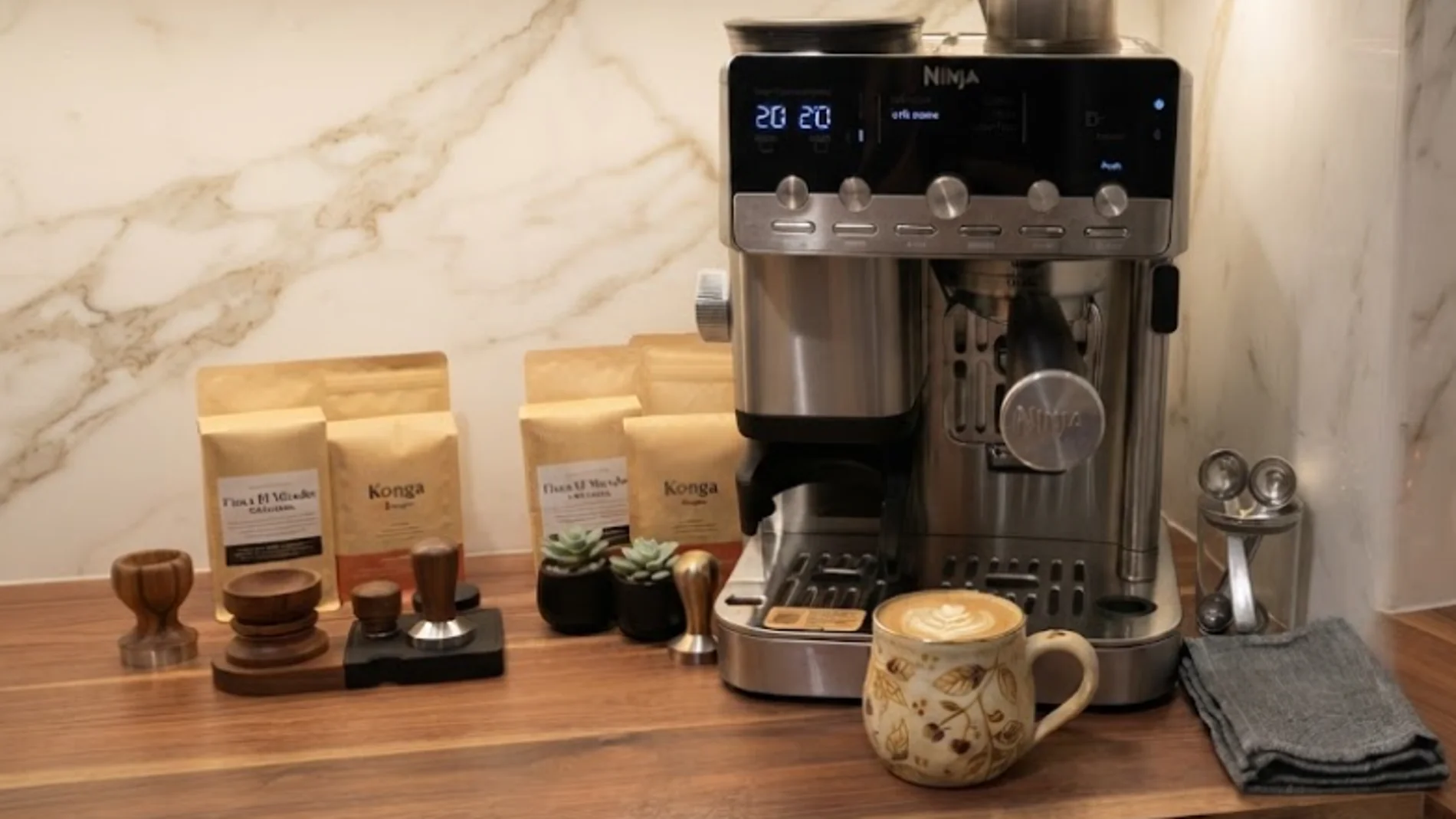
The Ninja Luxe Café Mini Plus does both quite enthusiastically. It is true that, when the grinder starts working, it is noticeable. It is not a silent machine and there is no point in reproaching it too much: Grinding coffee is a mechanical operation and the integrated grinders of this type of coffee makers inevitably produce a sound. much more present than the one we will have later, when the coffee begins to fall into the cup.
The difference is that here the noise is short-lived and has an immediate reward. Just a few seconds after pressing the button, the kitchen begins to smell like freshly ground coffee. The difference with a conventional coffee maker, Italian or French, is similar to what we have when we compare a cologne or a perfume: the intensity and permanence are much greater in the latter. And that is what remains when we grind the beans and let the espresso work. And here is an important detail: espresso has nothing to do with express or rapid, rather with pressure or the action of forcing pressurized hot water through ground coffee.
We must be very clear that we are talking about just two ingredients: coffee and water. And both are equally important. The first, due to quality, origin, aroma and body, is obvious, but the water (its hardness, acidity or alkalinity…) is also decisive. It is not strange that the Ninja Luxe Café Mini Plus comes with a kit that allows us to analyze the water in our home to know its characteristics and thus adapt it so that the pressure is adequate. And here comes a little science section. According to a study carried out by Fabian Wadsworth, to prepare a quality espresso, you need two things. The first is to ensure that the ground coffee is evenly distributed, eliminating lumps and compacting the disc homogeneously, “so that there are no areas where the water flow is greater than others,” says Wadsworth. A uniform disc ensures that the water diffuses throughout all the particles, thus capturing as much flavor as possible.
The second factor, adds Wadsworth, is “control the time it takes for the water to pass through the coffee”. The more compacted the disc is, the longer the water will remain in contact with the particles. Too much contact will result in bitter coffee, while too little contact will not extract enough flavor or caffeine. That is why the pressure and type of water are decisive. And Ninja knows it.
The good thing is that we don’t need to learn it. It’s not a super-automatic coffee maker where you just place a cup and press an icon, but it doesn’t require a biblical instruction manual either. We select the type of coffee we want to drink (6 different options), we adapt the grind to the selection and in a few seconds, we have a barista coffee… without the chatter, or the mileage options. Which, at 7 in the morning, is as appreciated as the aroma.
The key piece is Barista Assist. The machine It incorporates a precision grinder and scale and uses the information it obtains during brewing to recommend grinding and extraction settings. The idea is simple: that the user does not have to spend weeks discovering by trial and error which combination works best with each coffee. Instead of turning the kitchen into a small laboratory, the Ninja tries to become a kind of co-pilot.
And it is especially appreciated when changing coffee. Grains do not all behave the same. A grind that is too coarse or too fine can radically change the result of an espresso. Here the machine tries to detect when the setting needs to be changed and guides the user through the process. It does not completely eliminate human intervention (you have to place the portafilter, press and fit it), but it does considerably reduce the most unpleasant part of learning. The result also depends on how much we want to intervene. The Mini Plus allows you to prepare single or double espresso and offers three intensity levels and three temperatures.
The other surprise comes with the milk. The coffee maker comes with an automatic steam wand and carafe, so you can also take care of the foam. There are three predefined settings and the possibility of using both milk and vegetable drinks, yes, there is something for all tastes. Instead of learning how to hold a pitcher at exactly the right angle while searching for the right texture, simply select the type of foam (little, medium, or heavy) and let the machine do most of the work.
All this fits in a device that measures just over 26 centimeters wide and about 34 centimeters high, 30% less space than the Luxe Café Pro. It is not a small coffee maker in absolute terms, but it is surprisingly compact considering that it has a grinder, scale, extraction system and frother inside. And it’s easy to locate, even in a small kitchen. There is also a less romantic, but important question: the cleaning. The removable parts are dishwasher safe and the steam wand itself is designed for easy maintenance. Because, let’s be honest, a machine that makes good coffee, but requires disassembling it every morning to be able to use it again the next day ends up turning pleasure into just another household chore. After several coffees (many I must confess), the feeling that the Luxe Café Mini Plus leaves is precisely that: that of a machine that tries to remove obstacles without completely removing the ritual.
Verdict:
For those who enjoy coffee and like to explore a little beyond ground coffee or instant (Vade retro), this is a very interesting option, one of the best we have tried to date.