
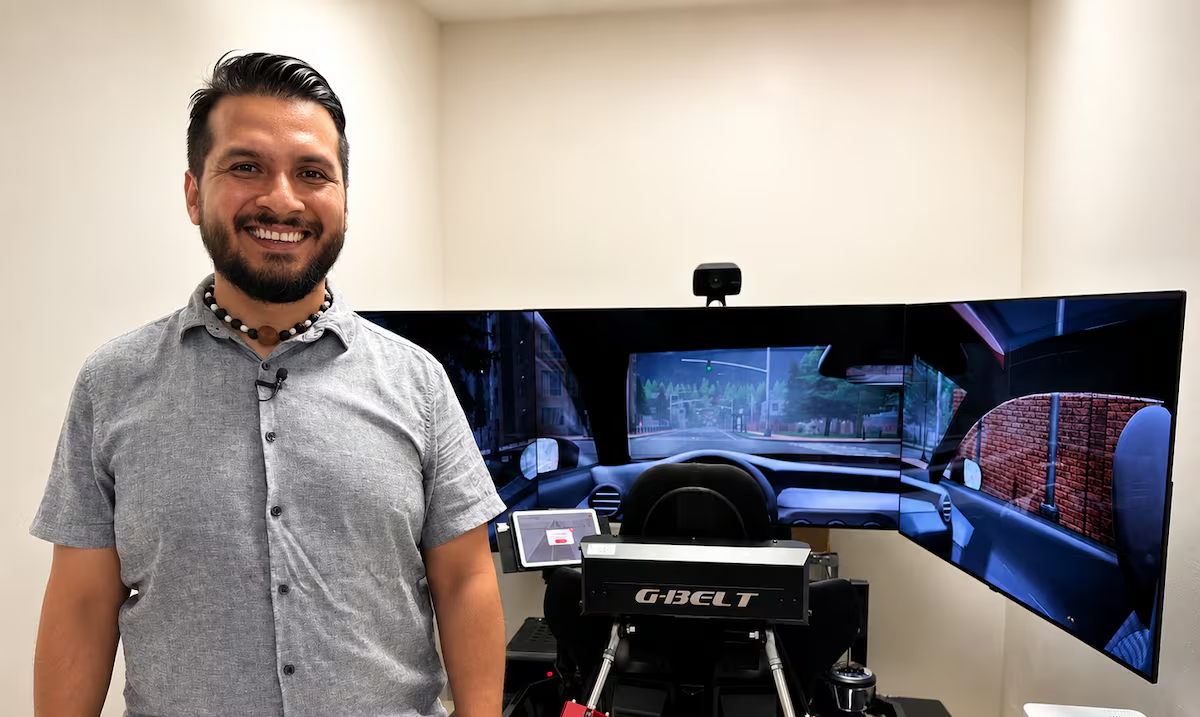
The doctor Juan F. Medina Leeassistant professor in the Department of Computer Science and Engineering of the Mayagüez University Campus (RUM) of the University of Puerto Rico (UPR), received the prestigious award CAREER that grants the National Science Foundation (NSF) to professors in the early stages of their academic careers with the potential to lead significant advances in research and education.
The grant, amounting to $517 thousand, will support, over the next five years, their project “A Computational Framework for Integrating Trust, Shared Awareness, and Joint Action in Human-AI Driving Teams”, focused on the development of new collaboration strategies between human beings and information systems artificial intelligence in highly automated vehicles.
The proposal seeks to transform the way in which relationships between people and autonomous systems are conceived. Instead of viewing artificial intelligence as a tool that simply executes instructions, or as a technology in which absolute trust is placed, The research proposes a collaborative model in which both act as members of the same teamcapable of sharing information, coordinating decisions and supporting each other to strengthen safety while driving.
“We want to explore the capability and feasibility of developing autonomous vehicles that are capable of interacting with humans on board the vehicle, making decisions together, assessing trust between human and machine, and see how the impact of these decision-making can have other implications, such as the person not trusting the system very much or, on the other hand, becoming overconfident and using it in unsafe ways.”explained Medina Lee, via press release.
He explained that one of the main objectives is to identify mechanisms that make it possible to build a healthy relationship between users and intelligent systems.
“We want to explore strategies that allow us to calibrate that healthy relationship and find a stable point in which both help each other maintain safer driving,” he said.
The research is based on the recognition that, although artificial intelligence has considerably expanded the capabilities of automated vehicles, complex scenarios continue to exist in which human intervention is essential. As part of the project, the team will develop computational models capable of estimating both the trust that people place in artificial intelligence and the trust that intelligent systems can attribute to their human collaborators.
For Medina Lee, the granting of the subsidy constitutes recognition of the relevance of this research topic, particularly at a time when automated vehicles are beginning to gain greater presence in different cities around the world.
“It is an honor, first of all, that NSF endorses my line of research for the development of science, especially in the United States, where autonomous vehicles are increasingly booming. That entity is aware the importance of exploring the teams between humans and artificial intelligence systemsso it represents a great achievement for us here, at the University, since that type of interactions is what we want to aim for,” he stated.
In addition to its scientific contribution, the grant will have a significant impact on the training of future researchers and professionals. The funds will expand educational opportunities, strengthen graduate research and develop community outreach activities.
“This project will allow us to have five years of development and research in this line of collaborative vehicles, human-machine interaction and exploration of human factors in autonomous vehicles. We bring $517 thousand to the Campus that will allow us to develop summer workshops with high school and university students. “We are going to hold robotics competitions and finance graduate students for master’s and doctoral degrees.”he expressed.