
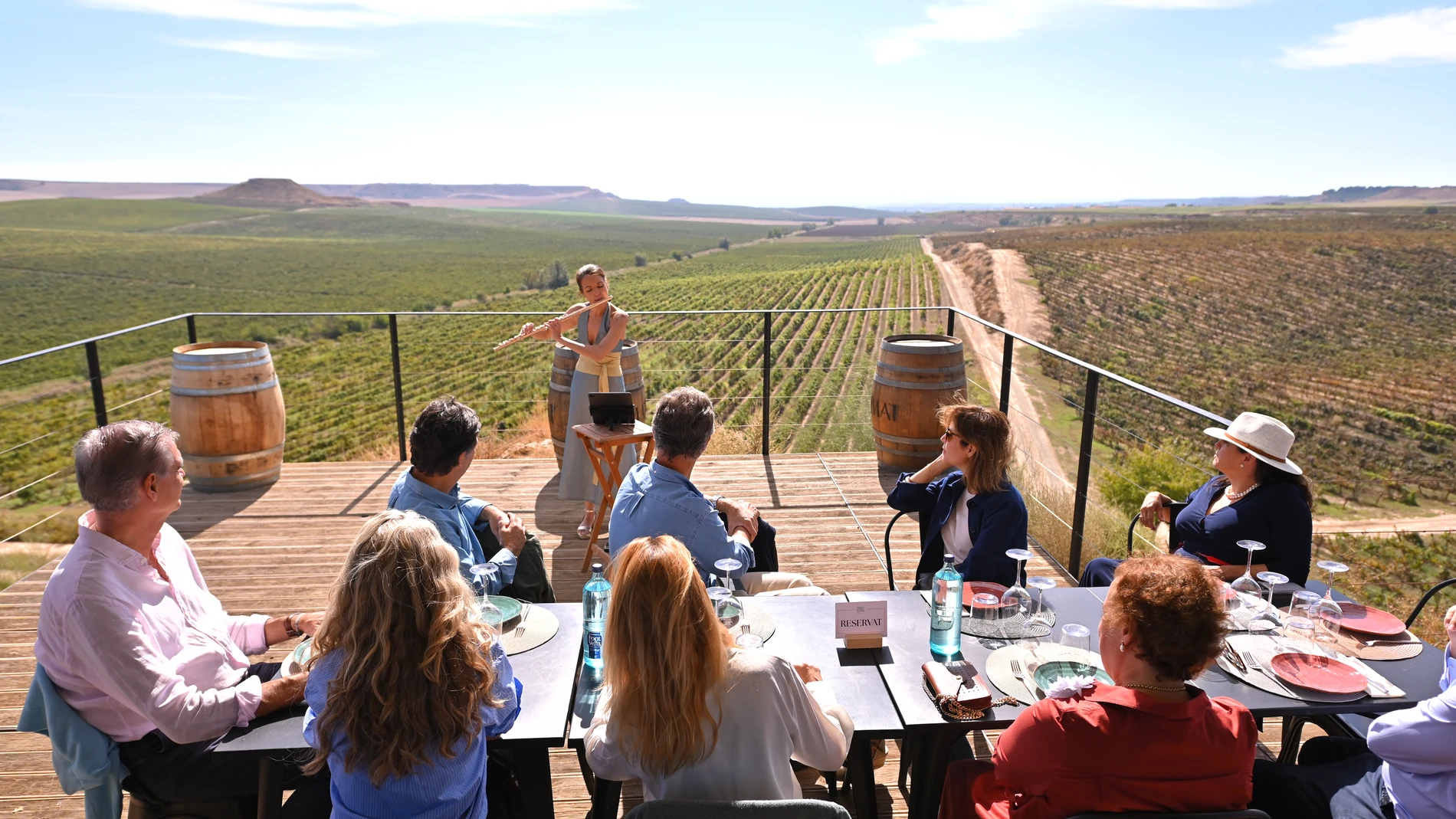
Listening to a transverse flute while, on the horizon, the October sun covers an extensive field of vineyards with gold is an experience to which many qualifiers can be put, without doubting that any of them will fall short. It won’t do. There are things that words don’t explain. They are property of emotion and the body; of the ears, sight, skin. Uniting culture and landscape in large letters, music and agriculture in detail, is what it proposes the Raimat Arts Festival. An event that defines itself as an “international classical music festival that transforms the territory through the arts.” A “polyhedral” quote that, returning to the great letters, wants to unite land and beauty, landscape and culture. Or maybe it just reminds us that they are both part of the same thing.
As a brief summary of the musical proposal, it can be said that the RAF has just celebrated its fifth edition under the direction of the violinist from Lleida Joan Plana and has had the participation of the trumpeter and saxophonist Andrea Motis, pianist and composer Yuanfan Yang, countertenor Xavier Sabata, the Cramer Quartet and flutist Elisabet Franch.
If instead of music, we follow the history of the territory in which the contest is rooted, we arrive at an 11th century castle, we pass through a desert and a reforestation project, a family with a winemaking tradition that dates back to 1551 and a woman’s name: Elena de Carandini Raventós. She is the founder of the festival and, in turn, president of the Raimat Lleida Community Foundation, created in 2022, to which the benefits of the event are allocated. Among the projects undertaken by this young foundation is the training of tractor drivers among young people at risk of exclusion and adults, an activity carried out in collaboration with United Way Spain and John Deere. Another of its bets has to do with local producers: all the gastronomy that is tasted during the three days of the festival comes from Lleida fields.
In addition, the festival is Water Positive, that is, it returns more water to nature than it consumes thanks to a desalination project with Acciona. He also does not forget about regenerative agriculture. Currently, they are developing a program in collaboration with the Association of Properties for the Conservation of Nature, with which they study which crops are most suitable for this environment, taking into account water savings or the introduction of native fauna.
Visionary
For one hundred years the echo of agricultural regeneration has resonated in the heart of Raimat. In 1904, Manuel Raventós i Domènech, owner of Codorníu -the oldest family business in Spain-, arrived at the Raimat estate and castle and what he found was a vacant desert and a castle in ruins. How he was able to see in that desolate landscape an agricultural future of vineyards and a production of wines that enjoys prestige among fans is something that undoubtedly makes him a visionary, ahead of his time and ahead of what we know today as regenerative agriculture.
Manuel Raventos He planted a million trees, laid out a hundred kilometers of irrigation ditches and transformed the town. Raimat is today a town and a case study of agrarian colonization in Europe. Elena de Carandini, inspired by her ancestor and the Napa art festival, in California, wanted to reactivate that family legacy through art.
Future
This year, the harvest was the earliest in memory in Raimat. At the end of July it was already being collected. So it is not surprising that environmental awareness is an extension of daily work here and also defines future projects. Recently, in these areas, it has been launched the largest natural gravity treatment plant in Europe. Together with the Polytechnic University of Catalonia, they have created 40,000 m² wetlands in the middle of their vineyards. These purify up to 80,000 liters of water per day, coming from the winery’s activity, hardly using energy and taking advantage of unevenness. It is estimated that in a single year they will save about 200,000 kWh, an amount equivalent to the emissions of 30,000 cars driving for one day. Also, and within the Lleida Alimenta initiative in which they work together with the Lleida Provincial Council, they are interested in developing a bioeconomy project and using agricultural by-products and organic matter to produce energy and biofertilizers.
All this, of course, without forgetting art. With the patronage of the Banco Sabadell Foundation, the RAF has just launched its first Emerging Talent Program and the new “Castell de Raymat” Artists Residency. Furthermore, next year it is planned to add a new festival in the Val d’Aran.