
The center of our galaxy is not a kind place. There, about 26,000 light years from Earth, a supermassive black hole reigns, the densities are extreme, the stellar explosions frequent and the radiation intense. However, it is precisely in that hostile environment where An international team of astronomers has discovered a surprisingly rich and complex chemistry that forces us to rethink how stars are born and what kind of ingredients can arise under boundary conditions.
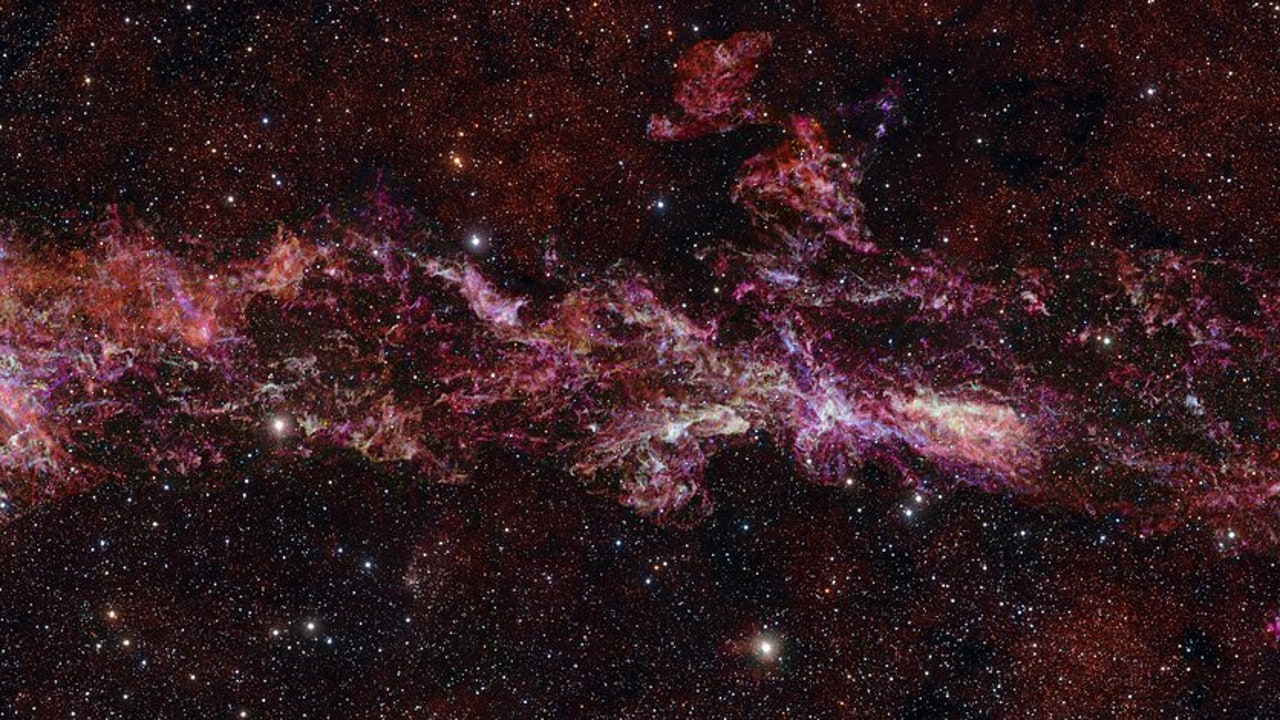
Thanks to the ALMA radio telescope, in the Atacama Desert (Chile), an international team of scientists, from NASA, the European Southern Observatory (ESO) and the European Space Agency, among other institutions, has obtained the largest image ever produced by this facility. The mosaic, equivalent in the sky to three full moons aligned, reveals with an unprecedented level of detail the so-called Central Molecular Zone (CMZ), a vast region of cold gas surrounding the supermassive black hole at the core of the Milky Way.
“It is a place of extremes, invisible to our eyes, but now revealed in extraordinary detail – explains Ashley Barnes, astronomer at the European Southern Observatory (ESO), in a statement -. For the first time, the cold gas of this entire region, the raw material from which stars form, has been explored in such depth.”
The region analyzed extends over more than 650 light years. They concentrate on it dense clouds of gas and dust subjected to intense gravitational forces, frequent collisions and waves of radiation from both massive stars and the central black hole.“It is the only galactic nucleus close enough to Earth for us to study it in such detail,” Barnes says. And what they have found is not just structure: it is chemistry.
The project, called ACES (ALMA CMZ Exploration Survey), has detected dozens of different molecules in this cold gas. From relatively simple compounds such as silicon monoxide to more complex organic molecules such as methanol, acetone or ethanol. In other words: one of the most violent environments in the galaxy, it has diverse organic chemistry.
This combination is disconcerting. For decades, models of star formation and chemical evolution have been largely built from “quieter” regions of the galactic disk. But the center of the Milky Way does not behave like the solar neighborhood. The new images show an intricate network of filaments of cold gas funneling matter toward denser cores. These “lumps” are the seeds of future stars. At the periphery of the galaxy we know this process quite well: gas collapses under its own gravity, fragments, and eventually ignites nuclear fusion. But in the galactic center the rules seem to be altered.
“The CMZ houses some of the most massive stars known in our galaxy, many of which live fast and die youngending their lives in powerful supernovae and even hypernovae – says Steve Longmore, leader of ACES and professor of astrophysics at Liverpool John Moores University -. “The question is whether our theories of star formation are still valid in such a chaotic environment.”
The density, pressure and turbulence there are much higher. The gravitational field is extreme. Supernova explosions continually reshape the interstellar medium. And yet, the cold gas survives and maintains surprisingly sophisticated chemistry. Understanding what happens in the Central Molecular Zone is not just a local question. “By studying how stars are born in the CMZ, we can get a clearer picture of how galaxies grew and evolved,” confirms Longmore. “We believe the region shares many characteristics with galaxies in the early universe, where stars formed in chaotic and extreme environments.”
In other words, The center of the Milky Way could function as a time machine. The first galaxies in the cosmos were denser, more turbulent and less chemically evolved. If star formation can thrive under these current extreme conditions, perhaps it also did so in more diverse ways than we imagined in the young universe.
And now the key question: What does new chemistry entail? Detecting complex organic molecules in such an aggressive environment raises profound questions. Traditionally it was thought that chemical complexity required stability: cold regions, protected from intense radiation. But here we see that chemistry can endure and perhaps even thrive, even under cosmic stress.
It does not mean that there is life in the galactic center. But if expands the range of scenarios where fundamental chemical “bricks” can be formed. And that forces us to reconsider what we mean by potentially habitable environments on a cosmic scale.
The team admits that even they were surprised by the richness of the final image. “We anticipated a high level of detail when designing the study, but were genuinely surprised by the complexity and richness revealed in the final mosaic. – concludes Katharina Immer, ALMA astronomer at ESO -. In many ways, this is just the beginning. “We will be able to resolve finer structures, track more complex chemistry, and explore the interaction between stars, gas, and black holes with unprecedented clarity.”