
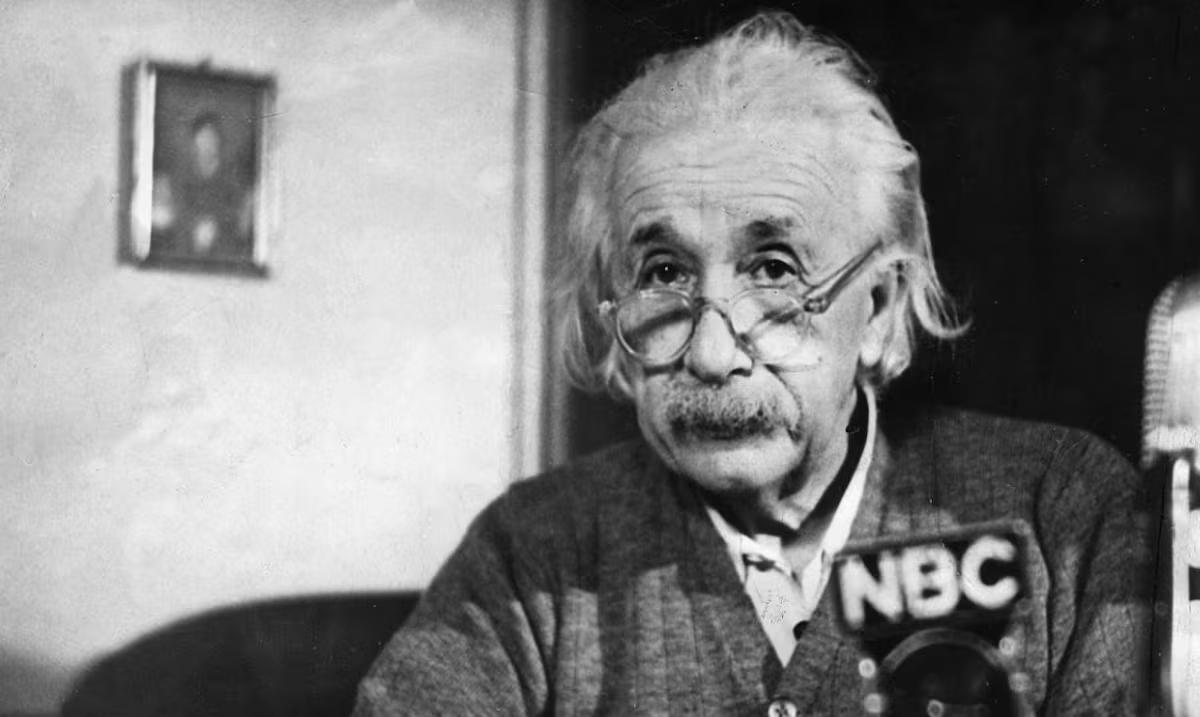
Albert Einstein He not only transformed modern physics with his theories, he also left personal reflections that have transcended generations.
One of the best known compares life to a bicycle and proposes that balance is only maintained when moving forward.
The phrase “Life is like a bicycle; to maintain balance you have to keep going” was written in 1930 in a letter that Albert Einstein sent to his son Eduard, in a complex period from a personal point of view, according to the newspaper ‘El Clarín’.
As time went by, the expression began to circulate independently until it became one of the scientist’s most widespread quotes.
The meaning of the metaphor
The comparison is based on a concrete experience: when riding a bicycle, balance depends on movement.
When the ride stops completely, stability is lost. From that everyday image, the physicist transferred the idea to the plane of life.
The approach does not refer to success or speed, nor to immediate transformations. The central idea points to continuity: moving forward, even gradually, as a condition to maintain balance.
According to this interpretation, stability does not arise when everything is resolved, but in the very process of continuing to move.
In daily life, metaphor is usually linked to situations of doubt or uncertainty.
Paralysis in the face of fear can generate a greater feeling of instability, while taking small steps, even without having all the answers, helps to regain confidence and direction.
Movement and change in Einstein’s thought
Although he is primarily recognized for the theory of relativity, Einstein also expressed reflections on thought and personal responsibility. In another of his most quoted phrases he stated:
“No problem can be solved from the same level of consciousness that created it,” which suggests the need to modify the perspective in the face of difficulties.
This change involves a process of review and learning. Throughout his scientific career, several of his proposals were debated before achieving recognition, which came after years of constant work.
The notion of moving forward, adjusting and persisting appears as a recurring element in your experience.
In that sense, the image of the bicycle does not propose moving forward without direction, but rather avoiding immobility in the face of obstacles. Movement, understood as action and continuous review, is part of the same process of search and understanding.