
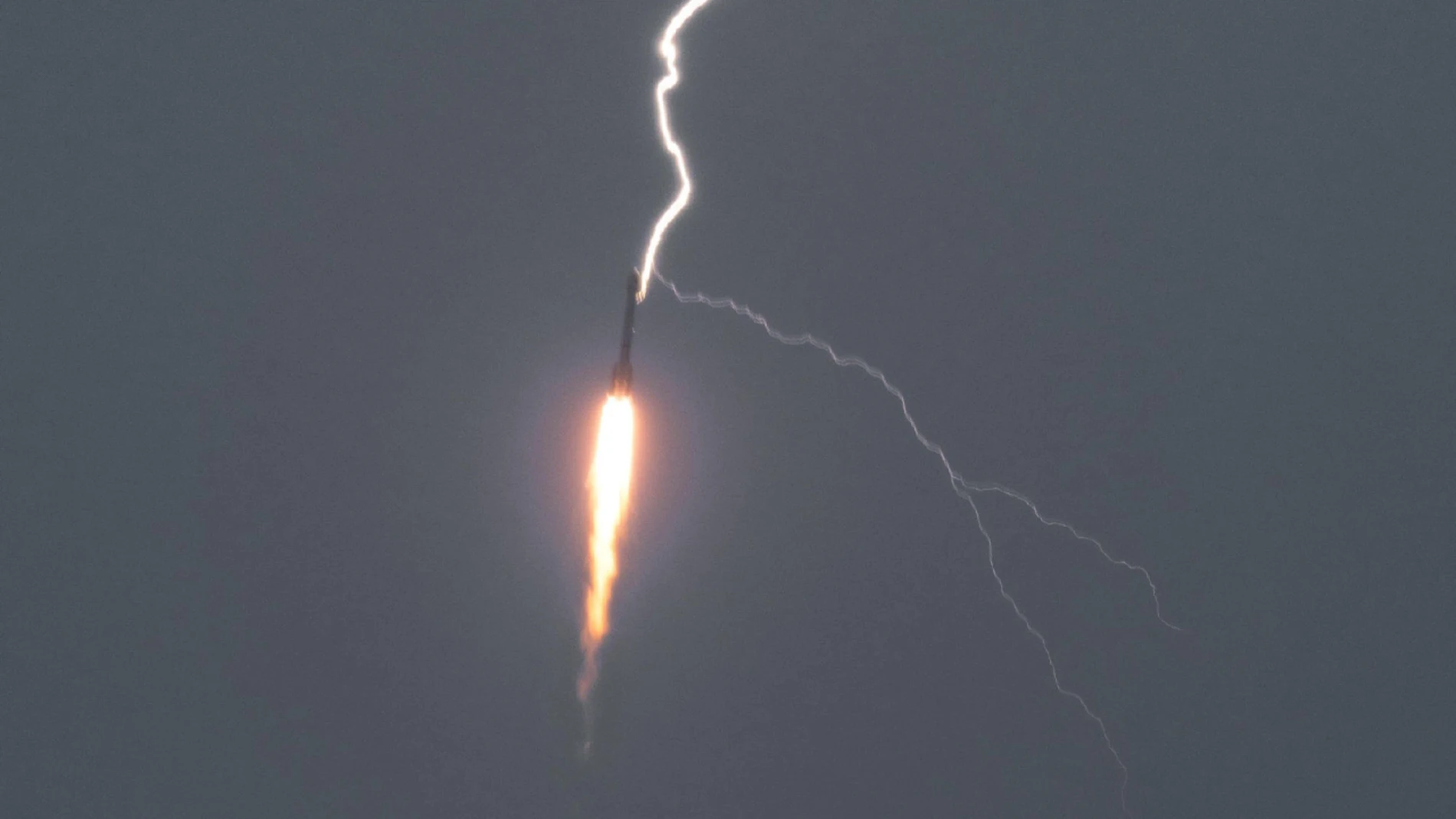
Lightning has hit the Chinese rocket Long March 3B just 30 seconds after it took off from the Xichang Satellite Launch Center this Thursday. The rocket carried a communications relay satellite destined for a geostationary orbit.
Despite the incident, the mission continued without apparent problems. According to the China Aerospace Science and Technology Corporationthe Long March 3B placed the satellite in the planned orbit. Its function will be to facilitate communications with the space station Tiangong and provide support to other manned missions of the Chinese space program.
En attendant, ça nous fait des images magnifiques. pic.twitter.com/g5cduYqgQJ
— Techniques Spatiales (@TechSpatiales) July 23, 2026
Why lightning can hit a rocket
Rockets can promote the formation of an electric discharge when passing through charged clouds. The column of ionized gases left by the engines creates a conductive path that facilitates the passage of current. For this reason, a launch can trigger lightning even when a thunderstorm is not occurring directly above the platform.
Other rockets that were struck by lightning: Saturn V, Soyuz-2.1b and Atlas/Centaur-67
One of the best-known precedents occurred during the launch of the Apollo 12the second mission to take astronauts to the lunar surface, in November 1969. On this occasion, the Saturn V was hit twice during the first minute of flight.
The downloads caused a voltage drop which left the system in charge of processing the signals from the ship’s sensors without normal operation. This converted measurements such as voltage, pressure or temperature into data that could be displayed on cockpit instruments and transmitted to the control center. Therefore, although many systems continued to function, the astronauts and technicians in Houston They began receiving inconsistent readings and couldn’t know for sure what had been damaged.
The flight controller John Aaron recognized the pattern and asked the system to pass to its auxiliary setting, designed to continue operating at a lower voltage. Alan Bean He flipped the switch and the readings returned, allowing the ship’s true status to be checked and the mission to continue.
Another case occurred in May 2019when lightning struck a Russian rocket Soyuz-2.1b a few seconds after takeoff from the cosmodrome Plesetsk. The discharge traveled through the vehicle without affecting the development of the mission and the rocket managed to place a navigation satellite into orbit Glonass-M.
The outcome was very different for the Atlas/Centaur-67 launched in March 1987. The rocket passed through an area of clouds and unleashed a discharge that altered the operation of its guidance system. Incorrect commands sent to the vehicle caused it to deviate from its path and began to disintegrate less than a minute after takeoff.
Following that accident, NASA reinforced its meteorological criteria for launches. The so-called Lightning Launch Commit Criteria They establish when a mission must be postponed due to the presence of clouds, storms, electric fields or certain atmospheric conditions capable of causing a shock.
These rules are not limited to avoiding visible storms. They also take into account the possibility of the rocket itself triggering lightning when passing through an electrified cloud. Since the strict application of these protocols, No vehicle launched in the United States has intercepted or caused a discharge during ascent, according to NASA.