
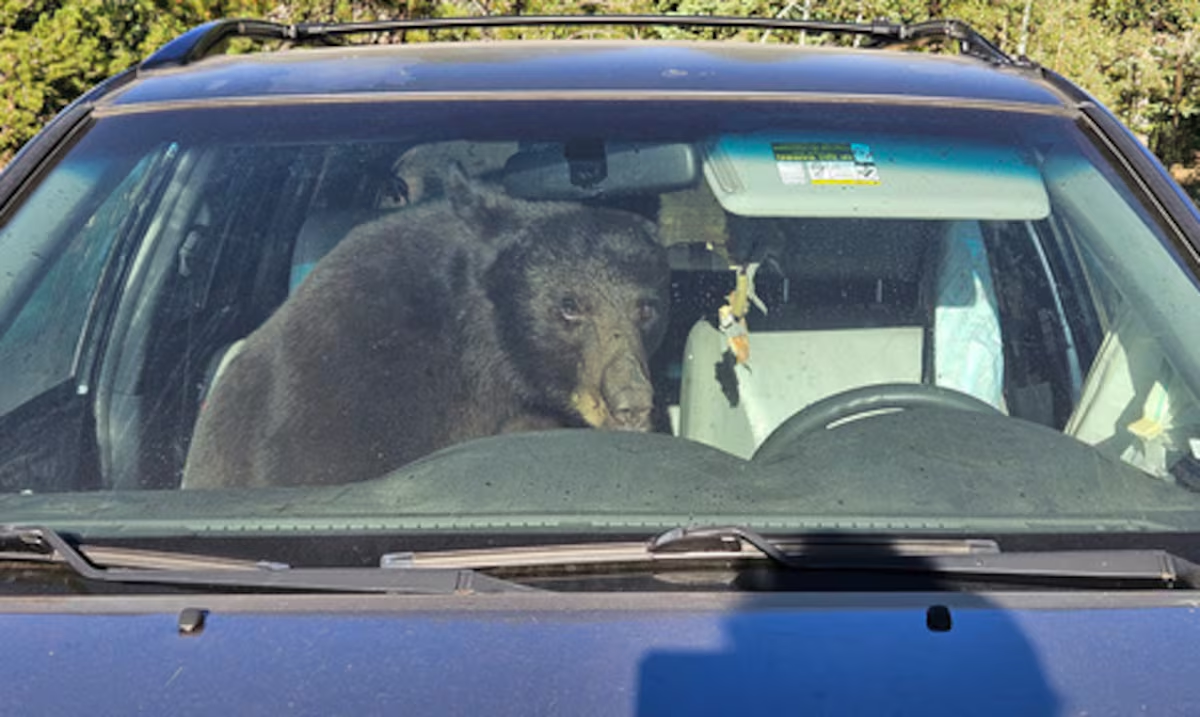
Colorado Springs – Patrick Sullivan, who was awake to feed his baby at 3:00 a.m. one summer night, was sure that whoever was honking a car horn non-stop was a “crazy neighbor.”
He was a neighbor, of course, but not human. A black bear had opened the door of a Toyota SUV and became trapped inside the vehicle in Gold Hill, Colorado, northwest of Denver.
In one of hundreds of examples of bears getting into more trouble than usual in the parched Rocky Mountains this summer, the animal continued to honk its horn while tearing up the interior of the Toyota, desperately trying to escape.
“It’s a total loss. It’s not suitable for driving,” Sullivan said of the car.
Millions of people live in or near bear habitat in the Rockies, where widespread drought has reduced supplies of nuts, berries and plants that bears eat. That is leading the animals to wander everywhere in search of food.
Sullivan’s brother-in-law eventually freed the bear trapped in the Toyota. But these encounters can be deadly for bears. One who was recently trapped in a car in Colorado Springs died from the heat, and wildlife officials have killed dozens of others who could endanger people.
Hungry bears on the move
Colorado officials report twice as many bear sightings and conflicts with humans this year compared to average, including bears hanging around places where they are not normally found. Wildlife managers in New Mexico and Utah report record numbers of hungry bears that have lost their natural wariness to raid homes, cars and campsites.
A black bear perched in a tree in downtown Denver was recently tranquilized and relocated. At Colorado State University in Fort Collins, a bear had to be captured and released elsewhere during the fall semester move-in season. In Utah, authorities transported four bears from the town of Moab, where they had been feasting in orchards.
“Bears aren’t necessarily behaving differently, but they are definitely increasing their activity in places where they forage for food,” said Travis Sauder, a state wildlife agent in southeastern Colorado.
Black bears generally remain in the mountains and foothills of Colorado. This year they have been seen on the plains more than an hour’s drive east of Colorado Springs.
“When they get this far east, there just aren’t any natural food sources that they would be looking for, like oak trees or wild cherries,” Sauder explained.
“A fed bear is a dead bear”
There are many temptations for hungry bears around homes: pet food in open garages, bird feeders and grease collectors under barbecue grills. And then there’s trash in unsecured containers, by far the biggest draw behind the increase in bear activity this year, according to data from Colorado Parks and Wildlife.
Many bears that visit populated areas are tranquilized and moved out of the city. However, if they begin to associate food with people, they may be put down.
“A fed bear is a dead bear” is the mantra of wildlife officials. They urge people to save anything a bear could even think of eating.
Black bears tend to avoid people and are less dangerous than the larger grizzly bears of the Northern Rockies.
But black bears can be aggressive toward humans: In June, a black bear followed and then attacked and scratched a hiker in Golden, Colorado.
Colorado has had at least four more attacks, including a bear outside an apartment building near Vail that scratched a man Aug. 17 as he left a laundry room.
Five days later, a bear knocked down and bit a fisherman in the mountains southwest of Denver. The young bear was tracked and shot.
A dry winter extends into summer
In Utah, more than three dozen bears have been killed this year. That’s more than the last three years combined, according to the Utah Division of Wildlife Resources.
The number of bears killed by wildlife officials and authorized landowners in New Mexico has now reached 187, the highest since 2011.
Across the entire upper Colorado River Basin, which encompasses Wyoming, Colorado, Utah and New Mexico, this year’s snowpack was the worst on record. Scientists say human-caused global warming made that much more likely.
“Human-animal conflict in the context of climate change hasn’t really been fully researched yet. And we’re just beginning to unravel what this means for us and what it means for all the species we share the ecosystem with,” said Samantha Miller, senior carnivore campaign manager at the Center for Biological Diversity.
Add in vast areas of bear habitat scorched by record wildfires, and it’s a recipe for trouble.
It’s not always a sad ending for bears or people
Some stories of bears in distress are heartwarming, such as those of orphaned cubs successfully released into the wild after spending time at a rescue center, where they learned to live on their own without raiding.
“We have had to rescue many bear cubs from trees, even standing on quite unstable stairs to remove a cub that is sleeping in a tree,” Sauder said.
Andy Kerrigan was working on a deck in Steamboat Springs, Colorado, this summer when he found a puppy that climbed into his truck through a window. He hit the truck to scare him into leaving.
“But I had found my lunch on the seat. And I was like, ‘I’m not going anywhere,'” said Kerrigan, who eventually chased him away with a piece of wood trim.
In Gold Hill, Sullivan’s brother-in-law solved the bear-in-the-Toyota problem by pulling on a rope tied to a door handle. The bear bolted through the open gate into the woods.
“He was basically sitting there waiting for someone to help him,” Sullivan said. “So I’m glad we were able to do that for him.”
This story was translated from English by an AP editor with the help of a generative artificial intelligence tool.