
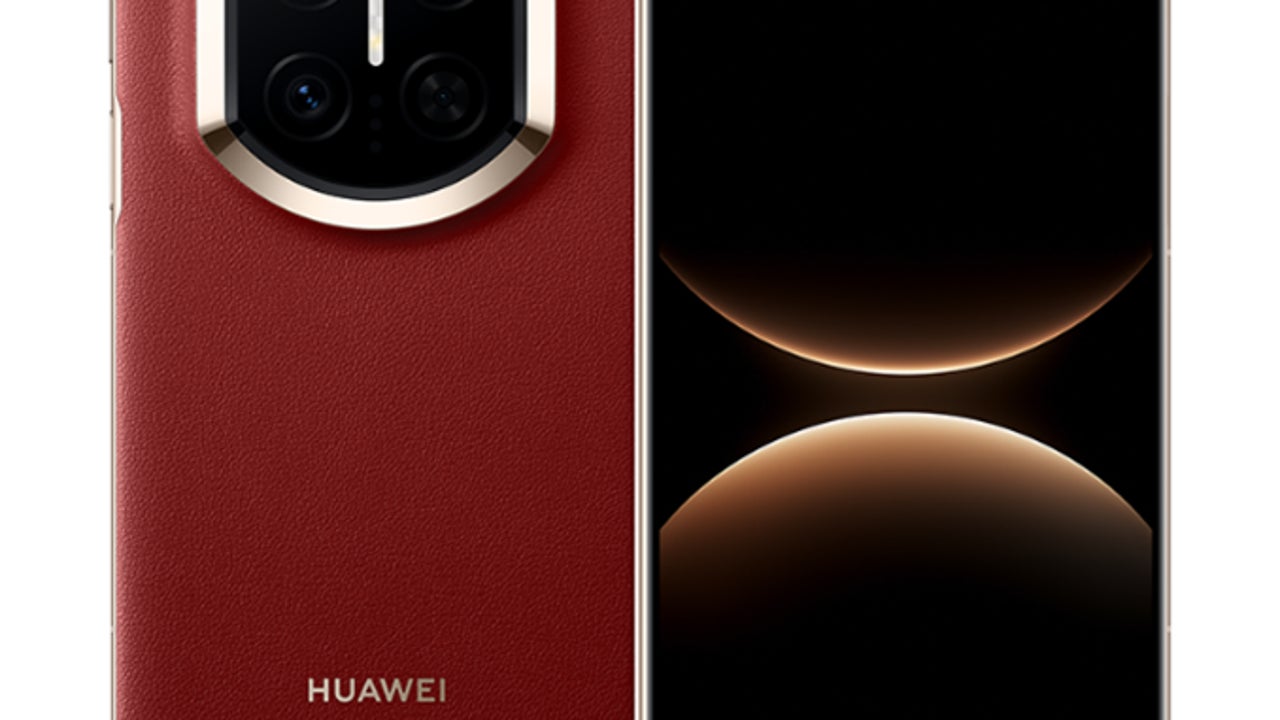
For a few years now, the folding phone market It has ceased to be a technological curiosity and has begun to be seen, by manufacturers and consumers, as a laboratory for the future. It is precisely with this spirit that the new Huawei Mate X7, the folding flagship of the Chinese company, arrives in Spain.
In terms of design, the Mate It comes in two versions: “Nebula Red” and “Black”, with a vegan leather texture that adds two advantages: better grip and less accumulation of fingerprints.
But in a folding device, design cannot be separated from engineering. One of the critical points of this category is durability. Huawei claims to have reinforced this aspect with a new generation folding architecture. The outer screen is protected with Kunlun Glass in its Ultra Durable Crystal Armor version, a screen glass developed by Huawei that is up to 20 times more resistant than traditional glass that other smartphones use and that took Huawei 4 years to develop. The process is complex: it was necessary to introduce nanocrystals during the glass production process and, using high temperatures, they fuse the nanocrystals with the glass to create a more resistant and dense material. Essential to protect both screens: the 6.4-inch and the 8-inch, once deployed.
The hinge, a key element in any folding, incorporates an arm system with five arches made of ultra-high resistance steel, while the internal structure is supported by a system composed of three layers designed to protect the flexible screen against wear and impacts. Added to this is an aircraft-grade aluminum intermediate frame and IP58 and IP59 certification against dust and water, something still unusual in this segment.
In photography, the Mate X7 seeks to compete not only with other foldables, but with the best traditional smartphones. Its system integrates a True-to-Colour camera that, according to Huawei, improves color rendering by 43% and increases light input by 96%. In total account with three lenses: two 50 MP and one 40 MP. On the front it includes two lenses (when closed and when deployed), both 8 MP. In video, the device promises 4K recording with a dynamic range of 17.5 EV through its Ultra HDR technology, a figure that points to a greater ability to preserve detail in both brightly lit areas and deep shadows.
Autonomy is another of the historical challenges in folding, where the internal space is more complex to distribute. Huawei integrates a 5,300 mAh silicon-carbon anode battery, accompanied by fast charging of 66 W by cable and 50 W wireless, a figure that some brands do not reach even with cable. To sustain performance under intensive use, the Mate
These are the specifications, figures and features on the label, but there is much more and that is what Huawei is aiming for with the Mate X7. The reality is that a foldable is much more than a phone with a larger screen. A foldable introduces a new grammar of use by introducing the option of being placed at intermediate angles. This allows semi-deployed modes that transform the experience: video calls without external support, photography supporting the mobile phone as an improvised tripod, video consumption with controls in the lower half or real multitasking with applications distributed in two different physical areas. That is, it is not only more surface area, but also new ergonomics.
It also provides something less obvious: physical separation between tasks. In book-style foldables, you can have an app on each half with a tangible border. Dividing a flat screen is not the same as doing it into two panels joined by a hinge; Psychologically, that division helps organize the workflow. It’s a nuance, but it makes a difference in mobile productivity.
There is another, more subtle advantage: closed mode. When folded, the device reduces the exposure of the main screen and this means less risk of scratches. And finally, there is the concept Formula 1. In the same way that this competition has allowed innovations to be transferred to the street, folding vehicles have the same destiny.
First with structural engineering and the aforementioned hinge. This has led to advances in metallurgy, micro-mechanisms and manufacturing tolerances. This brings us directly to materials science. Flexible screens require the development of ultra-thin layers, resistant polymers and ultra-thin glass capable of withstanding mechanical stress. This knowledge is later translated into more resistant panels, thinner and lighter glass and more durable coatings on traditional mobile phones.
Third: thermal management. A foldable concentrates a lot of power in a fragmented space and with less continuous volume to dissipate heat. That has driven improvements in more efficient vapor chambers, longer graphene sheets, and more optimized internal designs.. These thermal solutions directly benefit conventional smartphones, which increasingly perform more demanding tasks such as AI or high dynamic range video recording.
Fourth, energy miniaturization. Fitting high-capacity batteries into split structures requires innovations like silicon-carbon anodes or more efficient modular configurations. What is learned there can be transferred to classic phones to improve autonomy without increasing thickness.
There is also a software challenge. A foldable forces us to rethink the interface: continuity between screens, dynamic adaptation of applications, optimized real multitasking. This work on operating systems and apps ends up improving the experience on tablets, hybrids and conventional phones with large screens. In short, for Huawei, The Mate X7 is a laboratory in which materials, mechanisms and architectures are developed that will be transferred to conventional mobile phones.