
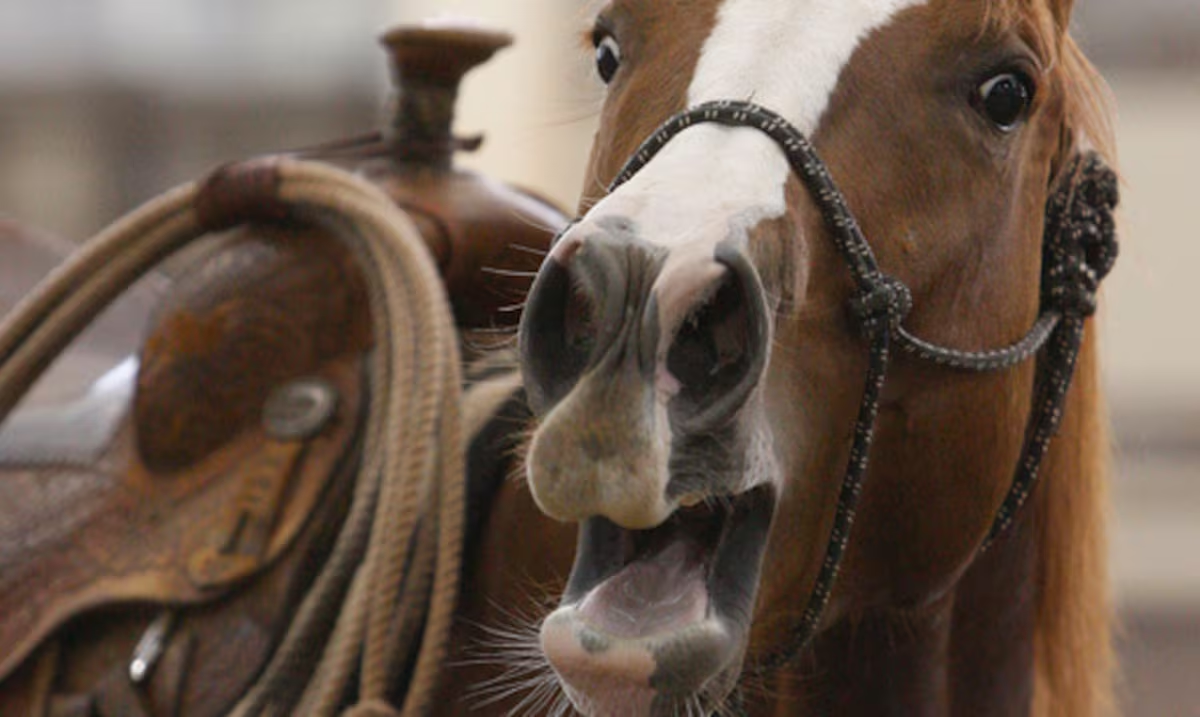
New York – Horses neigh to meet new friends, greet old ones, and celebrate happy moments like mealtime.
For a long time scientists have not known exactly how horses produce that characteristic sound, also called neighing.
The neigh is an unusual combination of high-pitched and low-pitched sounds, like a cross between a growl and a screech, that come out at the same time.
The serious tone thing didn’t have much of a mystery. It comes from the passage of air over bands of tissue in the larynx that make noise when they vibrate. It is a technique similar to that of human speech and singing.
But the acute part is more disconcerting. With a few exceptions, larger animals have larger vocal systems and tend to make deeper sounds. So how do horses do it?
According to a new study, they hiss.
The researchers slid a small camera through the horses’ noses to film what was happening inside them while they neighed and made another sound common to horses, the softest and most subtle of whistles. They also performed detailed scans and blew air through the isolated vocal boxes of dead horses.
They discovered that the mysterious high-pitched tones of the neigh are a type of whistle that begins in the horse’s larynx. The air vibrates the tissues of the larynx, while an area just above it contracts, leaving a small opening through which the whistle comes out.
It is different from human whistling, which we do with our mouth.
“I had never imagined there was a hissing component. It’s really interesting, and now I can hear it,” said Jenifer Nadeau, who studies horses at the University of Connecticut. Nadeau was not involved in the study, published Monday in the journal Current Biology.
Some small rodents, such as rats and mice, hiss like this, but horses are the first large mammals known to do so. They are also the only animals known to be able to whistle while singing.
“Knowing that a ‘neigh’ is not just a ‘neigh,’ but is actually made up of two different fundamental frequencies that are created by two different mechanisms is exciting,” Alisa Herbst with the Equine Science Center at Rutgers University said of the study in an email.
A big question that remains is how bicolor horse calls came about. Przewalski’s wild horses can do something similar, as can moose. But their more distant relatives, such as donkeys and zebras, cannot make those high-pitched sounds.
Two-tone neighing could help horses convey several messages at once. According to study author Elodie Mandel-Briefer of the University of Copenhagen, neighs of different pitch could help them express a more complex range of feelings when socializing.
“They can express emotions in these two dimensions,” says Mandel-Briefer.
This story was translated from English to Spanish with an artificial intelligence tool and was reviewed by an editor before publication.