
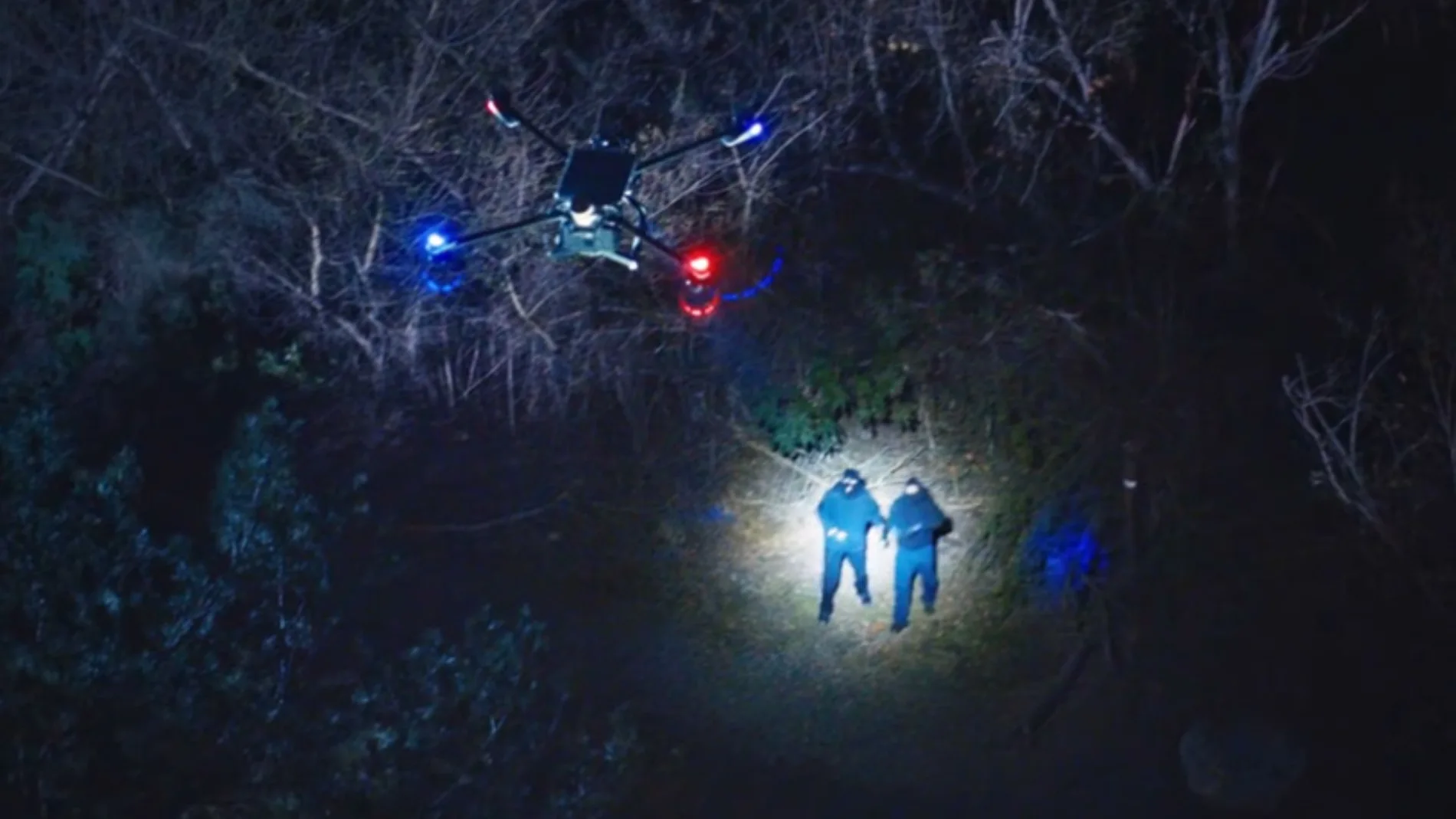
The startup BRINC has presented Guardiana next-generation drone that aspires to transform law enforcement response to emergencies throughout the United States. The Seattle-based company positions it as the 911 response drone (the emergency number in the US) most capable to dateas it combines advanced autonomy, long range and satellite connectivity in each unit through starlinksomething unprecedented in commercially available drones.
This new model, which will go into production at the end of this year, will have a flight range of 62 minutesa range of 13 kilometers which is more than double that of many current systems and will be able to reach a maximum speed of 100 kilometers per hour. BRINC defines it as ‘the first drone capable of chasing vehicles’.
Additionally, Guardian can carry numerous payloads from its cargo ‘nest’, including a flotation device, a defibrillator, epinephrine auto-injectors, the overdose reversal drug Narcan and more. The drone is part of a system that includes Guardian Stationa robotic base that automates battery swapping and redeployment.
This addresses one of the biggest limitations of drone first responder (DFR) programs, which is downtime between missions. Traditional systems usually require at least 25 minutes to rechargebut Guardian Station eliminates that delay by automatically swapping batteries in about a minuteand relaunch the drone immediately.
Guardian offers advanced imaging capabilities, with a camera 4K and total zoom 640xwhich, according to the company, can ‘provide clear vision from more than 300 meters away’. It also has two HD thermal cameras with zoom, focus 1,000 lumenslaser rangefinder, speaker system, certified weather resistance IP55 and a very powerful siren, capable of emitting 130dBroughly the equivalent of a jackhammer or a jet plane taking off.
An integrated Starlink satellite antenna Ensures connectivity in remote or disaster-affected areas. This allows the drone to maintain a stable data link even when traditional infrastructure fails, a critical advantage during emergencies.
‘First responder drone operations have been limited by camera capabilities, connectivity and contact charging. Guardian changes that paradigm, enabling true 24/7 operations and making advanced operations like vehicle chases possible. This is the drone I’ve wanted to build for a decade, and I’m proud of the entire BRINC team for making it a reality,’ says Blake Resnick, founder and CEO of the company, in a statement.
Seattle-based BRINC makes drones that are currently used by more than 900 U.S. cities. Cities typically pay several hundred thousand dollars a year for each drone, and contracts can run into the millions when more drones and capabilities are added. A year ago, Newport Beach, California, announced a five-year, $2.17 million contract with BRINC for seven drones.