
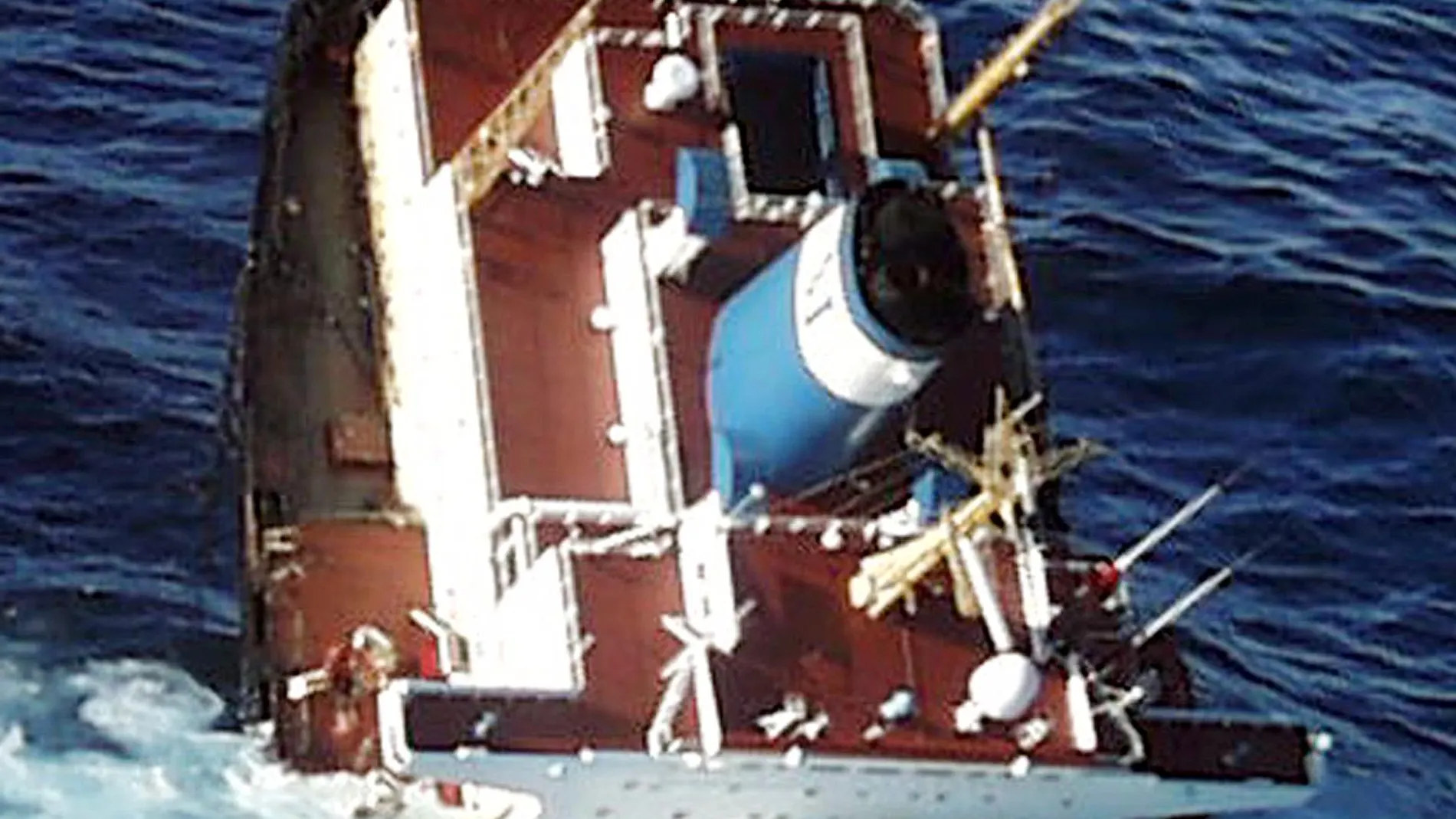
On January 22, the tanker M/T Chariot Tide, with Mozambique registration, was left ungoverned northwest of the port of Tangier, about 2.5 miles from the Punta Malabata shoals. The ship, sanctioned by the EU and the United Kingdom, came from the Russian port of Ust-Luga, and It was carrying at least 400,000 barrels of refined petroleum products. A damaged boat and bad weather: two basic ingredients for an environmental accident like the one that occurred on the Galician coast at the end of 2002 when the monohull Prestige spilled 63,000 tons of fuel, contaminating more than 2,000 kilometers of coast from Portugal to France. Under the flag of the Bahamas, she was operating beyond her useful life (her twins had been removed after inspection due to imminent structural failure) and began to list off the Costa da Morte. After several days adrift and without Spain, France or Portugal remedying the situation, it sank, causing the largest maritime ecological disaster in the history of Spain.
“Have we been close to an accident with a ghost oil tanker?” asked Rafael Muñoz Abad, doctor in the Civil Navy, maritime analyst and co-director of the Maritime Safety master’s degree at the International Campus for Security and Defense (CISDE) in a forum in La Gaceta de Canarias after the successful towing of the M/T Chariot Tide to the coast of Ceuta. “It has not been appreciated how close we have been to a new environmental accident,” he said.
The analyst responds to LA RAZÓN as one of the greatest experts in Spain on ghost fleets. A voice in the desert that warns about the dangers posed by this type of ship. Aging ships, flags of convenience, shell companies without assets or insurance, dedicated to illegal trade, mainly oil. It is the so-called ghost fleet. “The worst aspect of hydrocarbon transportation by sea,” for Muñoz.
A phenomenon that has grown since the war in Ukraine, but is not new in maritime transport. It is enough to remember the Prestige: «We were facing an operational prequel to the current phenomenon. Iran and Venezuela were already, and continue to be, patrons of the phenomenon shadow fleet. The basis of exploitation of this operational framework consists of bringing together a fleet of oil tankers under different exploitation formulas, without ruling out the ownership of floating assets, in order to avoid sanctions. A serious mistake is made by cataloging the dark fleet as a mere network of floating scrap metal or substandard ships. It is true that the most striking part are ships with more than 20 years of service, with IMO numbers 92XXXXXX…, expelled from their classification societies and registered in the worst flags of convenience; even, in the worst case, sailing without nationality or directly under a false flag. In many cases, they are authentic environmental time bombs that have been sold by their recognized shipowners to front companies created ad hoc for the new maritime panorama of sanctions against Russia. You can talk about anything in the dark fleet except homogeneity in its ships. I have seen tankers from the year 2024, with IMO numbers 99XXXXXX, doing freight related to the phenomenon,” he comments.
A more exposed country
The Atlantic coast of Spain and Portugal is a transit route for ships coming from Russia to China and India to avoid sanctions, which makes peninsular waters a space especially exposed to risks. «An accident with an oil tanker can occur anywhere, regardless of whether it is a dark fleet or a ship with a higher level of operational management. But the truth is that, The greater the density of maritime traffic in an area, the greater the probabilities of mishaps; And if we add to that factor a regular presence of ships from the ghost fleet, as happens in the international corridors of Finisterre, the Strait and the Canary Islands, the situation appears delicate for Spain. An accident with one of these vessels would be a ‘back to the future’ of the Prestige scenario, including the complexities, not to say the impossibility, of identifying the real shipowners, hidden behind trustees and front companies in third states, island or African, which would not be able to compensate the coastal State affected by an oil spill. Spain lives with its back turned to this reality, and the awakening can be very hard for a country that lives off of sun and beach tourism,” Muñoz Abad states emphatically.
The truth is that in recent months there have been several dangerous situations: “We have seen it these days with the double transit, first in the Canary Islands and later in the Strait of Gibraltar, of the tanker M/V Jin Hui. An oil product tanker with a false Syrian flag, outside of prestigious insurers and without the real owner being known. An especially serious case, since it has made double transit in waters very close to Spain, all without active institutional presence. A few days before, two large oil tankers passed by, also carrying false flags of Mozambique and Madagascar. The most striking was the M/T Deyna, with almost a million barrels of Russian crude oil, without knowing its owner or its insurer. The ship was captured in a French heliborne operation 48 hours after leaving the Strait heading east. But the climax occurred in the early hours of March 24, again in the Canary Islands, in the Spanish ZEE (Exclusive Economic Zone), with the transit of the M/T Paz, a leviathan 275 meters long and a million barrels of Russian crude oil, without a flag or with a false registration of Curaçao–Mozambique, without its owner being known since January 2025 and expelled from the Lloyd’s classification society that same year. The most worrying, and also surreal, thing is that the Navy announced a few weeks ago a maritime surveillance operation in the spaces around the Canary Islands. The archive of oil tankers related to the dark fleet that have been drifting in waters near the Canary Islands is as extensive as it is worrying.
Faced with this situation, the analyst first asks: “Why doesn’t Spain seize these ships that sail outside the law and are a serious environmental threat?” These are political decisions and a maritime policy that is as lax as it is indolent. Never point fingers at the Navy: they would be happy to enforce maritime law, but political calculation rules. Is there naval intelligence work to follow these episodes? And then he himself answers bluntly: “It seems reasonable that the country with the longest coastline in Europe, open to the Atlantic and with an archipelago in it, does not have a unified coast guard body. In exchange, There is a totum revolutum of entities in charge of law enforcement operations. Let’s not confuse SAR (areas in which Maritime Rescue operates) with law enforcement. Spain has the best maritime security agency in Europe, but it is a civil entity, not a coast guard body, and the Civil Guard, neither by tradition nor by training, can fill that space. It is urgent to create a coast guard corps to fill a gap that, in its absence, would correspond to the Navy. Spain carries out magnificent passive traffic control: vessels are reported to the DST (Traffic Separation Devices) and IALA procedures are complied with. Where it needs to be improved (and a lot) is in active control: in having a continuous presence in waters of influence, especially in the face of the phenomenon of the ghost fleet. It is not done, that is the reality. We are facing a problem of designing maritime policy and deciding which State Spain wants to be at sea. “There are means, there are also trained personnel: it is a political problem.”
Is the same thing happening in the rest of Europe? The truth is that the cases of danger related to the ghost fleet are not exclusive to the Iberian Peninsula nor do they seem to be stopping with the lifting of sanctions on Russian oil announced by the US administration. The Russian LNG tanker Arctic Metagaz activated the alert of the Italian authorities due to the risk of spillage off Valletta, in Malta, after a drone attack in mid-March. Under the Russian flag and 277 meters in length, it transported 900 metric tons of diesel and more than 60,000 of liquefied natural gas. The United Kingdom also reports several cases that have occurred in the English Channel, where “between two and three ships of the dark fleet transit each day,” Royal Navy officer Tom Sharpe tells The Telegraph. Your Prime Minister recently authorized the British Armed Forces to board and intercept sanctioned ships in transit and «The United States, France, Belgium, Estonia, Finland, Sweden, Germany, Italy, Norway and Latvia have boarded, detained or turned away ships in the last two years. The United States leads the list with eight, although some were not transporting Russian oil, but rather Venezuelan or Iranian. France now has four seizures, one of them in response to a ship suspected of launching drones into Danish airspace. Finland stopped to the Eagle S, accused of cutting underwater cables by dragging its anchor along the seabed. As we see, the problem of this fleet is broader than oil smuggling,” the newspaper details.
«The ghost fleet will continue to exist; The difference is that some of their ships, the older ones, will end up in scrapping, where they should have been before the invasion of Ukraine. Europe, energetically speaking, shot itself in the foot: the cheap and nearby crude oil that arrived from Russia now arrives in transatlantic freight from the United States, which means about ten more days of navigation and a clear increase in costs. The truth is that Russian fuel, somehow, has not stopped entering Europe and in third countries that act as ‘washers’ of origin. Morocco, Türkiye or India are examples of how Russian fuel can continue to reach our pumps under another designation of origin or by laundering bills of lading. It is a really uncomfortable issue that we prefer not to talk about. Spain does not have active control over these scenarios and, unlike France, the tankers of the ghost fleet transit nearby waters (including the EEZ) without a regular institutional presence, either through maritime patrol flights or naval deployment. A serious State at sea must know at all times who is sailing in its waters of influence, maintain a continuous presence and act to enforce international maritime law, especially in the face of these potentially dangerous transits and with the extensive archive of oil spills that we have in Spain,” Abad rules.
Piracy
►Fernando Ibáñez, director of CISDE, considers that the current complex scenario in the Middle East “could become even more complicated with the actions of the Houthis in the Gulf of Aden and the Red Sea. Not only would there be problems in the Hormuz bottleneck, but they would extend to the Bab el-Mandeb Strait and the Suez Canal, through which 12% of the world’s oil passes. Added to this are the actions of Somali pirates, which, although sporadic, continue to occur. In recent days, an Iranian fishing boat has been hijacked more than 400 miles off the Somali coast. It is likely to be used as a mother ship, from which to attack other merchant ships in the area. If the pirates manage to capture him, they would try to take him to shore and demand a ransom. It is reminiscent of the case of the bulk carrier Abdullah, for which five million dollars were paid two years ago. “That money generates a pull effect, attracting investors and more pirates,” he says.