
Two days after the start of the Iran war, the price of fertilizers had already skyrocketed. In these weeks It now reaches almost 45% more. This rapidity in the rise is what has led agricultural organizations such as Unión de Uniones to denounce possible speculation. “We have had skyrocketing prices for fertilizers and diesel for 20 days and cereal prices have not risen,” says Valentín García Fraile, member of the Unión de Uniones executive.
We are in the middle of the cereal cover fertilization campaign, but also at the beginning of the beet or rapeseed sowing. Given the situation, says Valentín, “some farmers are thinking about not planting or changing crops. The beet has a price already estimated in advance at 52 or 54 euros per ton, but if expenses skyrocket by 30% and the income is the same, it will be ruin. People want to take refuge in products that do not require so much fertilizer and expense, because there is no guarantee of profitability and, for example, changing corn for sunflower is less demanding in terms of the need for fertilizer,” he clarifies.
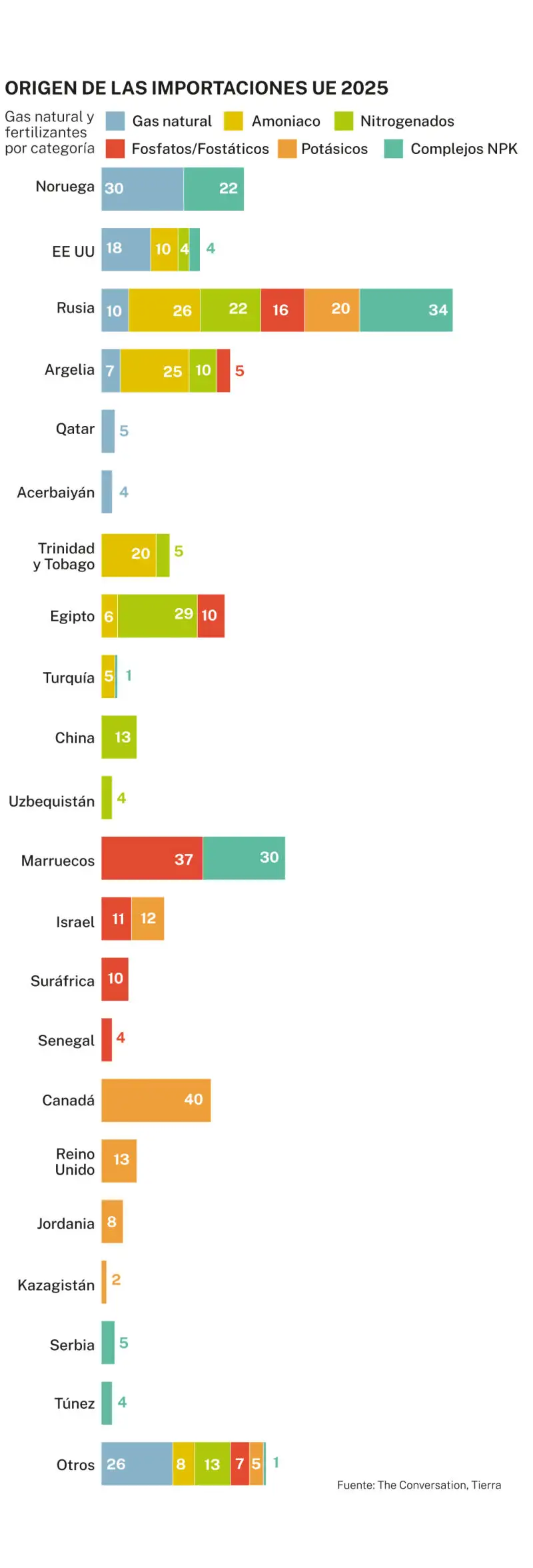
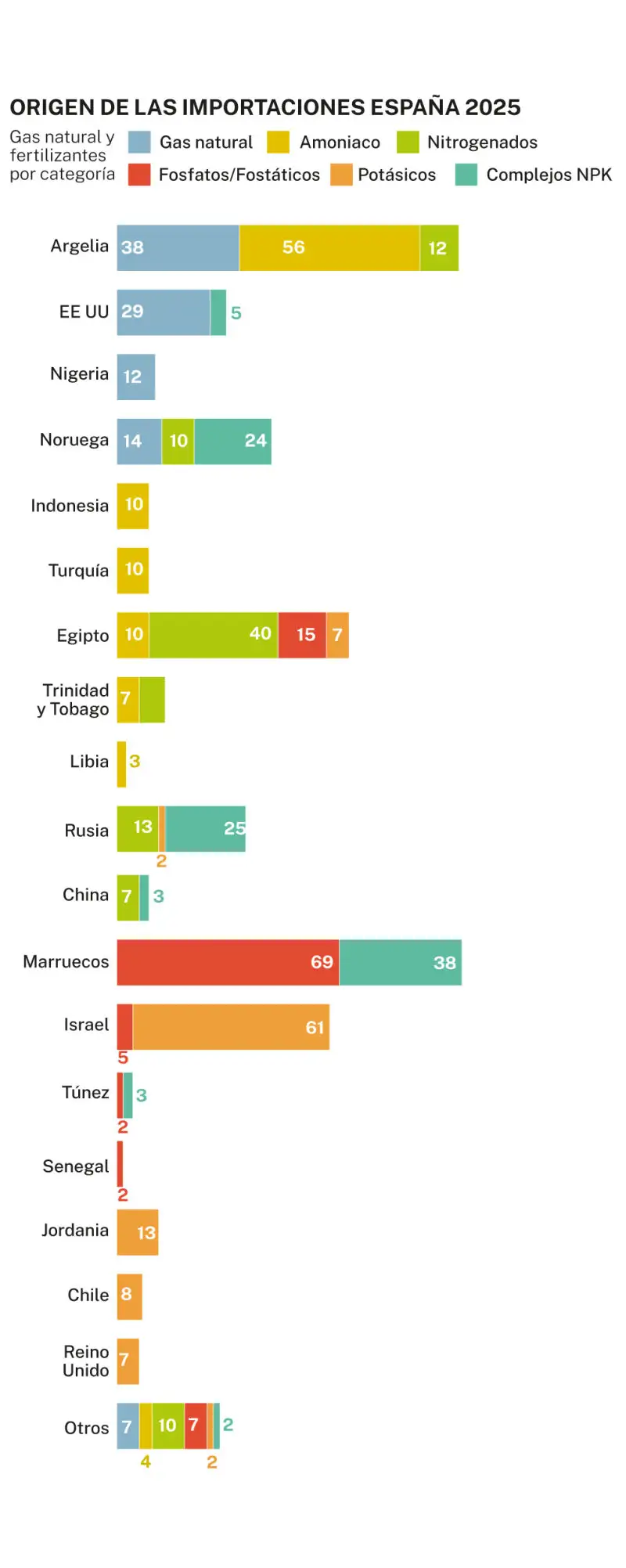
The Spanish Fertilizer Trade Association (Acefer), also in the middle of the campaign, explains that “being a commodity market, prices move quickly. As soon as the conflict began, prices at origin rose almost automatically; for example, in Egypt. There is less supply and demand also increases because we are in the middle of the campaign,” says Henar García del Olmo, general secretary, who insists that the biggest problem for this year lies in the slowness with which the market responds.
The speed with which a commodity market as global as that of fertilizers is affected is seen, for example, in QatarEnergy’s decision in early March to stop the production of urea after stopping the production of liquefied natural gas. A few days later, China, another major fertilizer exporter, imposed export restrictions to protect its domestic market from shortages.
Fertilizer, says Valentín García, “is irreplaceable and the difference compared to not fertilizing is that “a cereal can yield 70% less than a fertilized one.” These products are used for crop productivity; “They are the food of plants,” explains the general secretary of Acefer, who talks about the main compounds used worldwide: “nitrogen, phosphorus and potassium. Of these, the so-called nitrogenous (such as urea, ammonium nitrate, etc.) represent 70% of consumption and natural gas is basic in its production. Urea, natural gas and ammonia were exported from the conflict zone. Urea has risen in price and ammonia, therefore, too; making fertilizers in Europe is also more expensive.
The EU is not very self-sufficient in mineral fertilizers and the closure of the Strait of Hormuz is very worrying. 30% of the urea used to fertilize and approximately 25% of the ammonia pass through here. Furthermore, they recall from Acefer, “the sector had already suffered since the beginning of the year from the entry into force of the Carbon Border Adjustment Mechanism, which requires EU importers to purchase carbon certificates based on the emissions embodied in the imported product. An increase of between 10% and 30% in international prices of urea and nitrates was estimated..
bad years
“In areas of Castilla y León where nitrates have not yet been applied to cereal, increases of 30 or 40 euros per ton are an unaffordable outrage, especially because on this occasion the prices of cereals have not risen as they did at the beginning of the conflict in Ukraine,” says Valentín García. And the situation faced by European farmers is not new. Already during COVID, availability problems arose and during the war in Ukraine prices rose (up to a thousand euros per ton of urea, according to Euronews), but the cereal was also sold more expensive. Now, with cereal stagnant, urea is close to 550 euros per ton. Another medium, CNBC, states that “this crisis is worse, because it affects multiple producers. We’re not talking about one or two. “Everything that leaves Saudi Arabia, Kuwait, Qatar, Iran and the United Arab Emirates is affected.”
Famine
The situation affects globally, although not everyone equally. In the case of the United States, and as recalled by the Los Angeles Times, “up to 15% of fertilizer imports come from the Middle East and about half of the world’s supply of urea (a key ingredient) comes from the region, along with 30% of ammonia.” The Trump administration’s solution is to boost fossil imports from Venezuela, in addition to aid and compensation for losses.
The situation is much worse for the Gulf countries, which import up to 85% of the food they consume, and for African countries. According to an analysis by the UN World Food Programme, Up to 45 million more people could be acutely food insecure by 2026 if the conflict persists and oil prices remain high. This would raise the world total above current record level of 318 million people. «India, without a doubt, is one of the hardest hit. It exported rice to several Gulf countries. To get an idea of the magnitude, approximately 81% of the imports made by the Gulf are channeled through the Strait of Hormuz and have India as their axis. If we talk about wheat, 35% of imports from the countries in the area pass through here. The citizens of Saudi Arabia, Bahrain, Kuwait, Oman, Qatar and the United Arab Emirates will be the hardest hit,” comments Cristian Castillo, academic director of the Degree in Business Administration and Management at the Open University of Catalonia (UOC). The professor insists on focusing on “humanitarian aid to sub-Saharan Africa or areas of Asia and on another of the consequences if the conflict drags on: the semiconductor and chip market, as we already saw during the pandemic. One of the main manufacturers is Taiwan, which is why the focus is always on there and on the veiled threat from China. The other major manufacturer is South Korea. The Hormuz crossing is a priority for these products and any delay ends up affecting global production chains.
Solutions
Returning to Spain, the extra costs will end up being transferred to the purchase price. In fact, they are already doing it. The OCU states that the basket reached 320.78 euros per month in March, the highest level since it began to record prices in June 2024. Fruits and vegetables have had a rise of 5.78% in just 20 days.
Beyond the package of measures approved by the Government, farmers are asking for more long-term aid, such as a permanent reduction in VAT on agricultural inputs or “a professional diesel, a product that we need to be able to work,” says Vallentín García, and they point directly to the review of the agreements that the EU is signing with other regions: Mercosur, India and, this week, with Australia. From the fertilizer association, for their part, they ask for a delay in the application of CBAM.
Is it possible to replace fertilizers with organic fertilizer? In recent years, Acefer says, many soil analyzes have been carried out to apply only the necessary product. But the reality is, according to Valentín García, that “we could talk about 70%-30% of what can be covered by the organic matter on the farms. Nitrate and urea are chemicals; “Something can be substituted with slurry and chicken manure, but it is nowhere near enough for everything we farm in Spain.”