
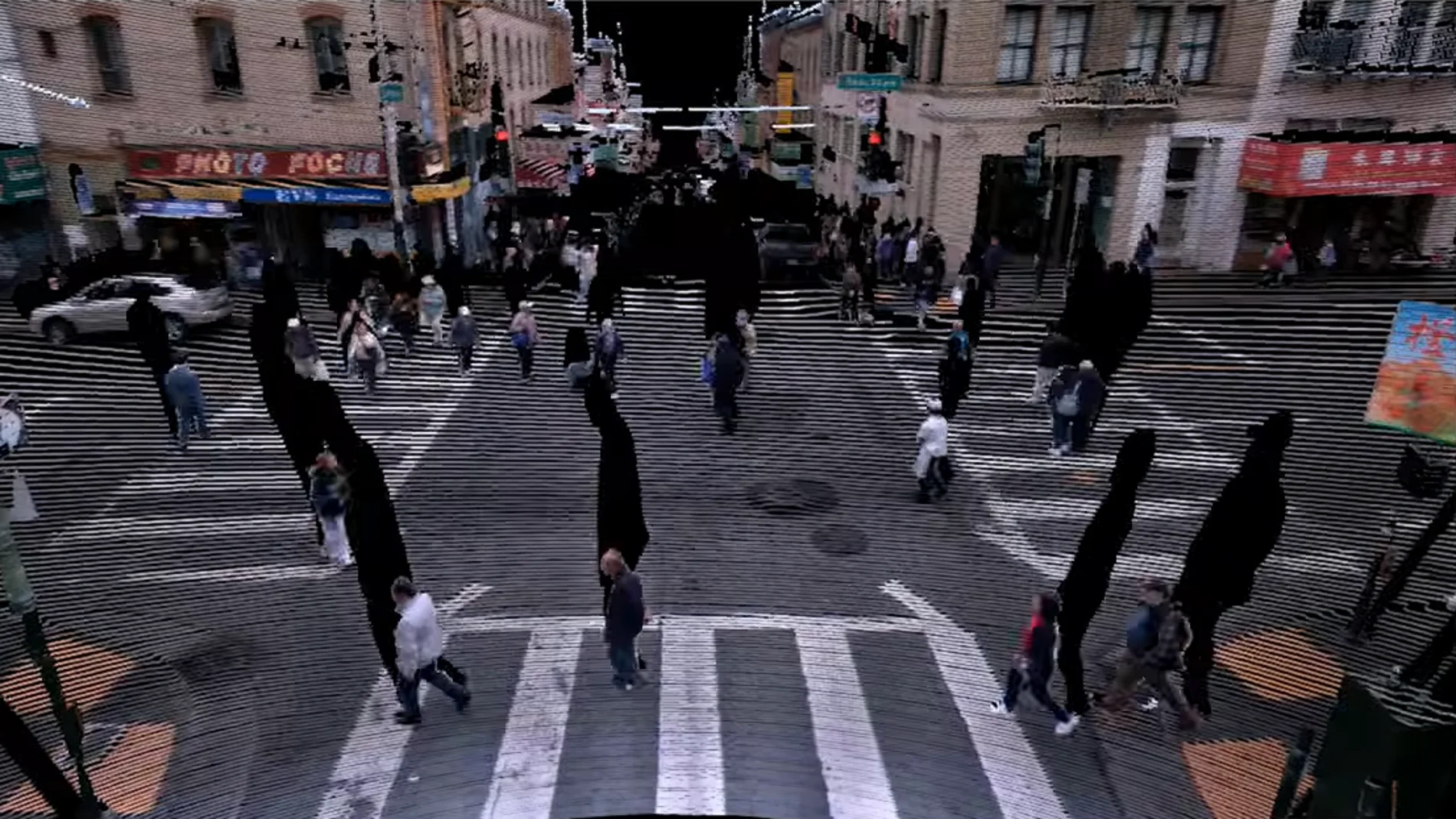
There are technologies that function as artificial senses. Radar allows you to “sense” objects at a distance. Cameras allow you to “see.” And LiDAR, a kind of eye made with lasers, has been, for years, one of the silent pillars of autonomous driving. Now, an American company has just given a step that could completely change that mechanical perception of the world: creating the first native color LiDAR.
To understand why this is important, it’s worth starting with how a conventional LiDAR works. The name comes from Light Detection and Ranging: a system that launches millions of laser pulses per second and measures how long it takes them to return after bouncing off objects, something similar to the bats’ strategy, only, instead of sound, they use lasers. With that information it builds an extremely precise three-dimensional map of the environment. Self-driving cars use these systems to “read” roads, pedestrians, signs or vehicles even in low light conditions.
But there is one important limitation: traditional LiDAR sees the world almost as a black and white point cloud. It detects distances, shapes and reflections, but does not really understand colors. To solve that, Current autonomous vehicles need to combine or fuse LiDAR data with conventional cameras. And there appears a huge technical problem: both systems see the world differently and must constantly synchronize.
Is as if a car had one eye that understands depth and another that understands color, but it will take them both a fraction of a second to agree on what they are looking at. In human driving that would be dangerous. In autonomous driving, more.
The new system presented by the Californian company Ouster attempts to eliminate that separation. Its Rev8 technology integrates in a single sensor the three-dimensional information and the “native” color of the environment, generating colored 3D maps point by point in real time.
The difference may seem subtle, but technically it is huge. There is no longer a need for artificial intelligence to “guess” that a red light belongs to a traffic light located at a certain distance or that an orange sign indicates roadworks. The sensor itself simultaneously delivers depth, position and color perfectly aligned from the origin.
That reduces errors, speeds up processing, and simplifies autonomous vehicle hardware. It also eliminates much of the calibration between cameras and sensors, one of the most delicate and expensive processes of these systems. According to Ouster engineers, the new chip can detect up to 20 trillion photons per second and process more than 10 million three-dimensional points every second, with temporal precision of picoseconds—trillionths of a second.
The simplest comparison would be Think about the evolution between the first GPS and current interactive maps. A classic LiDAR knows that “there is something” ahead and where it is. A native color LiDAR begins to understand what exactly that something is. And that can have much broader consequences than self-driving cars.
Those responsible for this advance believe that this type of sensors will be essential for the so-called world models: three-dimensional models of the real world that They use humanoid robots and physical artificial intelligences to learn how to interact with their environment. In other words: they will not only allow a car to drive better. They could also help robots understand complex spaces almost as we do.
The technological race here is intense. Chinese companies like Hesai have also presented similar sensors capable of integrating color and depth directly into the hardware, in a battle that It is no longer just about “seeing further”, but about interpreting reality better.
Even so, it is advisable to maintain some caution. Autonomous systems continue to face difficult problems: heavy rain, fog, snow, reflections or dirt can disrupt even the most advanced sensors. Engineers specialized in robotics remember that the real world remains much more chaotic than any technological demonstration. But the conceptual leap does seem important.
For years, autonomous vehicles have tried to reconstruct the world by combining different pieces of information: cameras, on the one hand, lasers on the other, radars apart. Native color LiDAR suggests something different: a unified perception from the first moment.
And perhaps that is the real breakthrough. Don’t make machines see more. But get them, for the first time, to begin to look at the world in a way that is a little more similar to us.