
Few equations have achieved as much fame as E=mc2. Three letters, an equal sign and a squared number were enough to change our way of understanding the universe. Albert Einstein showed that mass and energy are not independent realities: The energy corresponding to a body at rest is equal to its mass multiplied by the square of the speed of light. Because this speed is enormous, even a small amount of mass equals an extraordinary amount of energy.
The equation, however, does not by itself explain all the processes by which energy is transformed or exchanged in nature. And it is precisely in this field that a new study led by Luca Comisso, from Columbia University, in the United States, and Felipe A. Asenjo, from the Adolfo Ibáñez University, in Chile, is located. Published in Physical Review Dthe study presents a mathematical framework to describe a phenomenon the authors call “gravitational reconnection.”
The proposal does not correct Einstein or add a term to his famous equation. The scientists have found a different, although mathematically equivalent, way of expressing the equations of general relativity. In doing so, they have identified a similarity between the behavior of certain gravitational fields and a process long known in plasma physics: magnetic reconnection.
To understand the connection, it is worth looking at the Sun. Its magnetic field forms structures that stretch, twist and reorganize. Under certain conditions, some lines on the field may break their previous configuration and connect in another way. ANDThis change, known as magnetic reconnection, allows energy stored in the field to be released and transferred to the plasma particles. The result can be a solar flare, an explosion that releases enormous amounts of energy.
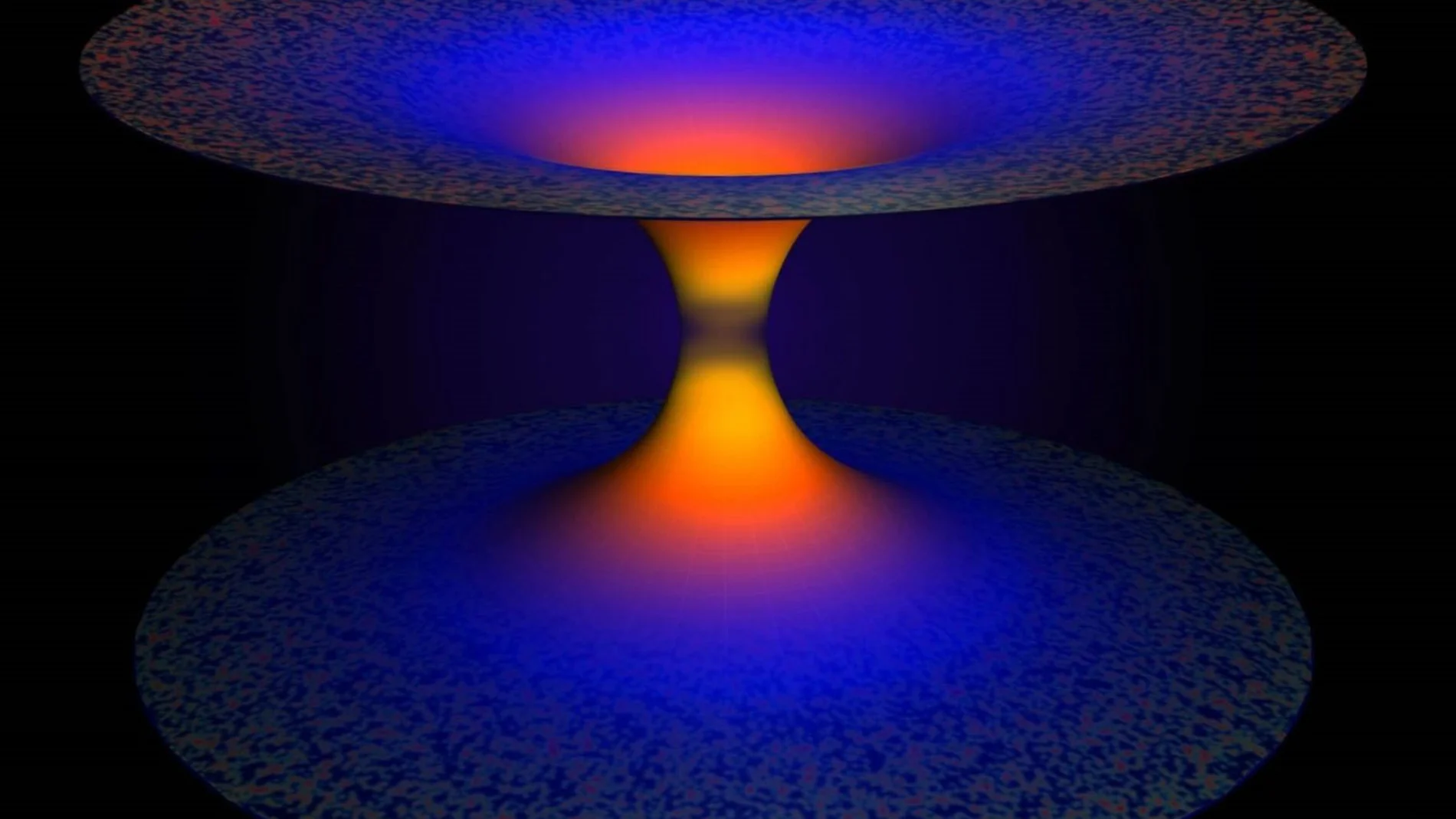
Comisso and Asenjo propose that an analogous process exists in gravity. The difference is that, while magnetic fields are usually represented by lines, the mathematical description of gravity in four-dimensional space-time uses structures that can be imagined as sheets or surfaces. They are not physical objects that we can see or touch, but rather mathematical tools to represent the organization of the gravitational field. Under ideal conditions, these structures retain their connectivity. But If the conditions that maintain that configuration are no longer met, the connections can change. lThe authors call this process gravitational reconnection. and show that it can modify the exchange of energy and momentum between the gravitational field and matter.
The idea is important because it offers another way to investigate how gravity behaves when space-time is subjected to extreme conditions. One of the scenarios in which it could be useful is the collision of black holes. When two of these objects merge, space-time warps in an extraordinary way. and the phenomenon produces gravitational waves, undulations that propagate through the universe and that can be detected from Earth.
Today, studying these events requires complex computer simulations. The new approach could help identify fundamental rules of the process and, in the future, improve predictions about the energy that is released or the signals that these events could leave in gravitational waves. But there is an essential caution: gravitational reconnection is, for now, a theoretical proposal. The study establishes a mathematical framework to describe it, but it remains to be determined how it would develop in specific astrophysical scenarios. and whether it would produce observable effects.
What does this mean for E=mc2? That Einstein’s formula is still intact. The equivalence between mass and energy is not in question. The new work addresses a different question: how the energy exchanged between gravity and matter can change when the structure of the gravitational field is rearranged. More than a century after Einstein formulated the equations that describe gravity, physicists continue to find new ways to explore everything they contain. It is not about replacing the most famous equation in science, but about discovering what other mechanisms can be hidden in the mathematics that describe the universe.