
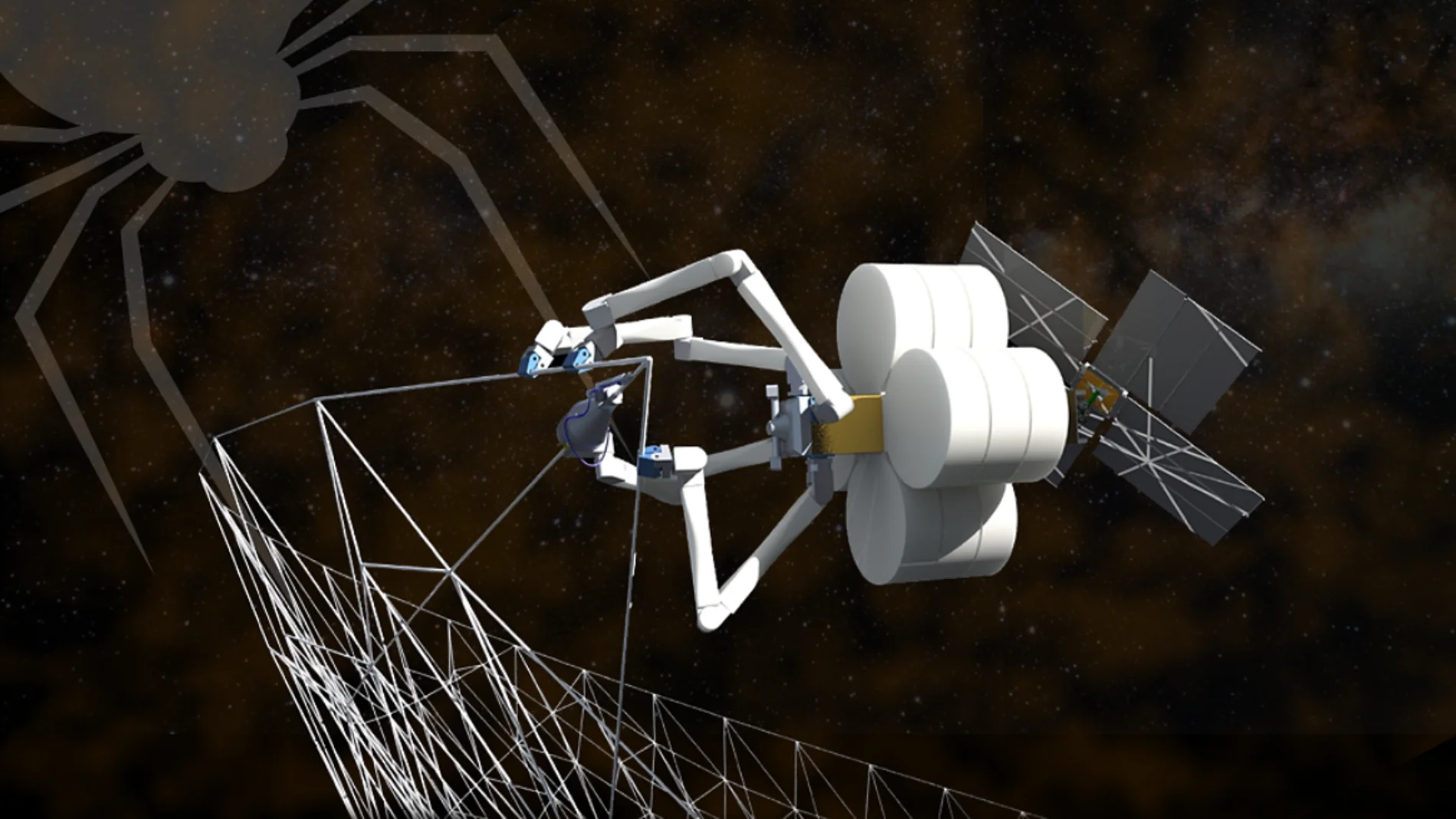
Some ideas take decades to find their moment. Not because they are impossible, but because the technology is not yet available. NASA tried it years ago. He imagined a kind of “space spider”: a robot capable of weaving giant structures in orbit, thread by thread, as if the void were an extension of its web. The project was calledSpiderFaband proposed something radical: stop launching folded satellites… to start building them directly in space. The idea was as surprising as it was ahead of its time. But it never took off.
However, that concept reweaves its threads. A team of scientists from the Shenyang Institute of Automation in China, led by Haitao Luo, is developing technologies that directly recall that vision: robotic systems capable of manufacturing and assembling structures in orbit, without having to send them complete from Earth. It is not exactly the same robot. But yes the same idea. One that they have described in Space: Science & Technology.
Every object we send into space shares the same restriction: the size of the rocket.. Everything must fit inside, everything must be folded, compressed, designed with that initial moment in mind: the launch. Solar panels that unfold like fans. Antennas that open in orbit. Structures that go from compact to giant in a matter of minutes. For now the whole system works, but there is a limit. And that’s where the idea of the “spider” comes in.
Instead of launching a complete structure, raw material is sent, for example, carbon fibers, and a robot that “weaves” it directly in spacebuilding antennas, panels or even solar stations of dimensions impossible to launch in one piece. It is no longer about deploying, but about manufacturing.
Luo’s team has presented the essential elements to create the new “space spider”. The study “proposes using translucent PEEK (carbon fiber/polyetheretherketone) joints 3D printed to connect tubular units, reinforced by transmission laser welding. The effects of temperature and welding speed were analyzed on the strength of the joint, and the microstructural characteristics of the weld were observed on a microscopic scale. Finally, a satellite dish structure was fabricated by cutting CF/PEEK composite tubular units into different lengths, verifying the feasibility of this method for in-orbit construction.”
In simple terms, the proposal is a robot with in-orbit assembly capacity and materials that can be deployed or manufactured outside of Earth. “Building structures in orbit eliminates the need to fold them inside a rocket or worry about size limits – adds the study -. “Parts can be manufactured, joined and assembled directly in space.” If this technology matures, space exploration could change its logic.
This movement does not occur in a vacuum. It is part of a broader trend: the automation of space. China has already tried, for example, satellites with robotic arms capable of docking and performing complex operations in orbit, including refueling.
The idea is the same in all cases: transfer to space tasks that previously could only be done on Earth. If the “space spider” becomes a reality, it won’t just be a new tool, it will be a new way of thinking about space. AND a new stage in the space race, with China clearly challenging NASA.