
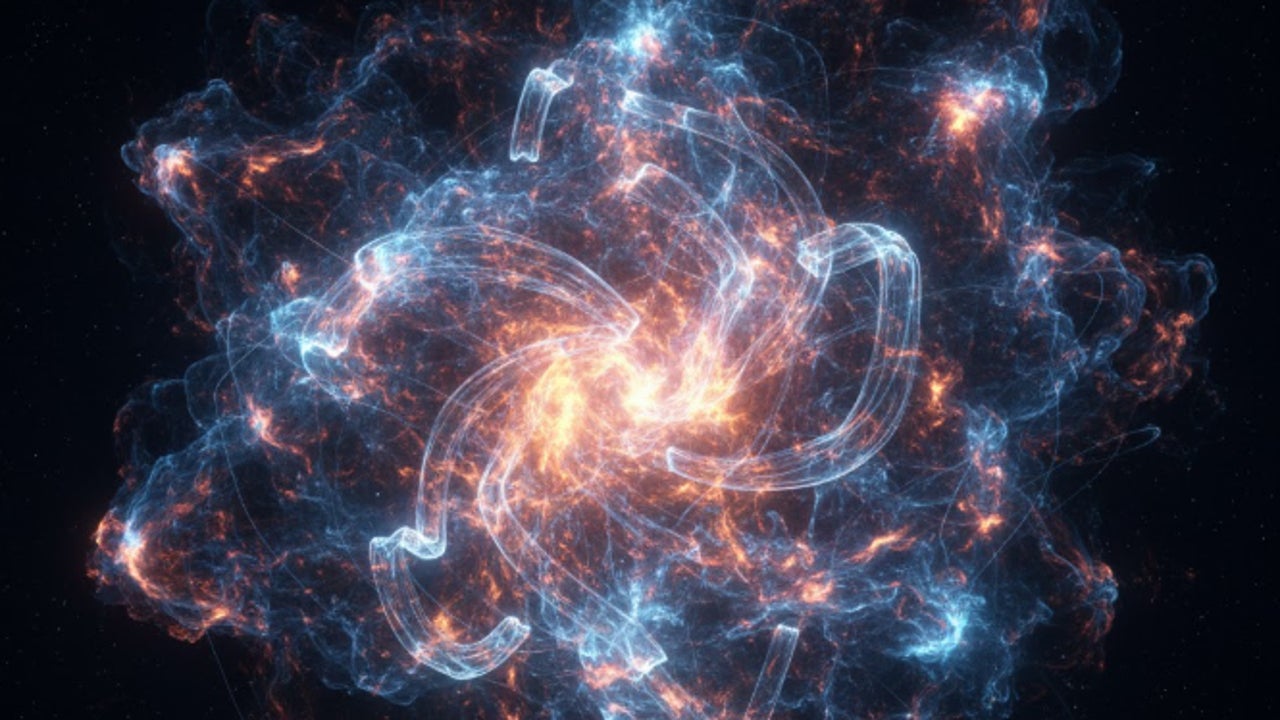
Everything that happens in the universe, from the fall of an apple to the explosion of a supernova, can ultimately be explained by four fundamental forces. If we get down to the basics, gravity holds planets and galaxies together; The electromagnetic force governs light, electricity and magnetism; the strong nuclear force keeps atomic nuclei cohesive; and the weak nuclear force is responsible for certain types of radioactivity and the reactions that power the Sun.
Of those four, gravity is the most familiar, although it is also the weakest. However, on cosmic scales, there is another force that is surprisingly dominant: electromagnetism. Magnetic fields traverse entire galaxies, shape stellar winds, deflect cosmic rays, and can influence the formation of cosmic structures. And yet, its origin remains one of the greatest enigmas of modern astrophysics.
Until recently, scientists did not know if these magnetic fields arose with the first stars, or if they already existed before, in the first moments after the Big Bang, when the universe was a soup of expanding plasma. Now, a new study from CERN and the University of Oxford, published in Proceedings of the National Academy of Sciences (PNAS)contributes one of the strongest clues to date: magnetism could have arisen spontaneously from electrical fluctuations in the primordial plasma.
The researchers combined laboratory experiments with numerical simulations that recreate the conditions of the early universe. In the experiments, carried out with high-energy plasma beams, they observed that small irregularities in the electric fields could generate microscopic currents which, in turn, gave rise to magnetic fields. The most striking thing is that these fields did not require prior structures: a minimal asymmetry in the distribution of charged particles was enough.
According to the study, this phenomenon, known as the Biermann effect, could have acted in a similar way in the early cosmos. In the first fractions of a second after the Big Bang, when the universe was composed of protons, electrons and photons in an extremely hot soupany fluctuations in density or temperature could have produced tiny magnetic fields. Over time, the expansion of the universe and the movement of plasma would have amplified them to the scales we observe today, spreading across galaxy clusters and cosmic filaments.
The finding is important because it helps explain how cosmic magnetism was “seeded” without the need to invoke more exotic mechanisms or arbitrary initial conditions. It also connects particle physics with cosmology, showing how phenomena that we can reproduce today in the laboratory, such as plasma dynamics, were decisive in modeling the universe on a large scale.
As the Oxford team points out, understanding the origin of magnetism is not just a theoretical curiosity. Magnetic fields influence the formation of stars, the evolution of galaxies and the propagation of cosmic radiation. Understanding when and how they appeared can offer us a more complete view of the history of the cosmos.…and remind us that, even in the quietest corners of space, the universe has never stopped vibrating with invisible forces.