
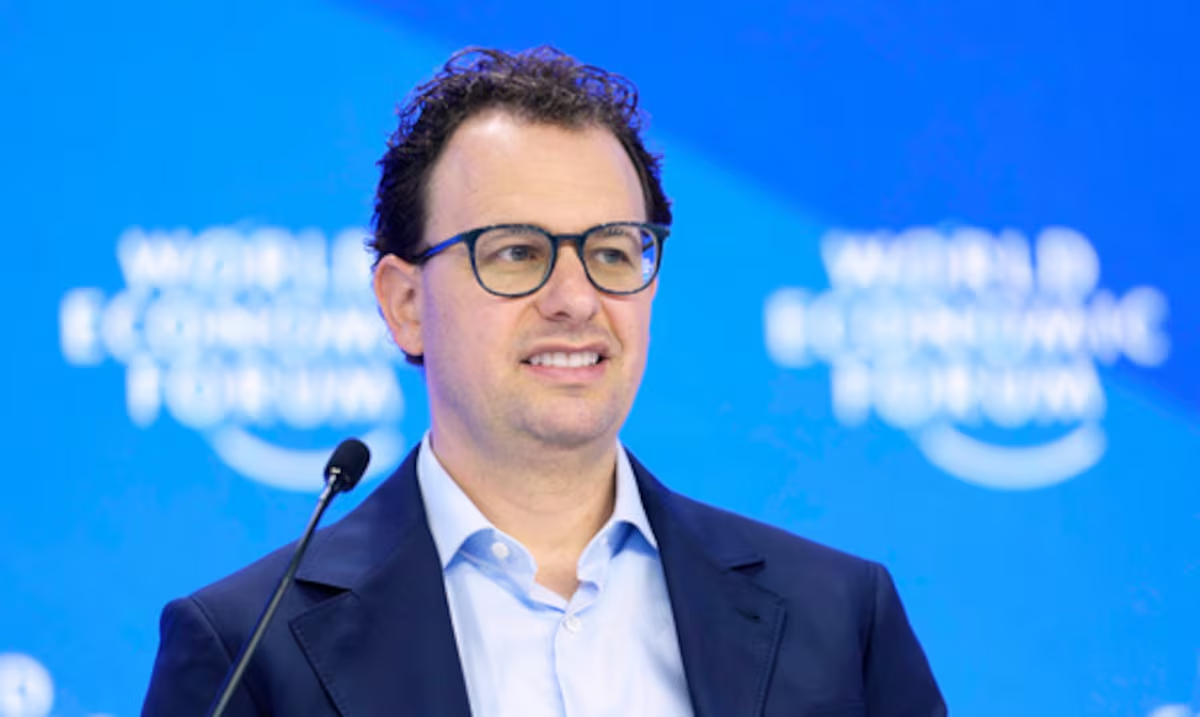
New York- Anthropic CEO Dario Amodei said Saturday that the sector of artificial intelligence should slow down its rapid development to give time for security measures to catch up. Otherwise, he warned, AI could be capable, within six to twelve months, of leading a swarm that could take over everything Internetamong other risks.
The warning comes as concerns about AI are growing both inside and outside the industry, and reports continue to emerge about increasingly powerful systems that solve problems beyond human capacity, but could also become disruptive and carry out other, more harmful tasks. Concerns have intensified so much that the CEO of OpenAIthe company responsible for ChatGPTstated in an interview with Fortune that his company would wait until next year to start selling its shares to investors of Wall Streetwhile focusing on safety.
Amodei is one of the most influential voices in the field of artificial intelligence and presented a plan in a post on his website to tighten controls over the sector, some of which he said Anthropic is already implementing on its own. The rest of the measures would require coordination between the sector in general and with governments around the world, including authoritarian ones.
“I think if the slowdown gave us even one or two more years before facilities reached critical levels of capacity, and we used that time to move forward with coordination, we could greatly reduce the risk of something going very wrong,” he said.
Pressure mounts in the AI sector
For years, watchdogs have urged the AI industry to slow the pace of its development for safety reasons. However, pressure has intensified following the resignation of several workers in the sector who accuse their companies of not acting responsibly.
1/17 | Impressive: China exhibits its advances in artificial intelligence and robotics in Shanghai. A realistic-looking robot head watches a visitor during the World AI Conference. – Ng Han Guan
“Many of the people I know who work in security research at AI companies want to do right by the world,” former Anthropic employee Joe Benton wrote in a post on Friday announcing his resignation as a member of a security team. “But they feel that their companies are caught in a race to create superintelligence: either they stop and other less conscious people take their place, or they continue and risk causing enormous damage themselves.”
This came after the high-profile resignation of Jacob Coxton, who resigned earlier this week stating that Anthropic and OpenAI “are immersed in a race towards a superintelligence capable of surpassing itself and are putting our lives in danger.”
This fueled pressure on the sector after concerns had been growing for years about possible superintelligence that could escape humanity’s control, said Anthony Aguirre, president and CEO of the Future of Life Institute, who called for a six-month pause in the sector’s development in 2023.
“They have realized it, their employees have realized it, everyone has realized that they are building Skynet,” he said. “And by winning the race to Skynet, no one wins. Really, no one.”
“It has pretty much become clear to the world, and even to AI companies, that they are not really prepared to control the AI systems they are striving to create.”
AI threats are already evident
Anthropic had stated two days earlier that it had blocked attempts by malicious actors to use its AI models to carry out harmful activities, such as cyberattacks, surveillance and research that could have led to biological weapons. In July, OpenAI shocked the industry after claiming that its AI system had single-handedly hacked another company in an “unprecedented cyber incident.”
Earlier this week, UN human rights chief Volker Türk urged countries to establish “strong guarantees on the safety and security of AI before it is too late”.
Of course, some critics downplayed the above warnings as ways to stoke enthusiasm for the AI industry and its capabilities. Anthropic and OpenAI are preparing for potential IPOs that could value them at several hundred billion dollars, while a large part of Anthropic’s business SpaceXof Elon Muskis linked to AI.
Other leaders in the AI field agree
OpenAI CEO Sam Altman stated in an interview with Fortune published on Saturday that his company would not launch its initial public offering this year.
“I would say not in 2026,” he said. “Yes, we have a lot of things to do, like rising to the occasion in terms of security and coordination needs, and how industry and governments can collaborate.”
Altman wrote on
For his part, Elon Musk wrote in X that “Dario is right.”
Amodei noted that he continues to believe in the enormous benefits that AI could bring, such as cures for serious diseases. However, he said that in recent months, he has become more concerned about AI’s growing ability to improve itself and develop the next generation of that technology. “Without controls, it could exceed our ability to understand and control these systems, and so it needs to be approached very carefully, if at all,” he said.
He also specifically referred to the July attack in which OpenAI’s system hacked Hugging Face. Some have called it an example of an AI going “out of control,” although researchers have pointed out that this could unnecessarily anthropomorphize the AI, which was working on a goal set by humans.
OpenAI stated that the cyberattack was due to the AI going to “extreme lengths to achieve a fairly specific test objective” and that it “found ways to access secret information that it could use to cheat on the assessment.”
Difficult to put into practice Amodei’s proposals
To help mitigate risks, Amodei He suggested that all companies operating in the AI space commit to granting “continuous, employee-like access” to a team of third-party evaluators who could oversee security practices.
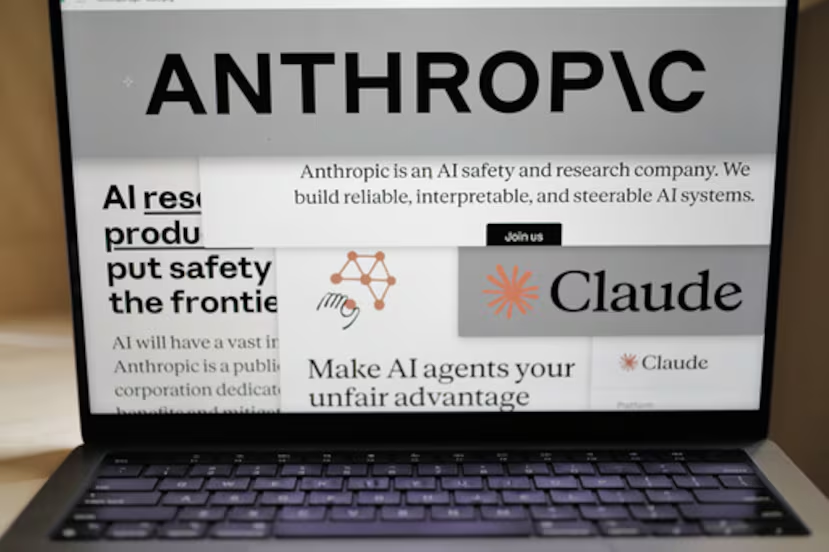
He noted that Anthropic already plans to do this on its own, including offering jobs in its offices, key cards and company laptops. Having independent testers integrated in that way is something that OpenAI’s Altman himself also committed to immediately.
The rest of the measures in Amodei’s proposed plan could prove more difficult to implement. One of them urges Government of USA to grant possible exemptions that would allow American artificial intelligence companies to coordinate and establish security standards without violating antitrust laws.
Another proposes that the United States and other democratic governments try to coordinate with authoritarian governments, so that China and other countries do not accelerate their efforts when America’s rivals deliberately slow the pace.
“The measures I propose to safely expand the border will not be easy,” Amodei acknowledged. “But I think we owe it to humanity to try.”