
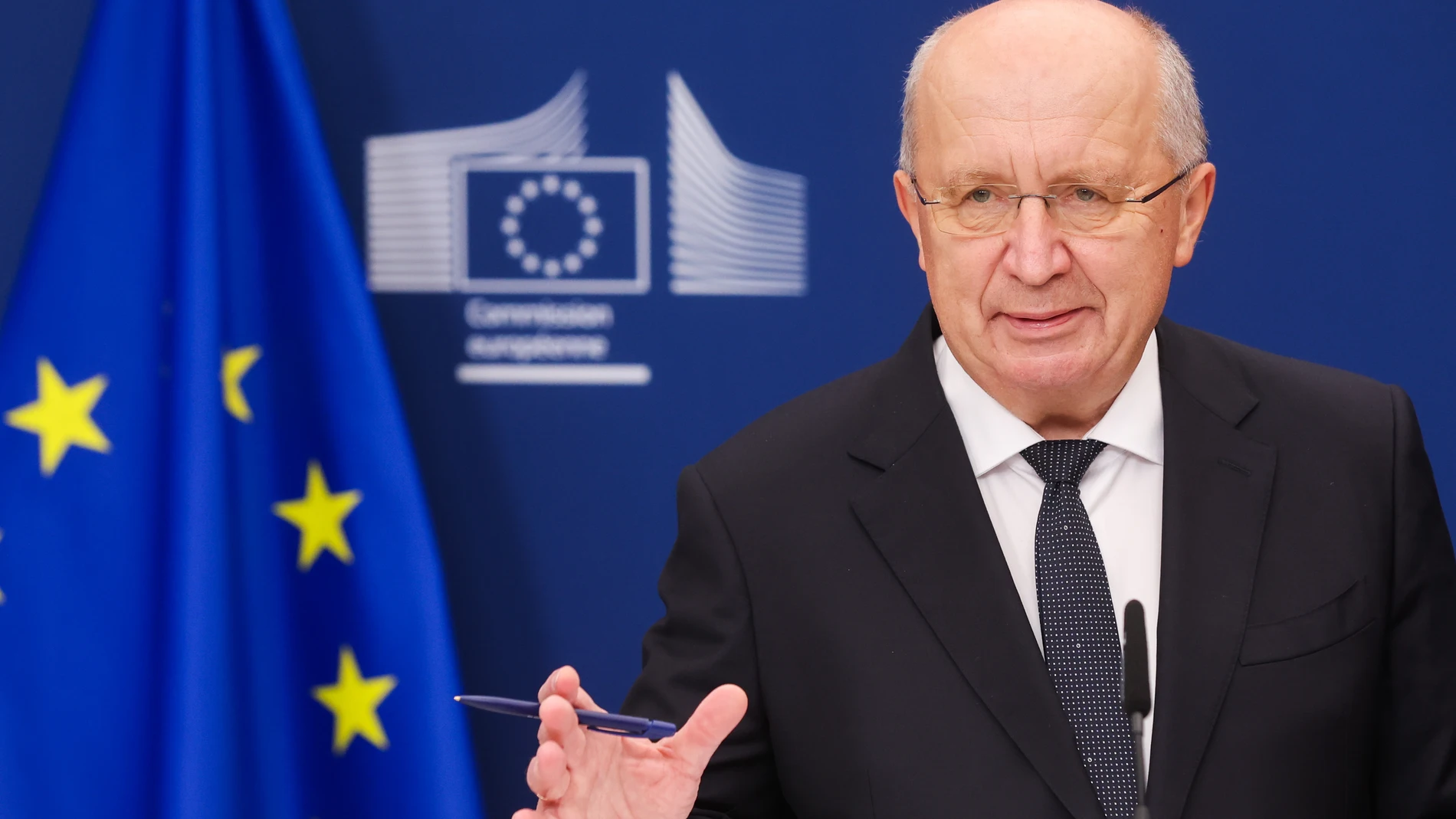
The European Union is going through one of its most complex geopolitical moments. Washington’s erratic policy and the growing tensions with Russia derived from the war in Ukraine have forced the Twenty-Seven bloc to reinvent itself so as not to lose influence in an increasingly hostile international context. Andrius Kubilius, European Union Commissioner for Defense and Space and former Prime Minister of Lithuania, knows this firsthand.
The experienced politician has the complex task of promoting the defensive capabilities of the Union, for which he considers it essential to speed up decision-making, improve cooperation between member countries and address the fragmentation of European industry, as he explains to LA RAZÓN from the European Parliament in Strasbourg. Just a few hours earlier, the President of the Commission, Ursula von der Leyen, had announced the creation of a new European Security Council that sees the leaders of the EU and other allied countries at the same table. “A topic very close to me,” acknowledges the commissioner.
Q: What will this new Security Council consist of?
A: There are many questions about how it will be created, what its legal basis will be, whether it will be based on an existing treaty or whether a new treaty will have to be signed between its members. I have been talking about this for the last year and there are many different opinions among jurists, so the debate will probably continue, but we will have to come to a very precise definition. The President of the Commission made it very clear that the Council should be composed of the leaders of countries that would include not only Member States, but also, and this is very important, Ukraine, Canada, the United Kingdom and Norway. Each of them can bring very specific military experience, especially Ukraine, and that will make us much stronger. How that experience will be used and what exactly we will do is still too early to say.
Why is Russia intensifying its hybrid attacks against the EU?
We can only guess. One possibility is that the Russians are starting to get nervous because the war they waged against Ukraine is not going so well and the Ukrainians, with the help of the EU, are capable of both defending themselves and causing harm to Russia, for example. Perhaps the second reason is that Russia really wants to test the ability of the European Union and NATO to defend their member states. The question is whether this escalation will continue as before, progressively increasing the intensity of their provocations, or if they will opt for something much more radical. That is why we need to develop our defense capabilities very quickly. We must be prepared to respond to Russia with measures that are as painful as those they are taking against us.
What measures are we talking about?
It is not something that should be discussed publicly. But the President of the Commission has said that we need to have a protocol against hybrid threats, a list of all the measures that we can use. That is, without a doubt, something very necessary and we will work on it.
To what extent are EU sanctions against Russia really working?
They are working; They are hitting the Russian economy, which is in a bad situation. But, even so, for them it is still enough to continue the war and carry out all those provocations against Europe. Perhaps we need to understand that sanctions alone are not going to stop Russia’s behavior. We have to find ways to respond to Russian provocations in a more agile, more effective and cost-effective way, to really demonstrate to the Russians that their provocations are not going to go unanswered. We do not want the escalation to reach very dangerous levels. But we must also understand that our fear of escalation is precisely creating a temptation for Putin to continue escalating it. If we do not respond, Putin understands that he can continue moving forward.
Do the interests of NATO and the EU differ?
No, NATO’s interests are the same: protect Europe. But NATO is also going through a fairly profound transformation, initiated by our transatlantic partners, by the United States, when they began to ask us Europeans to apply the so-called “NATO 3.0” strategy, based on the principle that we, Europeans, must assume in Europe the main responsibility for the conventional defense of the continent. So we have to be prepared for it. If until now the United States played the most important role in the defense of Europe, going forward that can no longer be the case.
What role does Spain play in European defense?
Spain is a very strong partner. European defense is based on the principle of collective defence, which means that Member States must take care of their own security and invest in capabilities defined by NATO capabilities objectives. These objectives that NATO has agreed with the different member states, including Spain, require national investment. That is why NATO members agreed to increase their defense spending to 3.5%. I know that Spain has some doubts about this. I hope that it will find a way to fulfill its obligations regarding European collective defense. Spain should set an example. And, of course, it plays and will continue to play a very important role in both the maritime defense of the Atlantic and the Mediterranean. We hope that the Mediterranean region will also become very active in promoting some type of pan-European project.
Do you think that your political experience in Lithuania has given you a different perception of the threats to Europe than that of leaders of countries further away from Russia, such as Spain?
Not at all. Many of the issues I have spoken about were also raised by the President of the Commission in her speech. If you look at opinion polls among voters in different countries, you will see that defense and security are a priority for everyone. So it would be positive if national politicians followed that same line. Of course, there may be a different perception of threats. For us, the biggest threat is Russia. For Spain, Russia may be far away, but, for example, all the problems in the Middle East, the war with Iran and so on can also generate a perception of threat in the Mediterranean region. That is why I consider that Europe is prepared to invest much more in defense and I hope that Spain follows that path.