
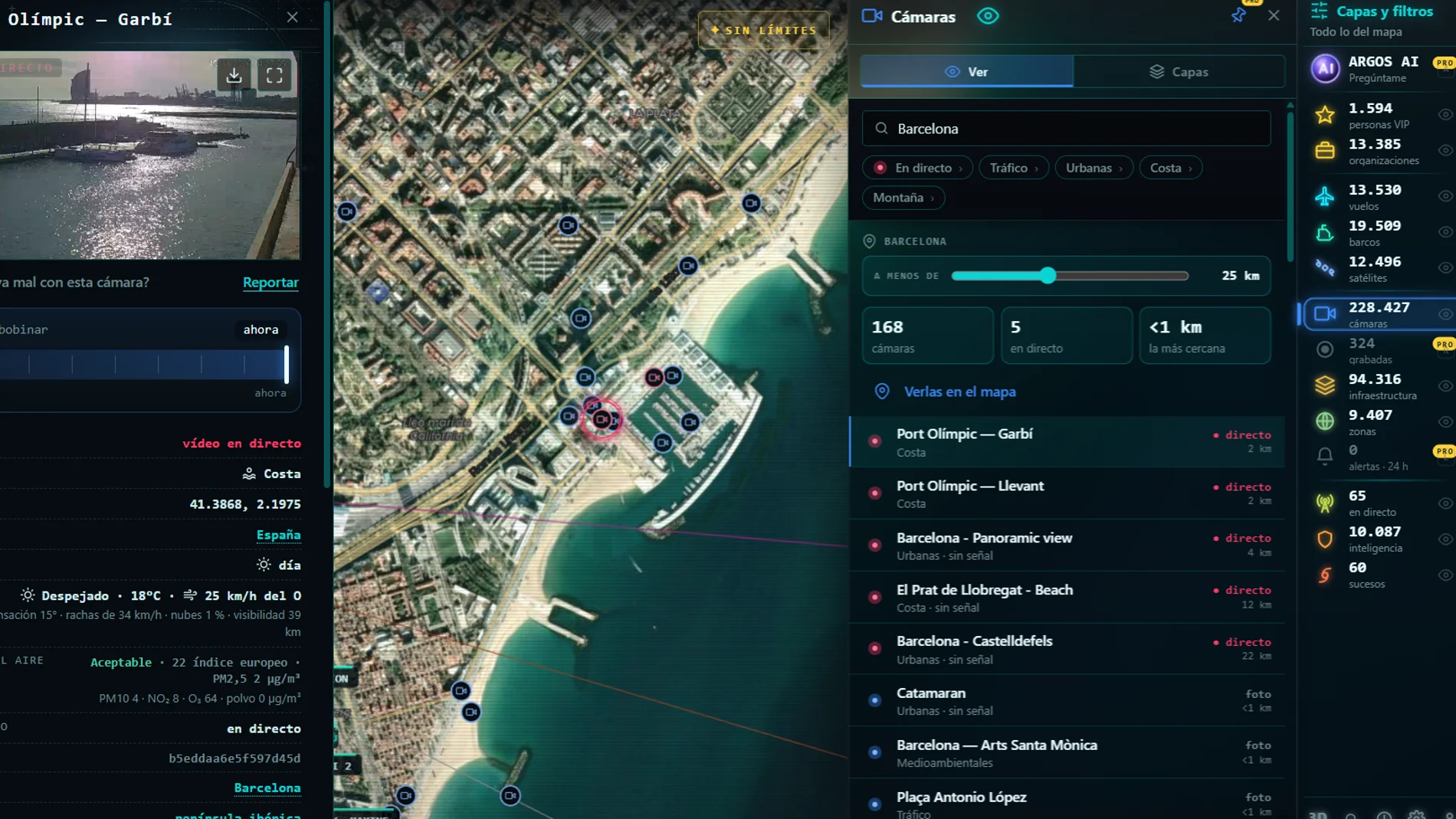
From a road in Asturias to a port in Japan, a beach in the Caribbean or a ski resort in the Alps. All you have to do is open a website to see thousands of places on the planet without leaving home. Argos Atlas ensures bring together more than 200,000 public cameras from more than 190 countries on a single interactive map. The figure is impressive, although it is worth specifying what it means: These are not all existing cameras, nor are they all surveillance devices. The catalog includes traffic, mobility, cities, ports, airports, beaches and landscape cameras. As if this were not enough, it is also possible to follow planes on their routes and the same with ships.
The idea is not to install cameras around the world, but to gather those that already publish images on the internet. As the platform itself explains in its methodology section, it obtains them from official portals of public traffic and mobility organizations. Each administration maintains its own systems, with different formats and addresses. Argos Atlas locates these resources, normalizes their data, identifies their geographical position and presents them together on a map. Instead of visiting dozens of institutional pages, the user You can approach a city or road and check the cameras available in that area.
The website also distinguishes between a video broadcast and a still image that is periodically renewed. The tabs show the last available capture and its time, so that the visitor can know if they are watching a continuous broadcast or a recent photograph. The platform adds other layers of information, such as the position of planes and ships, infrastructure and events. Thus, a camera stops being an isolated point and appears surrounded by data about what is happening in its environment.
This is precisely the difference between accumulating links and building a geographic information system: The usefulness lies not only in showing images, but in relating them to a location and other data. The same logic that allows you to check the status of a road can be used to observe a port, follow the weather conditions in an area or check the activity of an airport.
But that ability to gather images raises an issue that goes beyond technology: privacy. A traffic camera can have a very specific purpose, such as informing about traffic or helping to manage a road. When your images are added to a global platform, the number of people who can access them increases and the context in which they are viewed changes. An image that previously appeared on an administration’s website along with information about a road can now be integrated into a map that allows you to jump from one country to another and compare places in a matter of seconds.
Argos Atlas claims that it only reuses open sources, that it serves images in low resolution and that it does not apply facial or license plate recognition. It also ensures that it does not build a historical file: displays the last available frame and, on paid plans, retains recordings for a rolling window of up to 24 hourswhich is automatically deleted. They are measures declared by the company itself; They do not, by themselves, amount to an independent audit of all data flows and licenses for each camera.
In Europe, furthermore, just because an image is available on the internet does not mean that it is no longer protected. The Spanish Data Protection Agency reminds that the image of an identified or identifiable person constitutes personal data. The General Data Protection Regulation requires that its processing has a legitimate purpose and respects principles such as proportionality and minimization. In Spain, article 22 of the Organic Law on Data Protection and Guarantee of Digital Rights establishes that the capture of images of public roads must be limited to what is essential. for security purposes, with specific exceptions for certain infrastructures. The responsibility does not disappear because the camera belongs to an administration or because its signal can be consulted without a password.
The risk is also not the same on all platforms. Argos Atlas assures that it works with cameras deliberately published by its operators. It should not be confused with pages that have exposed misconfigured private devices. In 2014, several international data protection authorities warned about Insecam, a website that It showed more than 73,000 cameras connected to the internet whose owners had not changed the default passwords or they had left access open. In that case, the images could come from homes, businesses and workplaces, without the affected people knowing that they were being observed. The difference is essential: a public traffic camera is not the same as a private camera exposed due to a security breach.
The debate, therefore, is not about deciding whether we should turn off all the cameras. These systems can improve mobility, security and access to useful information. The question is who controls the images, for what purpose they are published, what conditions allow them to be reused, and how long they remain accessible. Because it is one thing for a camera to show a road and another for thousands of scattered signs to end up forming a permanent window on everyday life. Technology has made it possible to look at the world from anywhere; Now it’s time to decide how far that look should go.