
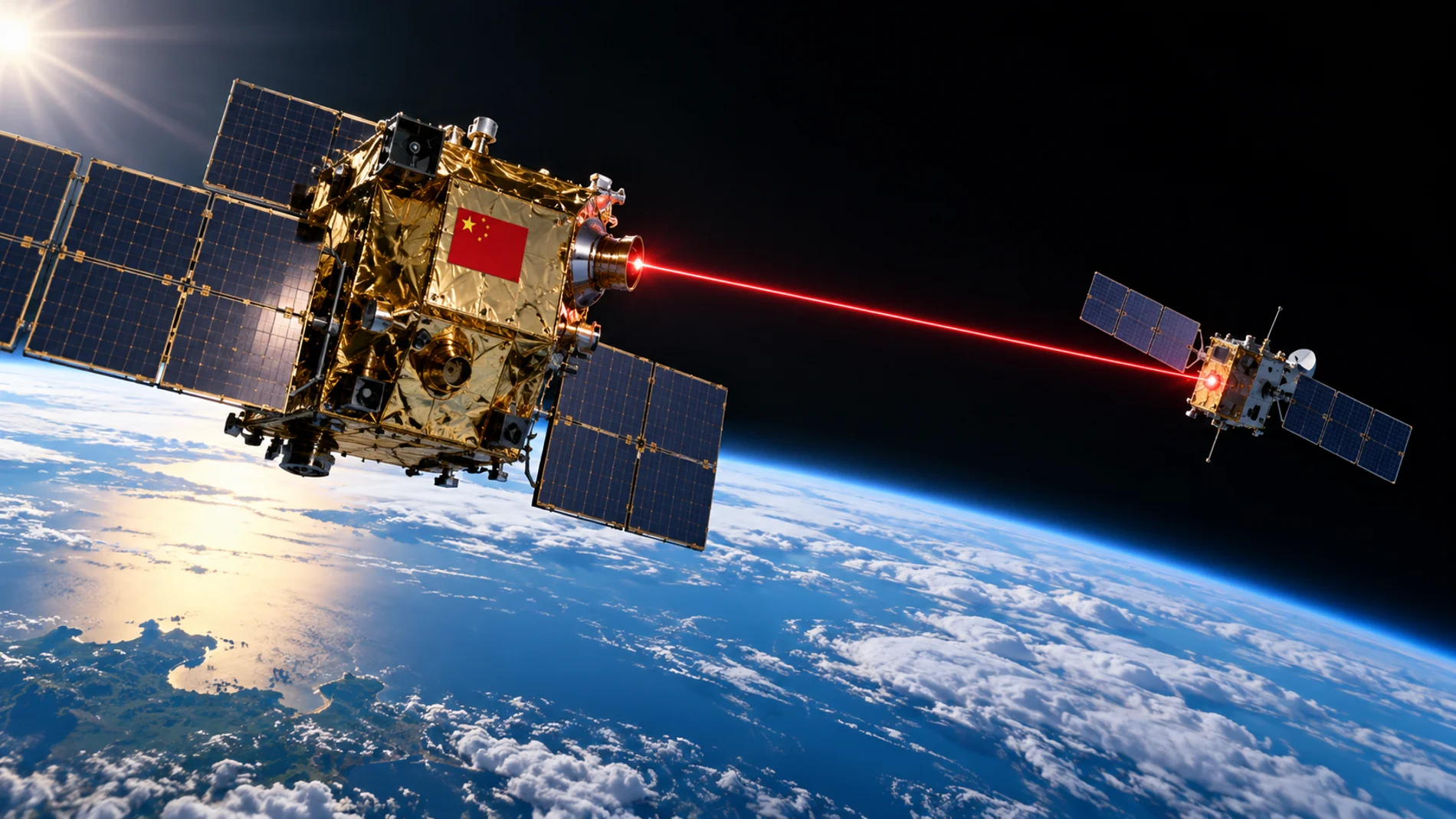
China could deploy directed energy weapons in space before the end of this decade, according to a new report from the United States Defense Intelligence Agency (DAY). These systems would expand their capacity to attack the satellites on which the communications, surveillance and military operations of their adversaries depend.
The document, published last Monday and based mainly in open sourcesdoes not specify whether Beijing develop lasers, high-power microwaves, particle beams or a combination. China already has ground-based directed energy weapons capable of affecting satellites, but the report raises its possible orbital deployment as a future capability.
‘The People’s Liberation Army probably believes that directed energy weapons They are ideal systems to act against space capabilities, because they can cause both reversible and irreversible effects on satellites.‘, explains the DIA. The agency believes that China could deploy this equipment in space by 2030, in addition to more powerful ground systems capable of threatening higher orbits.
The reversible attacks They temporarily prevent or hinder the operation of a satellite, for example, through interference with its signals or lasers that blind its optical sensors. The irreversible They cause permanent damage, such as that which could be caused by a laser by damaging components or by high-power microwaves by damaging electronic systems.
These weapons could be installed on satellites and, potentially, also on space planesaccording to The War Zone when analyzing the report. These vehicles, which China is already testing, can operate less predictably than conventional satellitesalthough its possible equipment with directed energy weapons is not confirmed.
Known Chinese orbital anti-satellite capabilities include vehicles capable of approaching, holding and moving other objects. In 2022, the Shijian-21 captured a decommissioned Chinese navigation satellite and moved it from its geosynchronous orbit to a graveyard orbit, demonstrating a useful technology for removing debris, but also susceptible to being used against foreign satellites.
The risk of these approaches was illustrated this month by the Russian satellite Cosmos 2612which followed the American for three weeks ICEYE-X36a commercial satellite that provides images to Ukraine, and arrived to come within 26 meters of him. Although no contacts or damage were detected, the episode showed the danger of a deliberate action or an accidental collision.
The expansion of these capabilities coincides with the growth of Chinese space infrastructure, whose intelligence, surveillance and reconnaissance fleet, according to the DIA, ‘it had more than 510 systems, after having multiplied by more than three since 2018’. The agency warns that data collected by many civil or commercial satellites can also be used for military purposes.
Chinese research into space weapons goes back considerably further than these advances. ‘At least since 2006, Government-linked researchers have studied aerospace engineering technologies related to kinetic weapons deployed in space, a class of weaponry used to attack land, sea or air targets from orbit‘, says the report.
The document also details some of the areas studied for those weapons, other than directed energy weapons. ‘Chinese research on kinetic weapons deployed in space included reentry methods, payload separation, transport vehicles and transfer orbits for attack purposes‘, states the DIA.
Much of China’s anti-satellite doctrine describes these systems as useful instruments to deter external intervention in a regional conflict or as a method to manage its escalation‘, according to the agency. His evaluation points to a continuity of that strategy, pointing out that ‘China has developed and will likely continue to develop weapons for use against orbiting satellites in order to disrupt, damage and destroy the space capabilities of its adversaries’.