
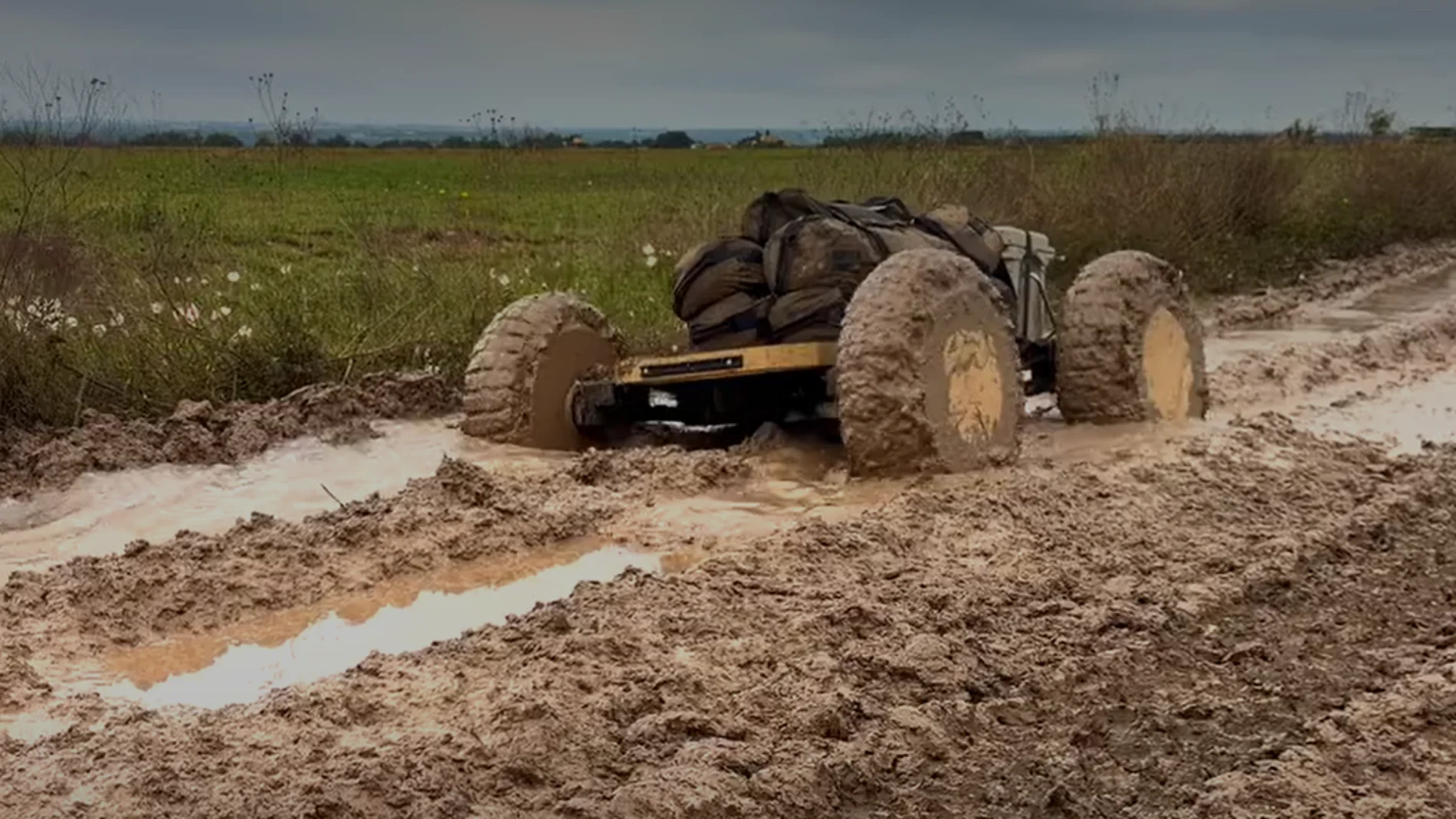
It took us at least 3,000 years, between the invention of the wheel and the suitcase, to unite the two and make travel easier. Now a company linked to the defense sector is carrying out an innovation with a similar impact. A wheel is usually the starting point of a vehicle, but also one of its most conventional elements. AZAK wants to change that idea: what if each wheel was actually a complete electric vehicle?
The American company has turned that question into a mobility system that brings together a motor, battery, brakes and electronics inside each wheel. Now, your S26 Stoat ground robot has began joining US Army units deployed in Germanywhere soldiers have already used it in exercises to evacuate wounded and transport weapons.
This week, servicemen from the 2nd Cavalry Regiment tested the system during a tactical exercise at the Grafenwöhr training area. In a combat simulation, soldiers placed an injured comrade on a flat platform installed on top of the robot and was transferred to the rear. The vehicle moved forward controlled by a soldier who walked behind with a portable controller. The scene illustrates one of the most immediate applications of this technology: removing a person from a dangerous area without forcing other soldiers to carry a stretcher under enemy fire.
The regiment has received the first three units of an order for 26 vehicles, within a US Army program designed to accelerate the arrival of new technologies to troops. It is not, therefore, a German manufacture, but rather the deployment of a system developed by AZAK, based in Denver, Colorado.
Innovation is in architecture. In a conventional vehicle, the engine, transmission, battery and controls are distributed throughout the chassis and must work in coordination to transmit power to the wheels. AZAK reverses that logic: each S26 wheel integrates the components necessary to generate and manage its own movement. The center of the vehicle can be reduced to a simple structure that supports the load, while the power is distributed between the wheels. The company places a good part of the components below the center of the wheel. This arrangement lowers the center of gravity and, according to AZAK, improves stability and the ability to overcome obstacles. It also allows the vehicle to be modified without redesigning the entire drivetrain: adding wheels can increase the available power, while the same drive unit can be installed on different platforms.
Modularity has a practical consequence on the battlefield. The Stoat used in Germany uses four wheels attached to a light structure on which a stretcher, ammunition boxes or a mortar can be placed. The wheels are replaced by releasing two locks in just 3 seconds, according to the military who have tested the system. And, according to their testimonies, the vehicle can continue running even if two of its four wheels are seriously damaged or punctured. In an environment where a breakdown can leave a unit isolated, repairing a conventional transmission without disassembling is an operational advantage.
The possibilities are not limited to medical evacuation. Soldiers have already used the robot to transport a 60-millimeter mortar and other heavy equipment across approximately eight kilometers of rough terrain, at night and using night vision. The company claims that the Stoat can carry more than 230 kilograms and travel between 32 and 97 kilometers, depending on load and terrain. It can also be controlled remotely or operate autonomously, although that does not mean that all missions are carried out without human intervention.
A previous AZAK demonstration showed another of the capabilities that have caught the Army’s attention: a robot of about 227 kilograms towing a military truck of approximately 24 tonsplus an additional load of ammunition. The test does not equate to carrying that weight on the platform nor does it in itself demonstrate performance on any terrain, but it illustrates the traction force that the system can achieve.
According to its specifications, it reaches a maximum speed of 20 km/h, charges in an hour and a half and its range is almost 100 km. Depending on the configuration, it can carry more than 750 kilos in mud, snow, sand and slopes.. The wheel has been one of the most effective engineering solutions for centuries. AZAK is not intended to replace it, but rather to turn it into something more: a propulsion unit that can be combined like a construction part. If the formula proves useful on the ground, the change will not be in the way it rolls, but in the way the vehicles that carry us are designed.