
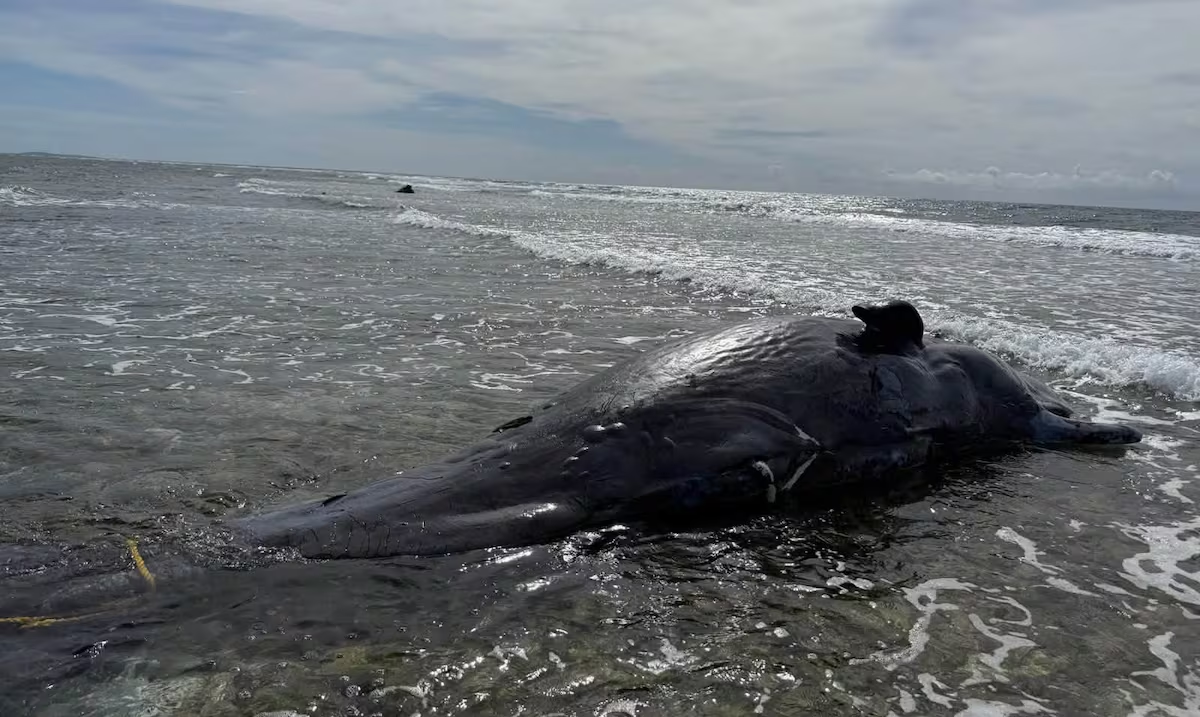
He Department of Natural and Environmental Resources (DRNA) confirmed this Thursday that the necropsy carried out on a baby sperm whale (a species of whale) that was found dead on Margarita Key, in Slabs, revealed that he died after being hit by a large boat.
The mammal, about 17 feet long, was hit in the right lateral area, which caused its death. According to the agency, the staff of the Marine Mammal Rescue Program and Guánica Forest determined that due to the magnitude of the impact, they concluded that the calf was hit and torn by a large boat
“This is the second baby sperm whale found here in the southern part of Puerto Rico. We had one in May, but that one in May was very decomposed and we could not determine the cause of death. On this occasion this was a 17-foot male, it was an animal between one and three years old, it still had milk teeth, its bones were not yet well ossified, so it was a fairly young animal, but it was already an animal that ate on its own.. Not independent, because he must have been with his mother. It had stomach contents and had the beaks of the squid, which indicate to us that it was an animal that was already eating solids,” he explained to The New Day the doctor Grisel Rodríguezwho, together with Dr. Anita Jiménez, was in charge of the autopsy.
Rodríguez mentioned that the animal had an impact on the lateral part, in the area of the peduncle, located on the trunk of the tail. That impact caused bleeding and also affected the baby’s right kidney. As part of the tests carried out on the corpse, samples were taken for more specialized studies. Impact marks were also found on the back.
According to Rodríguez, this species is common in Puerto Rico, in deep areas. Sperm whales are distinguished by where they eat, in the deep areas, thousands of feet deep, only rising to the surface to breathe and rest. It is at these times where accidents can occur with these animals, since boats passing through the area can easily injure or kill them. An adult sperm whale can reach up to 30 feet in length, so injuries, in most cases, are due to impacts with large vessels and not recreational boats.
“Counting all species, this would be the 12th animal we have found impacted this year, including manatees and dolphins. A problem worldwide is the impact of large whales with ships and that is why there are regulations and continuous education is also given to the captains of these vessels so that they are aware of the species.. We do not have very large populations of sperm whales in Puerto Rico, but they are present and we do know of populations in the south of Puerto Rico mainly and in the east,” Rodríguez added.
The expert urged that people with boats always comply with speed limits and safety measures in areas such as La Parguera, where manatees, dolphins and turtles live. He also emphasized the importance of reporting animal stranding situations to the DRNA, so that its staff can respond with the necessary urgency.