
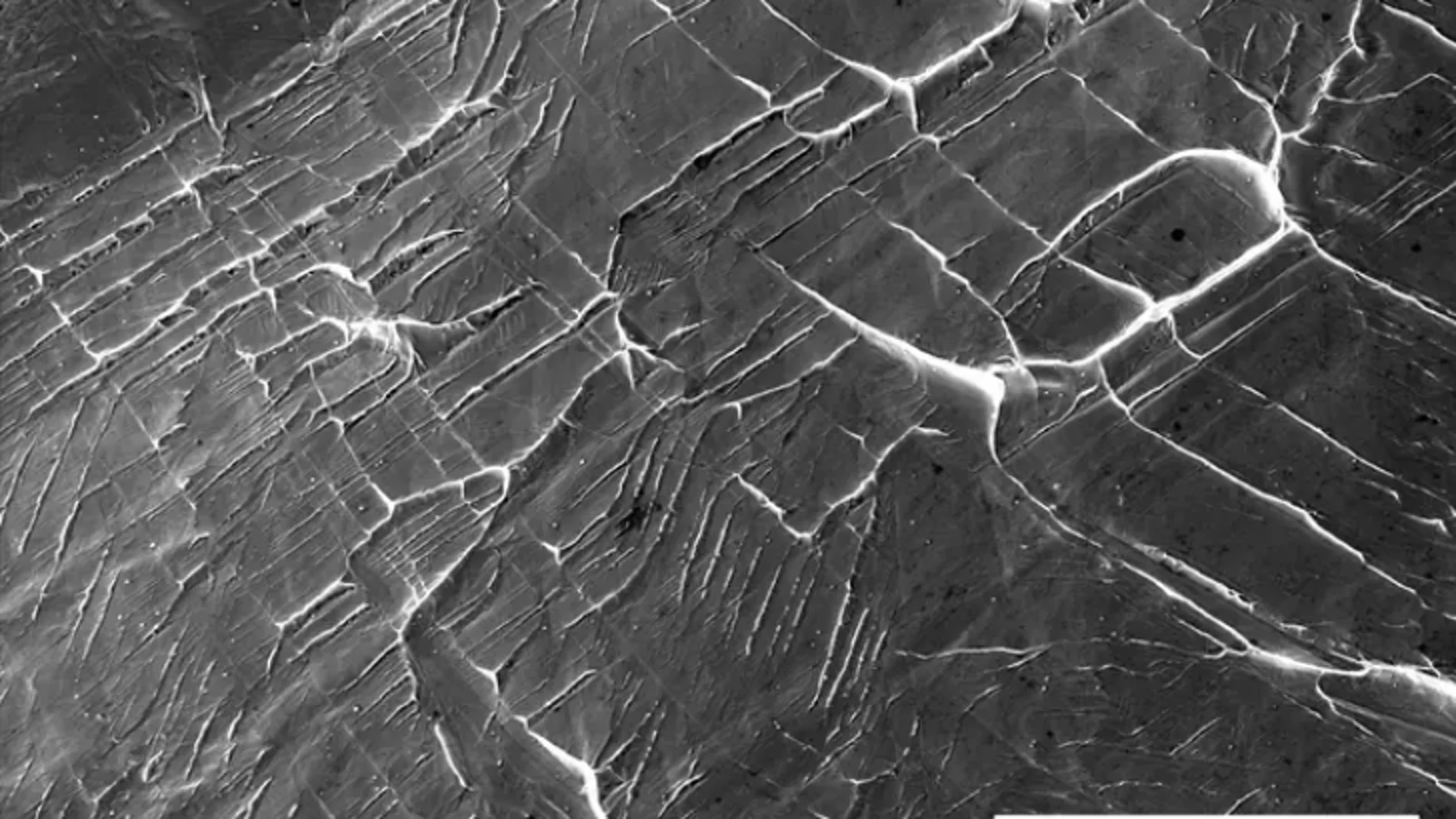
A sword must be hard to keep its edge, but also flexible enough not to break when hit. The Japanese master weaponsmiths who forged katanas sought that balance between resistance and adaptability. Now, An international team of scientists has discovered a mechanism that could inspire materials capable of withstanding extreme conditions: Two experimental alloys based on niobium and titanium have maintained their ability to deform without showing a measurable transition toward brittle behavior at −253 degrees Celsius.
The discovery, published in Naturequestions a known limitation of certain metals. It does not mean that scientists have found an alloy to make indestructible swords, but that have identified a new way to design structural materials capable of better resisting the formation and propagation of cracks at cryogenic temperatures. But, let’s go from the beginning. Cold can increase the resistance of some metals, but also make them more brittle. This is what is known as the ductile-brittle transition: a material that can normally deform and absorb part of the energy of a blow becomes more prone to fracture when the temperature drops.
The phenomenon especially affects metals with a body-centered cubic crystalline structure, such as iron, tungsten and chromium. In them, the deformation depends largely on the movement of linear imperfections in the crystalline network called dislocations. These defects allow the atomic planes to shift and the metal to change shape without breaking. At very low temperatures, moving them becomes more difficult and a crack may propagate before the material can absorb the stress.
The alloys studied resort to an alternative. The scientists observed the formation of twins at the nanometer scale: small regions in which atoms are rearranged in a mirror orientation with respect to the neighboring structure. At the same time, local phase transformations occur, that is, changes in the crystal organization. The combination of both processes concentrates tensions at the boundaries between crystals and favors the appearance of new dislocations.
Thus, the material manages to generate new points from which it can continue deforming, even when its usual mechanisms encounter difficulties. It’s like a city where the roads are blocked by frost: opening new routes allows traffic to continue. In this case, The new crystal structures help redistribute stress around cracks rather than letting them cause sudden fracture.
To observe the phenomenon, the team used the Engin-X instrument at the ISIS neutron and muon source in the United Kingdom. They cooled the samples to about 20 kelvin (about −253 degrees Celsius) using helium gas and subjected them to traction while a beam of neutrons passed through them. They then examined the material with electron microscopy, analyzed the distribution of its elements and used computational models to understand the mechanisms involved.
“For decades, the ductile-brittle transition has been considered a fundamental limitation of metals with body-centered cubic structure – explains Dong Liu, professor of engineering and leader of the study -. What surprised us is that these alloys continue to show extraordinary damage tolerance even at 20 kelvin. By discovering how twinning and phase transformations work together to generate plasticity before conventional dislocation motion occurs, we identified a new avenue for designing structural metals that can function in extreme cryogenic environments.”
The results could help develop components for cryogenic systems, aerospace technologies and energy applications, such as the storage and transportation of fuels at very low temperatures. However, it will still be necessary to evaluate its behavior under real conditions of use and determine how these properties are manufactured and maintained on a larger scale.
“From this knowledge – concludes David Crook, co-author of the study -, we can design microstructural conditions that allow a material to create its own paths to remain ductile at extreme temperatures”. The real novelty is not having found an invulnerable metal, but rather demonstrating that its structure can open new paths of deformation when the cold makes the usual ones difficult. A strategy that could change the way materials are designed for the most extreme environments.