
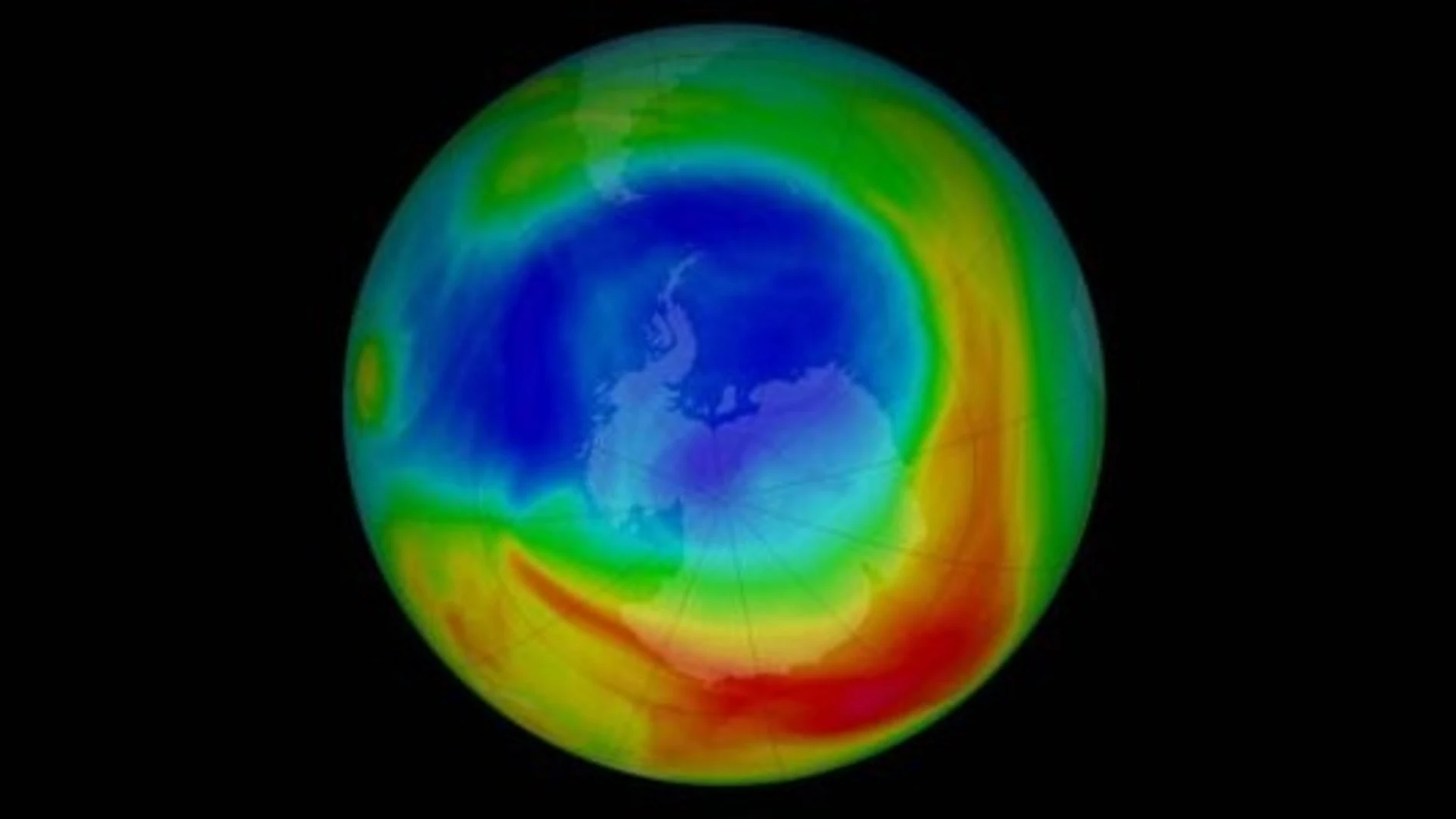
The current state of the ozone layer is one of sustained recovery, according to the most recent data from the World Meteorological Organization (WMO) and NASA. The most recent scientific observations confirm that the concentration of ozone-depleting substances (ODS) in the stratosphere continues to decline steadily.
According to the joint balance of NASA and the National Office of Oceanic and Atmospheric Administration (NOAA), last season’s Antarctic “hole” was one of the smallest since it began to be measured with satellites, well below the record size of the mid-2000s. Paul Newman, one of the researchers who has been following the phenomenon for the longest time for NASA, summarizes it with cautious optimism, “the gradual improvement we have seen in the last two decades shows that international efforts are working.”
Positive trend
Also, the World Meteorological Organization (WMO) confirms the same trend in its latest report in which it ensures that the Antarctic hole was once again smaller than in previous years and formed later than usual, a solid indication that recovery is already underway. When presenting the report, the Secretary General of the WMO, Celeste Saulo, underlined the role of science: “the World Meteorological Organization has been promoting scientific research on the ozone layer for decades.”
Every four years, the United Nations Environment Program (UNEP) and WMO also publish a much more comprehensive assessment, involving hundreds of experts. The latter calculated that the ozone layer could return to pre-Antarctic hole levels by mid-century in most regions, although in Antarctica itself the process will take several more decades. The next major evaluation is being finalized and will be released at the end of this year.
The Montreal Protocol
The Montreal Protocol, in force since the late eighties, forced the gradual elimination of the famous CFCs and other compounds that, released in aerosols, refrigerators or air conditioners, rose to the stratosphere and destroyed the ozone. Those substances can stay up there for decades, so recovery was never going to be quick. Even so, Kofi Annan, then Secretary General of the UN, went so far as to describe it as “the most successful international agreement ever reached”, a phrase that the scientific community continues to repeat.
Organizations and experts warn that we must not let our guard down, because the recovery of ozone “is neither automatic nor irreversible.” And to the already known threats comes another, relatively new one, such as the increase in space launches and satellites that, at the end of their useful life, disintegrate upon re-entering the atmosphere. A study by the University of Canterbury warned that this process releases particles and gases capable of damaging the ozone, with effects that can travel throughout the planet, including Antarctica. With thousands of satellites in orbit, scientists acknowledge that they still do not know precisely how much this threat weighs, although they already recommend monitoring it and looking for less polluting fuels.
With the new scientific evaluation underway, this year the calculations on when the Antarctic hole will definitively close and what role new threats play in that calendar will be updated. In any case, the current balance continues to be one of the few reasons for environmental optimism since the ozone layer is recovering and science and international cooperation have demonstrated it with facts.