
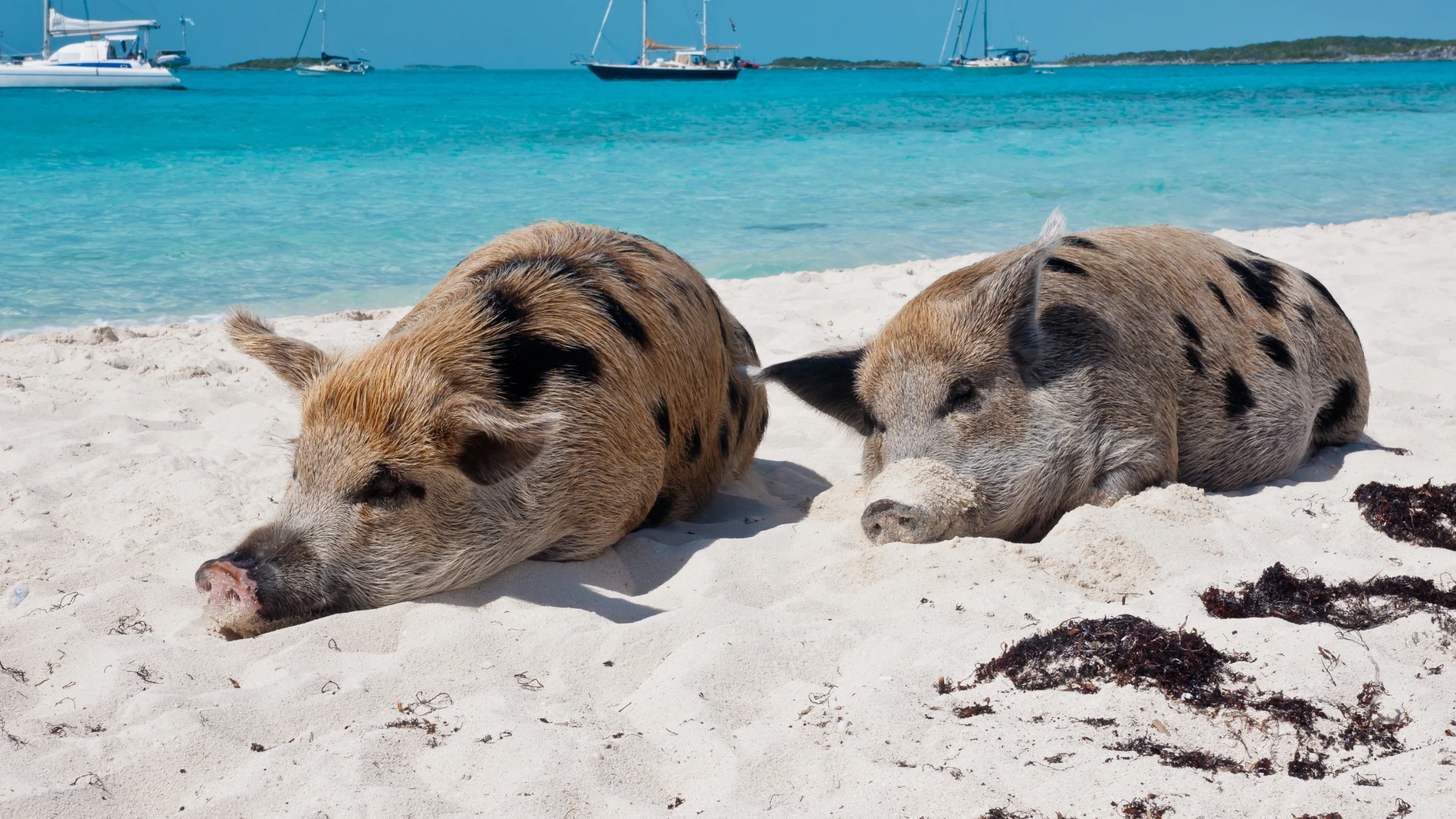
to some 450 kilometers south of the South Island of New Zealand is a remote archipelago, buffeted by wind and with a particularly harsh climate. There, on the Auckland Islands, a small group of pigs starred in a survival story that lasted almost two centuries.
It all started in 1807when sailors left a small number of domestic pigs on the largest of these islands. They did not intend to establish a livestock farm. The idea was much more practical. At a time when shipwrecks were a constant danger, animals could become a reserve of meat for those who managed to reach the mainland alive.
The pigs found enough food and began to reproduce. As the decades passed, that small population gave rise to animals capable of living without human help in conditions very different from those of their domestic ancestors.
Nearly two centuries of isolation changed pigs
Surviving in the Auckland Islands was not easy. The weather is cold and wet all year roundwith frequent rains and vegetation made up of low forests, ferns, peat bogs and rocky areas.
After 192 yearsthe descendants of those first animals presented their own characteristics. They were generally smaller than modern farm pigs, had thick, dark fur and strong legs and hooves that allowed them to navigate difficult terrain.
They had also become extremely hardy animals. They could survive by feeding on roots, shoots, algae and even marine invertebrates that they found in the coast. Their isolation also meant that they retained genetic characteristics different from those of many current commercial breeds.
But their extraordinary ability to survive ended up becoming a problem.
From food for castaways to threat to the ecosystem
During the 20th century the way of understanding the Auckland Islands completely changed. The territory went from being a remote point on maritime routes to being considered an important nature reservehome to birds, marine mammals and other species.
Pigs, originally introduced by humans, moved around in search of food, damaged vegetation and competed for available resources. New Zealand then embarked on a policy to eliminate introduced mammals from its remote islands that were disrupting ecosystems.
The authorities found themselves, however, faced with a dilemma. Eliminating the pigs would help recover the ecosystem, but it would also mean losing a lineage that had been living practically isolated for nearly 200 years.
The solution was to preserve a small sample of that population.
17 pigs were rescued before eradication
Before wiping out the wild population, several teams traveled to the islands to capture some live specimens. The work was not easy due to the terrain and the elusive nature of animals accustomed to living without regular contact with people.
They were finally rescued 17 pigsa mix of males and females belonging to different family lines. The animals were moved to mainland New Zealand to keep their genetic heritage alive.
Then the elimination of the specimens that remained in the wild began. At the beginning of the 2000s, there were no wild pigs left on the Auckland Islands and the vegetation began to recover areas that had been removed by animals for years.
The descendants of those pigs are still preserved
The end of the wild population did not mean the complete disappearance of this particular lineage. The rescued animals were kept in secure facilities in New Zealand, away from places where they could become an invasive species again.
Since then, controlled breeding programs have been used to retain their genetic diversity and some of the characteristics acquired during generations of isolation.
The story that began in 1807 with a few animals destined to serve as emergency food ended in an unexpected way. Almost 200 years later, pigs had ceased to be a pantry for shipwrecked people and had become a lineage that deserved to be preserved.even after their presence in the Auckland Islands came to an end.