
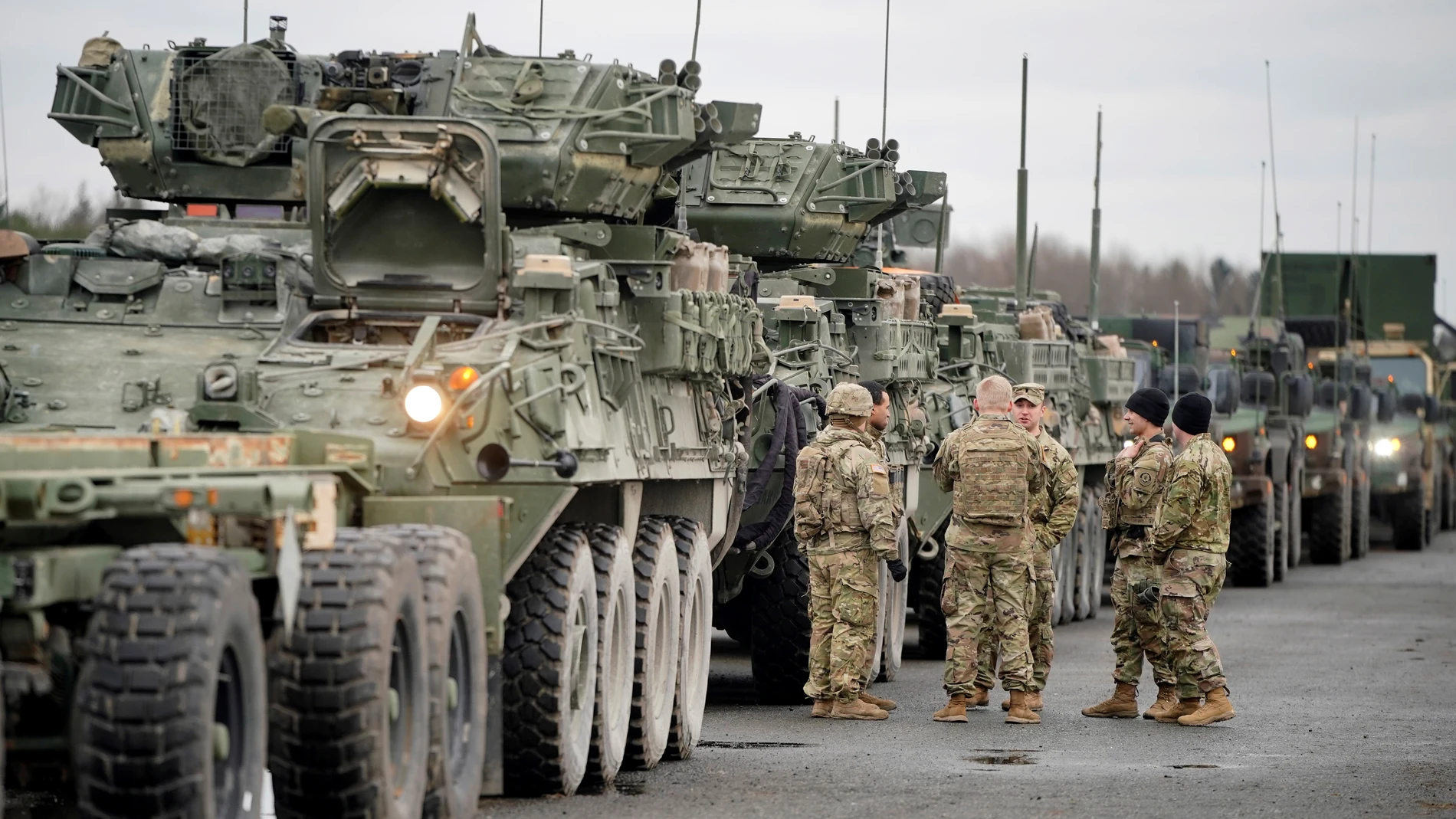
Technological advances have not only led to changes in the daily routines of citizens, but also in the course of wars and the weapons used by the army. This has generated a transformation of war conflicts towards a more technical issue, since not as dependent on close or medium range combatbut rather the use of drones or even artificial intelligence.
That is why the United States Marine Corps has presented an update to the document “Ground Combat Element 2040” or GCE 2040, in which they develop how technology will change the development of land wars in the future. A fact that is already being seen in current conflicts, such as the war in Iran, where Drones are playing a fundamental role in the offensive of the countries involved.
Among the factors that will gain increasing importance on the battlefield are artificial intelligence, autonomous systems and long-range weapons, as well as the creation and reinforcement of distributed command and control structures. However, by the year 2040, the figure of the marines will continue to be essential to carry out offensives on the ground.
The objective is to adapt to technological advances
As explained by Lieutenant General Jay M. Bargeron, deputy commander for Plans, Policies and Operations of the Marine Corps, the main objective of this document is to establish “the essential vision and framework to guide our transformation.” To do this, the capabilities of possible adversaries are studied so that the army is capable of confronting, deterring and defeating those who pose a threat.
“This is not simply a modernization plan; it is a commitment to ensure our Corps remains the nation’s premier rapid response force, ready to win battles into the future,” Bargeron says. And for this, the document is divided into different time periods, following short-term, preliminary and long-term trends.
War trends between 2026 and 2030
In the first period, which will take place between 2026 and 2030, the GCE establishes short-term trends. According to what has been observed in the different current wars, especially the one being waged by the United States and Israel against Iran, which has already been active for approximately 6 months, as well as in the very advances that are revolutionizing the technological landscape.
As he explains, artificial intelligence, networked sensors, long-range precision weapons and autonomous robots are becoming fundamental pillars to increase transparency and lethality in land combat, as they offer greater efficiency and speed. Likewise, lethal drones have been adapted as tools capable of detecting enemies or air attacks and neutralizing them.
The evolution for 2035
In order to face current threats and, above all, those that will come in the future, the GCE recommends greater investment and deployment of this type of technologies. Especially in order to prepare for the period called ‘preliminaries’, which will begin in 2031 and will extend until 2035. In this period, and if the pertinent changes have been carried out, they predict greater speed and agility when making decisionsall thanks to the use of artificial intelligence.
“Autonomous systems expand maneuver options through enhanced bridge-building and line-breaking capabilities, while reinforce resilience and adaptability of logistics lines of communication,” the report indicates. This is why investment in this type of technology must continue, as well as in robots and drones designed for combat tasks, especially unmanned aerial systems (UAS).
The war in 2040
Likewise, what the document recommends is to carry out technical improvements to guarantee greater integration of CJADC2, also known as Combined Joint All-Domain Command and Control. This is a central support system that allows the sensors of all the Armed Forces and their allies to be connected to a single network, allowing everyone to have access to the same information through a single platform.
“Extending this capability to the division level in conflict will be essential to increase the operational tempo in the future” and allow a successful entry into the long-term period, between the years 2036 and 2040. In this period it is expected that the Marine Corps will have improved all the previous areas, which will allow it to have a decisive advantage to face possible threats.
The skills of the US marines of the future
In this context, it is expected that the marines have managed to adapt to new war trends. Although these will continue to be the central and essential element of the Corps, they must acquire knowledge to use war technologies to your advantage and fight in an environment increasingly marked by these. Likewise, they must use them to increase their lethality, using both kinetic and non-kinetic fire.
On the other hand, they must also adapt to a combat modality in which They will be constantly observed and attacked by the enemylearning to fight in what they call “high-tech multi-domain combat, maintaining fundamental combat excellence even when technology is degraded or denied.”
Finally, they must learn to make decisions with the help of artificial intelligence, achieving a more effective and faster response; and be able to adapt to threats that may arise during combat. Well, as Marine Corps Doctrinal Publication 1 indicates, “there are two dangers with respect to equipment: over-reliance on technology and failure to take full advantage of its capabilities.”