
At 11:45 in the morning a burly man, about forty years old, accompanies his son to boarding gate D45 at Malaga Airport. Alexis is 13 years old. Small, with a pale complexion, a faded soccer haircut, a sharp nose and green eyes. Deep look, sharp voice. The father tells him that he is either accompanied or not going to the soccer game he plans to play in the afternoon. «Your mother will take you by car, if you don’t take a taxi. “Just don’t even think about it.” You can smell the fear that has been going through a Spanish city for more than a month and captivating the other side of the peninsula, in North Africa.
The Alboran Sea looks like a grayish catwalk that a navy blue helicopter flies over with no small difficulty: the fog opaques the short trip. Suddenly, the outline of an isthmus. And the Port. The red and white flag waves somewhat timidly. At the scheduled time, 12:30, the landing takes place and, minutes later, the heliport doors open. The mother receives her son with a hug.
The two agree to walk home, because there are no taxis. They never had such a level of demand. «This has no solution, because the laws do not change. And they… They are not going to leave,” the woman laments.
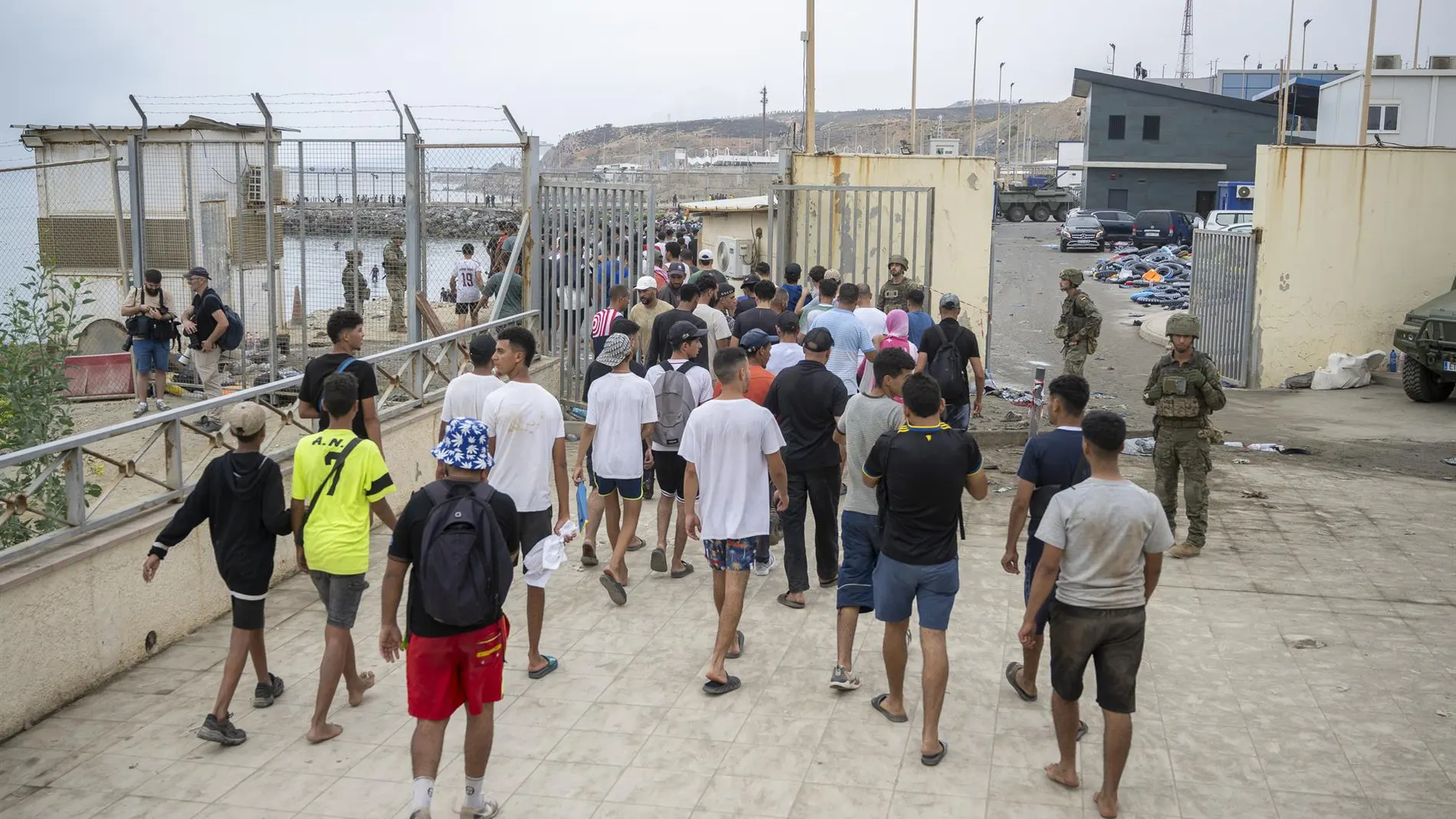
First contrast: avenues, streets, roads; roundabouts, parks, buildings; infrastructure, shops, franchises; First world restaurants and hotels coexist with a wandering third world population. They are the “invaders” who crossed the border illegally in the massive assault at the end of July. For outsiders, it is difficult to distinguish them from the people of Ceuta: a multicultural society in which four different religions coexist in harmony. Christians, Muslims, Jews and Hindus.
The locals, with a keen eye, do not hesitate: “This is an invader.” The mystery is resolved quickly. «How are we going to distinguish them if in Ceuta there are very few of us? Here we all know each other». There are more variables: the taxonomy, the language, the company. Or blatant poverty. If there were an average profile, which there isn’t: feet in flip-flops, cell phone in hand, shoulder bag or fanny pack from shoulder to hip. Almost always in a group of three or four. Men the most. Women the least.
They prowl the doors of supermarkets, guarded by soldiers or security agents, they try to deceive the cashiers, they fiddle with all their keys, just in case they collapse and spit out money. There are those who have a credit card and manage to get bills. They beg the people of Ceuta, who react in different ways: some drop the money, others avoid them and there are those who directly ask them to take the road back to Morocco to recover the truncated normality: “To your country!”
Seven hundred meters separate the Heliport from the Town Hall Square. A route that becomes a showcase for North Africans and, at times, sub-Saharans. Young people predominate. Between adolescents and adults. None old. The contrasts continue: some corpulent, muscular; others starving, helpless. With earrings and pendants, dressed in a sweatshirt and pants, in jeans, in a tracksuit; with hardly any clothes, with his torso in the air. Defiant, challengers, rebels; sarcastic and happy, sad and helpless. There is no homogeneity.
This is corroborated by the authorities, unable to find the exact number of those who remain within a radius of 19 square kilometers. The endless debate on the data ranges from the 5,000 that Pedro Sánchez listed and the 15,000 estimated by his party colleague and vice president of the Assembly: the “wayward” Melchor León.
The local count, which is also not exact, is made from the food distributions of social entities and neighborhood associations, largely responsible for avoiding the feared social outbreak. Except for the shelter centers – with capacity for about 6,000 people, Sánchez stated – the Government does not take care of the rest, who are found in illegal settlements, on the streets, hidden in the mountains or in marginal neighborhoods, where the underground economy has exploded. «There are more and more rentals. People who rent their storage room or rooms without a contract so that immigrants can stay there. And those who offer free accommodation in exchange for working for them,” a National Police agent tells LA RAZÓN.
On Trampolín beach, the Red Cross distributes 4,500 menus daily. And, sometimes, it does not meet all the demand. Luna Blanca, between the Naves del Tarajal, the Príncipe neighborhood and its own tent distributes 2,700 rations. In Monte Hacho, an NGO covers 1,000 people; 300 portions go to the girls who protect themselves from possible attacks in a camp located in the Príncipe neighborhood and, finally, the Engloba association and the Samu foundation prepare 1,600 dishes. The count: 10,150 meals a day.
Apart from those who are in the Temporary Immigrant Center and the reception spaces that have been enabled in recent weeks, especially since a single government command was established: Loma Margarita, with 1,200 sub-Saharans; Loma Colmenar, the Tarajal ships, the Rosales, the Equestrian Center. And those to come. In contention, the Port, where there is a pulse between the central and local governments. Óscar Puente has ordered the imposition of some 1,000 places, despite the resistance of Juan Jesús Vivas.
“State of siege,” he comments Cristina Diazsenator of the PP and responsible for the party’s communication in the autonomous city. Almost forty days have passed and he is still shocked by the police and military presence on every corner. At the door of the equestrian center, the image is the following: fifty women with niqab or veils wait in tents, longing to get a place that offers them bed, food and protection. The most vulnerable women and girls are found here, including those who have been victims of sexual assault. The same thing happens in Loma Colmenar.
Gonzalo Torrado, a thirty-year-old Ceutí who works as a political advisor in Madrid, presses the brake of his car to allow a group of North Africans to cross the road. The pocket that normally manages the Strait Pass is now a camp with military tents in which daily conflicts and confrontations occur. At the door, half a thousand illegals sitting on the ground crowd behind a police cordon for hours and hours to get a bracelet that will allow them to enter. They fight among themselves. The agents are forced to break up the attempt with shots in the air.
From above, next to the city’s only hospital, two Legion patrols contemplate the exterior and interior panoramic view of the camp, where immigrants play soccer, do push-ups, and pray. From the neighboring neighborhood, the Prince, comes the echo of the Adhan, a song that proclaims the greatness of Allah. It is heard five times a day. In these ways, the feeling of insecurity sets the tone. «They don’t usually do anything to the Spaniards, don’t you see that what they want is to stay? If they attack someone it is an expulsion file and it is what they want to avoid at all costs,” a legionnaire reassures us.
Dawn on the Tarajal ships does not occur until well into the morning. «Many spend the night playing, drinking, smoking joints and don’t get up until one o’clock or so.”explains a cleaning worker, who has an impossible mission ahead of him: cleaning an area that he describes as “the favelas of Brazil.” He believes that “this couldn’t be managed any worse,” because “the same people” who entered are still there.
So far, the incidents have not escalated, due to the deployment of security and the attention that the majority of immigrants receive. The moral dilemma is: feed them to remove the temptation to steal, or leave them without food and thus encourage their voluntary return. “But they’re not going to leave.”insists this Ceuta worker of Muslim origin. Last week, the Civil Guard estimated the voluntary returns of immigrants per day at around one hundred.
On the streets of the city center there are teenagers who are increasingly looking more worrying. “Many are skinnier than when they arrived,” he admits with regret. Kissy Chandiramanithe Hindu Treasury advisor. There is a growing fear that the situation will explode somewhere.
Mabel Deu She is “the condemned one.” She jokes with an extraordinary sense of humor about her situation: a court imposed a sentence of 9 years of disqualification on her for administrative “prevarication.” In 2021, she, in her capacity as Vice President of Ceuta and responsible for Minors, and the then Government delegate, Salvadora Mateoswere in charge of executing the order of the Ministry of the Interior to expel the minors who participated in the May assault. Its precedent serves as an alibi for the Government to justify the slowness with which return files are being processed. The only way out that the president of Ceuta defends to recover normality in a city that has been immersed in the most complete abnormality for more than a month.