
There are two ways to make moving easier. One is to improve the vehicle we use to get around. The other, perhaps more ambitious, consists of directly helping the body that performs the movement. NAVEE has brought both ideas to IFA 2026 with two products that, although they seem to belong to very different worlds, share the same philosophy– Make getting around easier, more efficient and more adaptable.
The first is the NAVEE Fold P10, an electric scooter conceived around a very specific question: what happens when the problem is not getting around a city, but rather storing and transporting the scooter itself? NAVEE’s answer is a triple-folding system that reduces the volume needed to store it by more than 80%. The company ensures that, once folded, it can fit in the trunk of a conventional car, be placed under a desk or stored in small spaces in a home. IFA presents it as one of the company’s main innovations for urban mobility.
The key is that the Fold P10 does not sacrifice performance to achieve that compact size. Its motor reaches a maximum power of 1,350 W and has front and rear suspension using damping arms. The Announced autonomy reaches 70 kilometers. In addition, it incorporates a removable battery that can be replaced in a matter of seconds. With a second battery, the range can be doubled, while the ability to remove the power unit allows it to be charged at home or in the office without having to carry the entire scooter to an outlet. The paradox is interesting: the smaller it is when folded, the less necessary it seems to give up the benefits of a larger scooter. NAVEE plans to launch the Fold P10 in Europe in 2027.
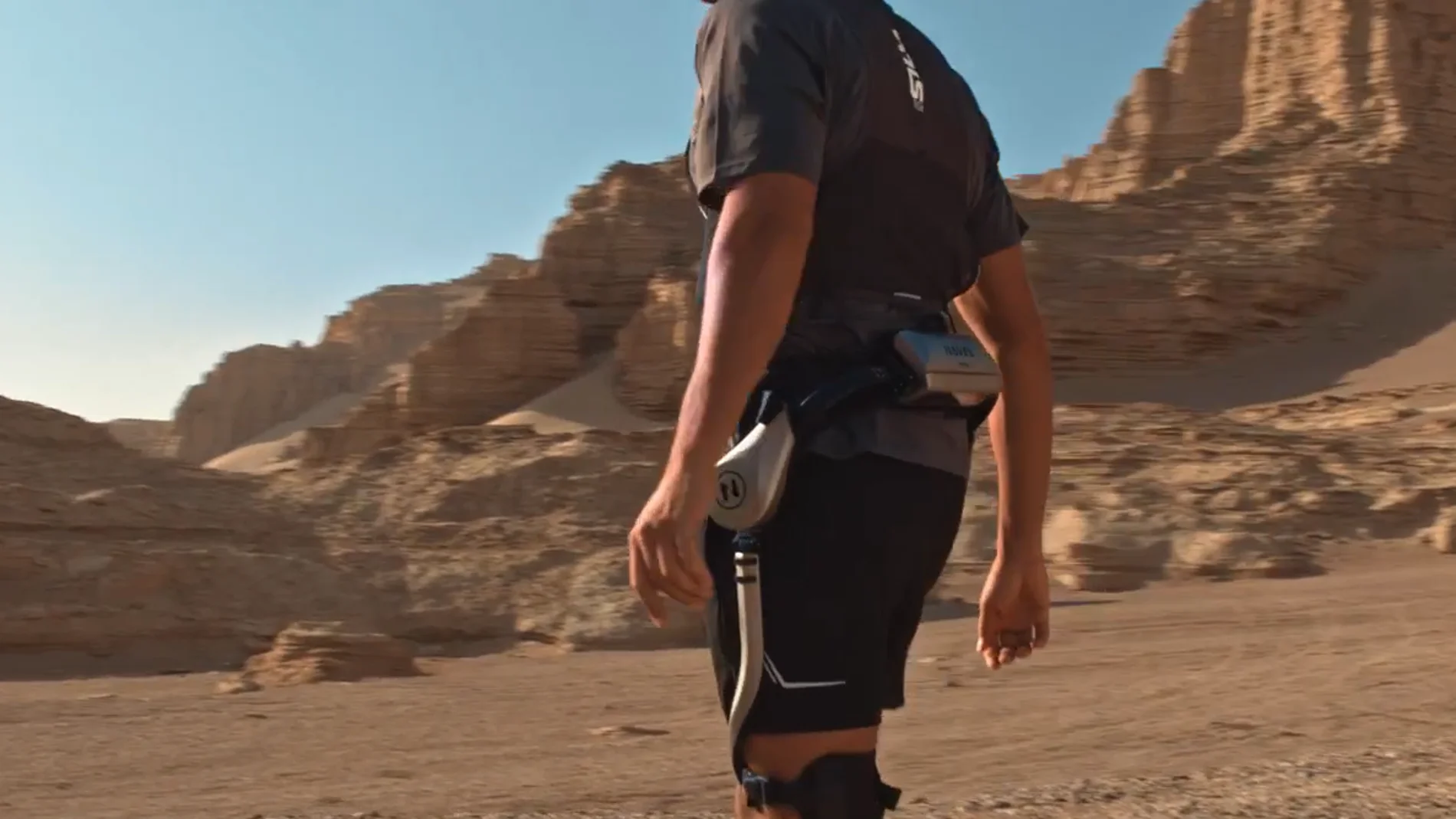
But the product that is probably most surprising from NAVEE’s presentation is the EXO S Pro, because it completely changes the scale of what we understand by personal mobility. It is not a vehicle. It is an exoskeleton designed to be worn and provide assistance during movement. With Weighing only 1.8 kilograms, the device incorporates a carbon fiber structure and an assistance system capable of recognizing ten different movement patterns. According to NAVEE, the system analyzes what the user is doing and adapts the help in a matter of milliseconds. Among the modes contemplated are walking, running, going up and down stairs, ascending or descending slopes, moving on trails or gravel terrain and even riding a bicycle.
The objective is not to replace human movement, but to complement it. The EXO S Pro is designed to detect how the person moves and provide assistance synchronized with their steps. NAVEE states that It can reduce physical effort by up to 35%. The company bases this figure on comparative heart rate tests performed during activities such as walking uphill and running.
The idea brings exoskeletons closer to much more everyday situations than those we usually associate with this technology. NAVEE plans to use it during excursions, trips, training or outdoor activitiesespecially when it is necessary to walk for a long time or carry weight. The company itself gives examples of carrying a backpack, a camera or outdoor equipment, and also points out photographers and content creators among its potential users.
The EXO S Pro features a 5,000 mAh battery and offers assistance for up to 40,000 steps, equivalent to about 25 kilometers according to official specifications. The battery is interchangeable and the device is IP54 certified against dust and splashes, with a declared operating range of between -10 and 45ºC.
The company already markets the EXO S Pro in Europe for 1,099 euros, according to its official store. The IFA presentation thus leaves a fairly clear image of where NAVEE wants to go. Until now, the brand was mainly associated with electric scooters, but its catalog already extends to electric bicycles and electric golf vehicles. It now also incorporates technology capable of interacting directly with the human body.
And that is perhaps the most interesting thing about these two products. The Fold P10 tries to eliminate one of the physical barriers to urban mobility: space. The EXO S Pro try to reduce another: effort. One folds to take up less space; the other adapts to the body so that it can do more with less fatigue. In both cases, the idea of NAVEE is similar: that the technology is not limited to providing more power, but rather that it adapts better to the needs of those who use it. A way of understanding mobility in which The future is not just about moving faster, but also about making moving easier.