
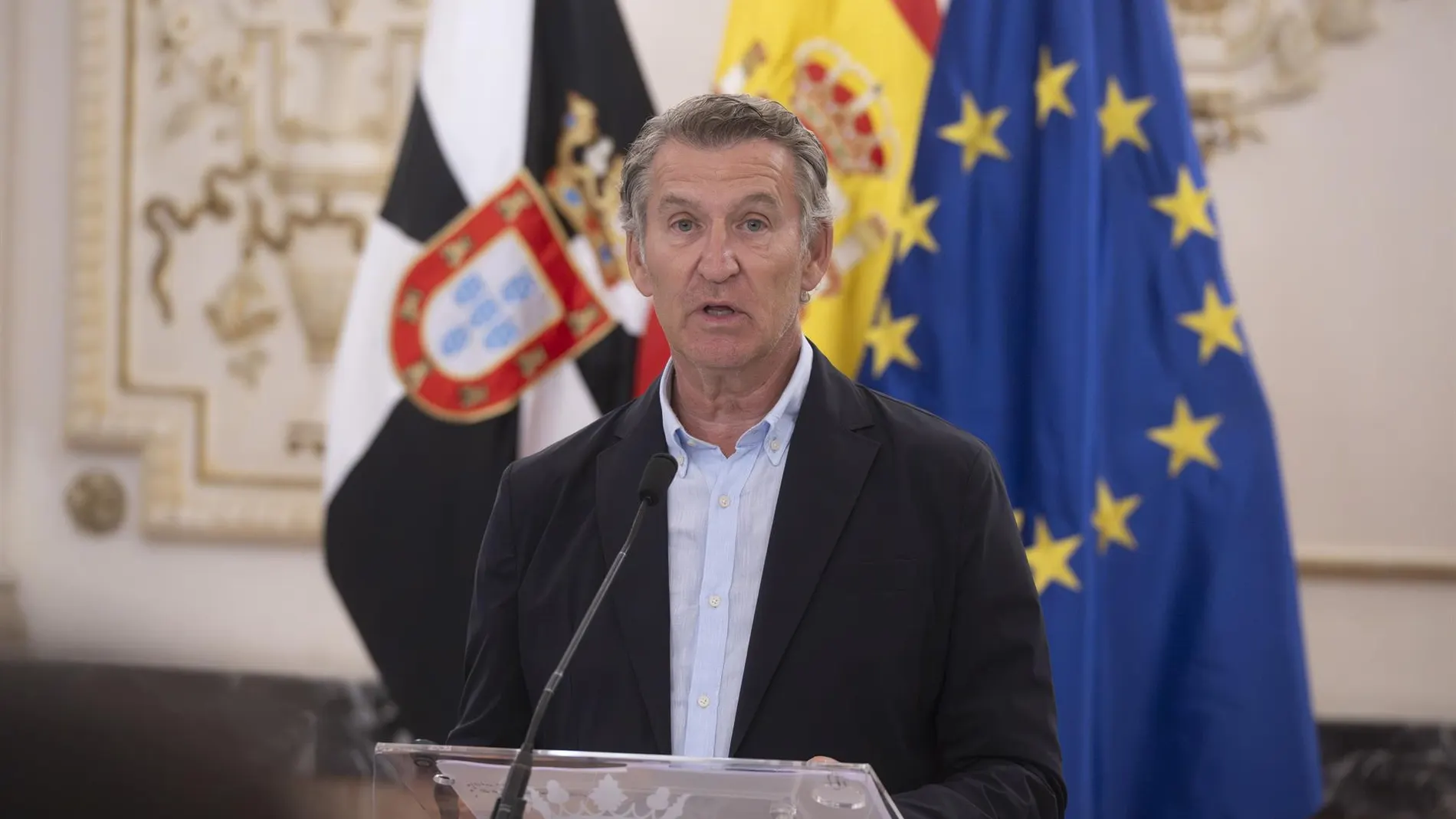
The PP has decided not to grant Pedro Sánchez the possibility of politically closing the Ceuta crisis after his appearance in Congress. Alberto Núñez Feijóo will bring his own plan to the Plenary next week, but The operation has more political than parliamentary implications. Many of the measures are known and some have even ended up appearing, with differences, among those announced by the President of the Government. What Génova intends to dispute now is something different: who imposes the diagnosis of what happened and, above all, from what ground the wear and tear left by the crisis is managed.
There has been a displacement that benefits the PP. For weeks, the Government tried to contain the debate around the management of a migration emergency. But Feijóo, on the other hand, took it from the beginning to another space: security, border control, sovereignty and the State’s ability to react. Sánchez’s appearance on Thursday did not close that discussion and, to a certain extent, ended up entering it.
The president announced the extension of the Tarajal and Benzú breakwaters, permanent maritime containment systems, thermal cameras and drones, the speeding up of returns and the request for the permanent presence of Frontex and Europol in Ceuta. These are decisions with which Moncloa intends to prove that there is a post-crisis response, but that They allow the PP to claim that the Government has ended up accepting the need to reinforce precisely those instruments whose insufficiency the opposition had been denouncing for weeks.
Therein lies one of the keys to the offensive that Genoa is preparing. The PP had already demanded on August 17 a single command, more Police and Civil Guard, more Immigration officials, the physical and technological reinforcement of the border and accelerating returns. He later expanded his proposal with an economic plan for Ceuta and Melilla and greater European involvement. Now he is taking these measures to the Plenary Session, when part of the Executive’s response has already approached that terrain. For Feijóo, therefore, the battle is not only about demonstrating that he has an alternative plan: it consists of install the idea that Sánchez has ended up acting on problems whose seriousness he did not initially recognize in the same terms.
The popular story will be simple: if more resources, more border control, Frontex and faster return procedures are needed now, the question is why they were not prepared before July 30 and 31.
This question connects with the flank that remains open for Moncloa: prior knowledge of the threat and the State’s reaction. The political discussion is no longer limited to establishing who was behind the massive entry, but also reaches to what information the different State structures handled, how it was valued and why the response did not prevent what happened. That is why the controversy over the reports is so politically uncomfortable for the Government.
Sánchez has tried to separate both debates. It maintains that there is currently no “solid evidence” to attribute participation or consent to the operation to Morocco and has ordered the publication of the available reports. But The appearance left an added difficulty: Some of his own partners did not fully buy that story either. Sumar, ERC and PNV questioned the delay in the government’s response, while Sumar and ERC pointed directly at Morocco.