
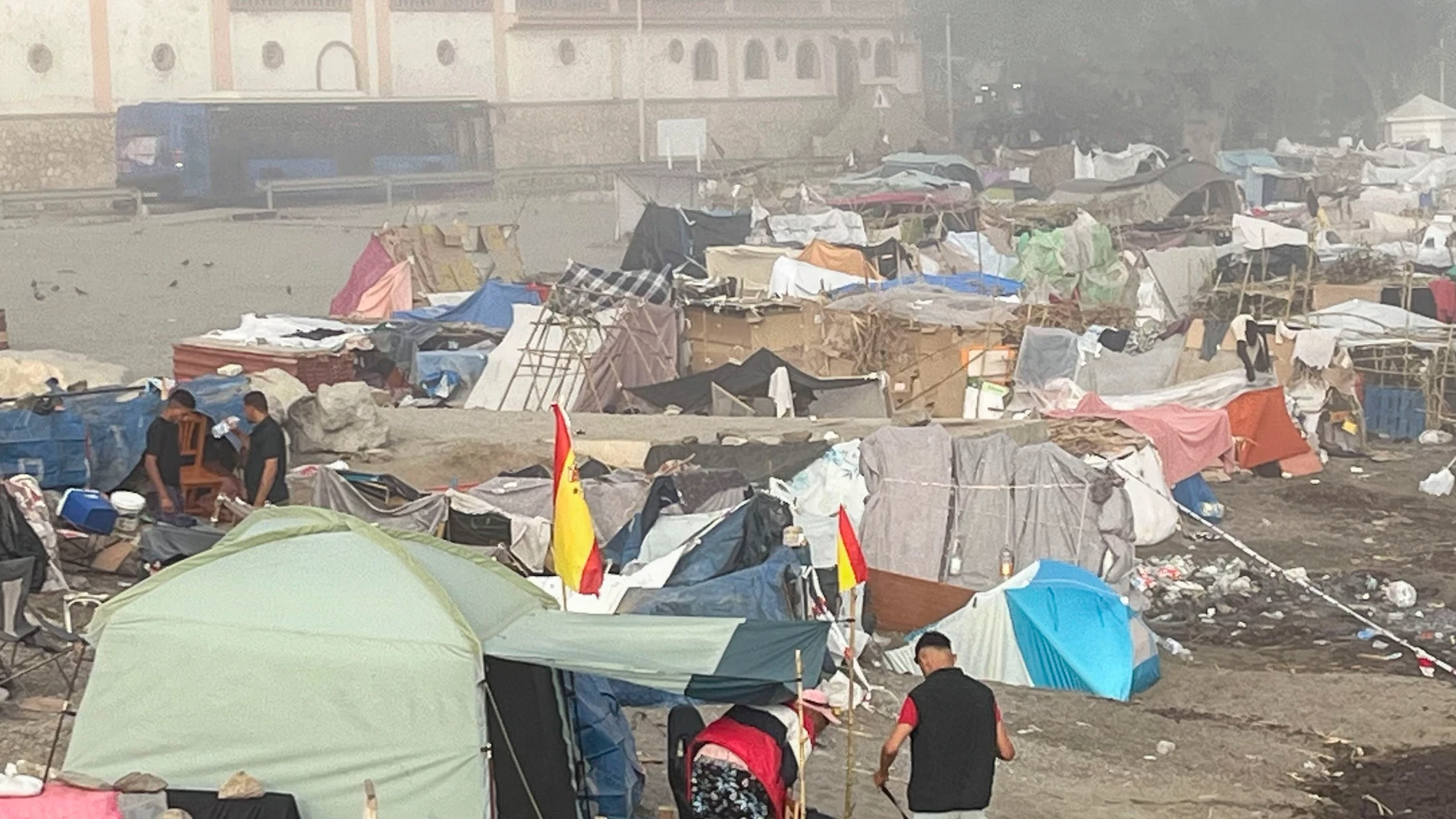
Ceuta does not have the same express territorial guarantee that the Treaty of Washington grants to European Spain and the Canary Islands. This does not allow us to conclude that the allies would leave Spain alone. In the face of aggression, NATO’s response would depend on the facts, the Government’s request and a political decision by its 32 members. Although this depends a lot on the geopolitical situation that the world is going through, diplomatic relations, and tensions within NATO, which increasingly resembles a modern Delian League.
The same happens with Melilla. That both cities are an integral part of Spain does not resolve a different question: whether an attack limited to their land territory would activate article 5 or whether support would have to be articulated through other means. The text signed in Washington on April 4, 1949 offers a first response that is not very reassuring. Article 5 considers an attack against all the aggression suffered by an ally “in Europe or North America.” Each member must help with the measures they deem necessary, including the use of armed force. Article 6 draws the map of the mutual defense obligation that articulates the essence of the treaty. It includes allied territory in Europe and North America, all of Türkiye, and the islands under a member’s jurisdiction located in the North Atlantic north of the Tropic of Cancer. It also covers forces, ships and aircraft in those areas or in the Mediterranean.
Ceuta is about 36 degrees north latitude, well above the Tropic of Cancer. It’s not enough. This criterion applies to the Atlantic islands, while Ceuta and Melilla are located on the African continent. The Canary Islands do meet the two conditions of the paragraph.
The old mention of the French departments of Algeria reinforces that reading. The founders expressly incorporated them and the clause became void after Algerian independence. The accession protocol of Greece and Türkiye did modify article 6 to add all Turkish territory. The one from Spain did not do the same with Ceuta and Melilla. The country joined on May 30, 1982.
The doubt was already on the table during the 1981 parliamentary debate. Leopoldo Calvo-Sotelo recognized that Article 6 delimited the space for collective defense and argued that other provisions of the treaty supported Spanish territorial integrity. The finally approved accession did not name the two cities and that has forever left a legal limbo over the two most historically compromised territories. The word “automatic” is misleading even within the area covered. Article 5 requires assistance, but does not order everyone to send troops nor does it set each person’s contribution. Support may consist of military force, intelligence, air defense or logistics, depending on what each State decides.
The treaty also does not establish a specific activation procedure. The attacked country must request or consent to collective action and the North Atlantic Council examines whether the event is covered. Decides by consensus, without majority voting.
It has only been invoked once. After 9/11, NATO first conditioned its application on proving that the attacks had been directed from abroad. He then approved eight measures, including radar aircraft patrols over the United States and a naval operation in the Mediterranean. Not even that case worked like a spring. In Ceuta, a previous obstacle appears, since before discussing what help each country would give, it would be necessary to agree whether the attack falls within the territorial definition of article 6. A strict reading leads to a negative response.
Miguel Ángel Acosta Sánchez, professor of Public International Law at the University of Cádiz, concludes that the two cities are not among the territories covered, although a threat would allow consultations to be opened. Natividad Fernández Sola, professor at the University of Zaragoza, shares that literal reading. Félix Arteaga and Luis Simón, from the Elcano Royal Institute, emphasize the other level: in a crisis the allied qualification of the attack and the willingness to respond would weigh. For this reason, everything is more a political promise than a palpable reality of defense.
Jens Stoltenberg had the opportunity to clear up the doubt before the Madrid Summit in 2022. Asked about the two cities, the then Secretary General recalled the limits of Article 6 and added that invoking Article 5 is “a political decision” that must be adopted by consensus and according to the specific case.
Three days later he assured that NATO protects all its allies and asked Spain to trust in that commitment. He repeated, however, that the invocation would depend on a political decision. He offered support, but that did not translate into a truly palpable response that the autonomous cities would be backed by the alliance.
Pedro Sánchez was more emphatic and maintained that the Strategic Concept approved in Madrid ensured the defense of every allied centimeter and emphasized: “Ceuta and Melilla are Spain.” The Government had informed Congress months before that it was not on its agenda to promote an amendment to the Washington Treaty.
The Strategic Concept reinforced attention to the southern flank and assumed a 360-degree defense. It also incorporated hybrid threats, cyber attacks and the instrumentalization of migration. It is a political and military guide, not a reform of Article 6.
The declaration of the Ankara Summit on July 8 maintains the same architecture: it reaffirms Article 5 and the 360-degree defense, but does not change its territorial limits or mention the two cities.
The defense of Ceuta begins in Spain. The Army attributes the immediate military defense of its area to the city’s General Command. In the face of an armed attack, Spain could exercise legitimate defense recognized by Article 51 of the United Nations Charter without waiting for a prior agreement from NATO.
Spain would defend Ceuta from the first moment and could receive European and allied support, but the situation also suggests that the opposite could happen.