
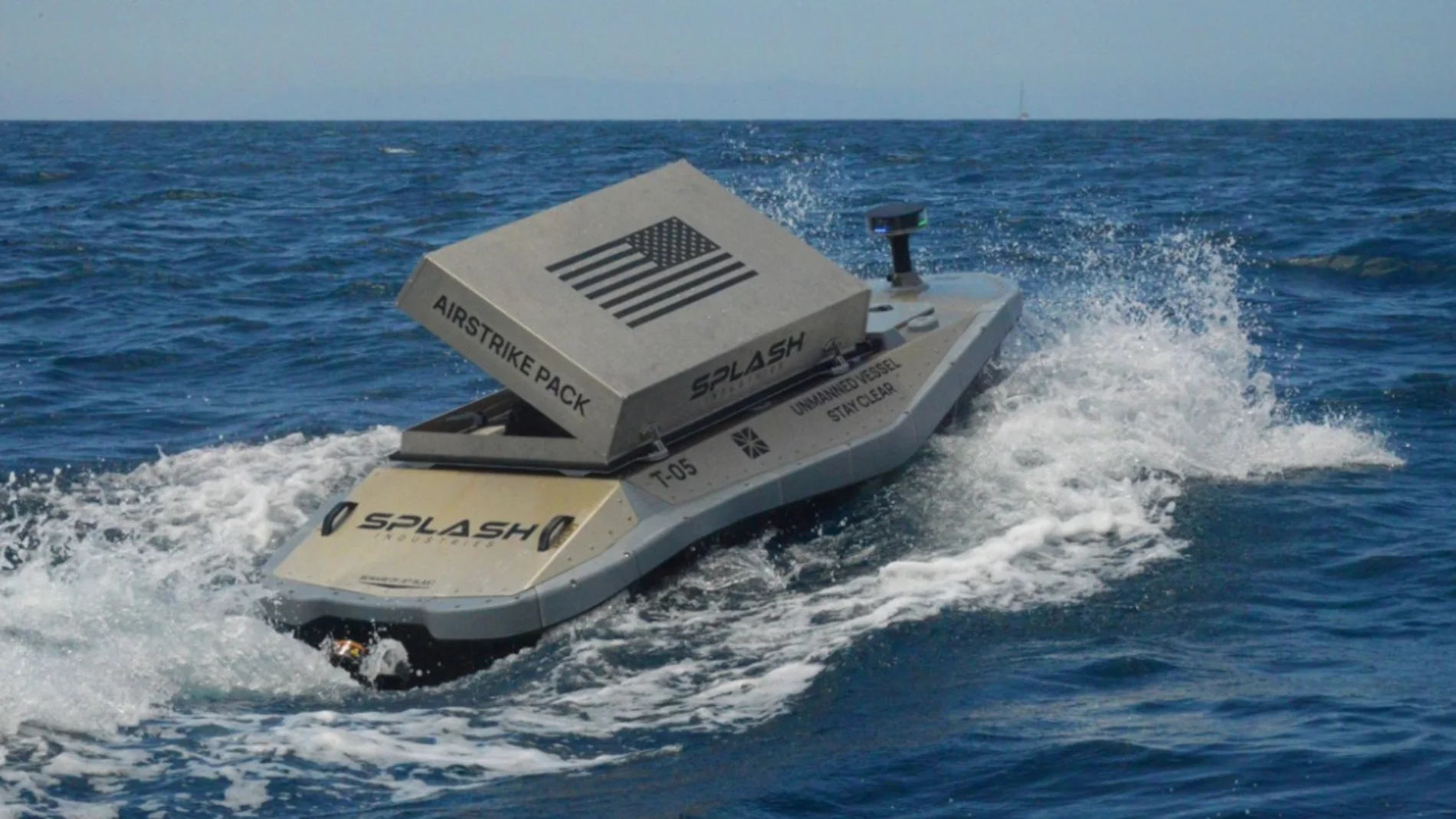
A ship of Just 3.4 meters long, it can travel more than 1,100 kilometers unmanned and is now also capable of launching drones from the sea. The combination seems straight out of a science fiction movie, but it is precisely the new capability that Splash Industries has incorporated into its Typhoon, an unmanned surface vehicle designed for military and security missions.
The American company has just presented the Airstrike Pack, a module that transforms the Typhoon into a platform capable of deploying single-use aerial drones. Launch can be carried out using Splash’s command and control system, called Splash C2, with a single command from the operator. The company assures that the system has already been tested during a confrontation exercise between forces, although it has not yet revealed how many drones it can carry or their dimensions, weight, autonomy or capabilities. What yes has demonstrated is the ability to convert an autonomous vessel into a mobile air launch platform. And therein lies the real news.
The Typhoon is not a conventional ship with a launcher added. From its conception it is an unmanned and modular vehicle. It measures approximately 3.4 meters, it can maintain speeds above 50 knots and has exceeded 70 knots during tests (almost 130 km/h). Its cover can be configured to carry different loads, sensors or other systems. Splash further claims that it can be assembled in about eight hours.
But probably the most striking figure is its autonomy: more than 600 nautical miles, equivalent to about 1,111 kilometers. This allows us to imagine a very different function than that of a simple naval surveillance drone. The Typhoon can travel for hundreds of kilometers before eventually becoming a kind of mobile base for other unmanned vehicles.. The idea fits with a transformation that is sweeping military technology: drones no longer necessarily have to act in isolation. An autonomous platform can transport, deploy or coordinate others.
In this case, the system adds an aerial dimension to a vehicle moving through water. The concept has one obvious advantage. An aerial drone that starts from the ground needs to travel the entire distance to its area of operation. If it is transported by a vehicle that has already traveled part of that journey, it can begin its mission much closer to the place where it will be used. And the platform that transports it does not need to carry a crew either. The result is a distributed architecture: one unmanned system carries other unmanned systems.
It is not the first time that the idea of launching drones from maritime platforms has appeared, but the interest of the Typhoon is in combining it with a relatively small, fast, modular vehicle conceived from the beginning to operate autonomously. The company had already demonstrated that the ship could perform complex tasks without continuous human intervention. during exercise RIMPAC, a Typhoon performed what Splash described as the first fully autonomous seaborne replenishment of a U.S. warship. The vehicle carried parts to the USS Essex and sailed into its floodable dock. without using radio or satellite commands during the operation.
That demonstration had a mainly logistical purpose. The new Airstrike Pack considerably expands the range of possibilities. The same vehicle can transport supplies, sensors or now unmanned aircraft depending on its deck configuration. That modularity is perhaps as important as the launcher itself: there is no need to build a different ship for each mission. Splash also claims that it develops much of the system’s electronics and software internally. According to the company, this vertical approach keeps the cost of the drone deployment system at approximately one tenth of that of its closest competitor.
The move also reflects a broader trend in modern warfare: replacing large, expensive platforms with networks of smaller, numerous and potentially expendable systems. There are still many unknowns. It is not publicly known how many drones the Airstrike Pack can carry, what range they have, how they are coordinated once launched or what degree of autonomy they have.. Therefore, to speak of a fully autonomous swarm would be to anticipate the available data. But the concept is already there.