
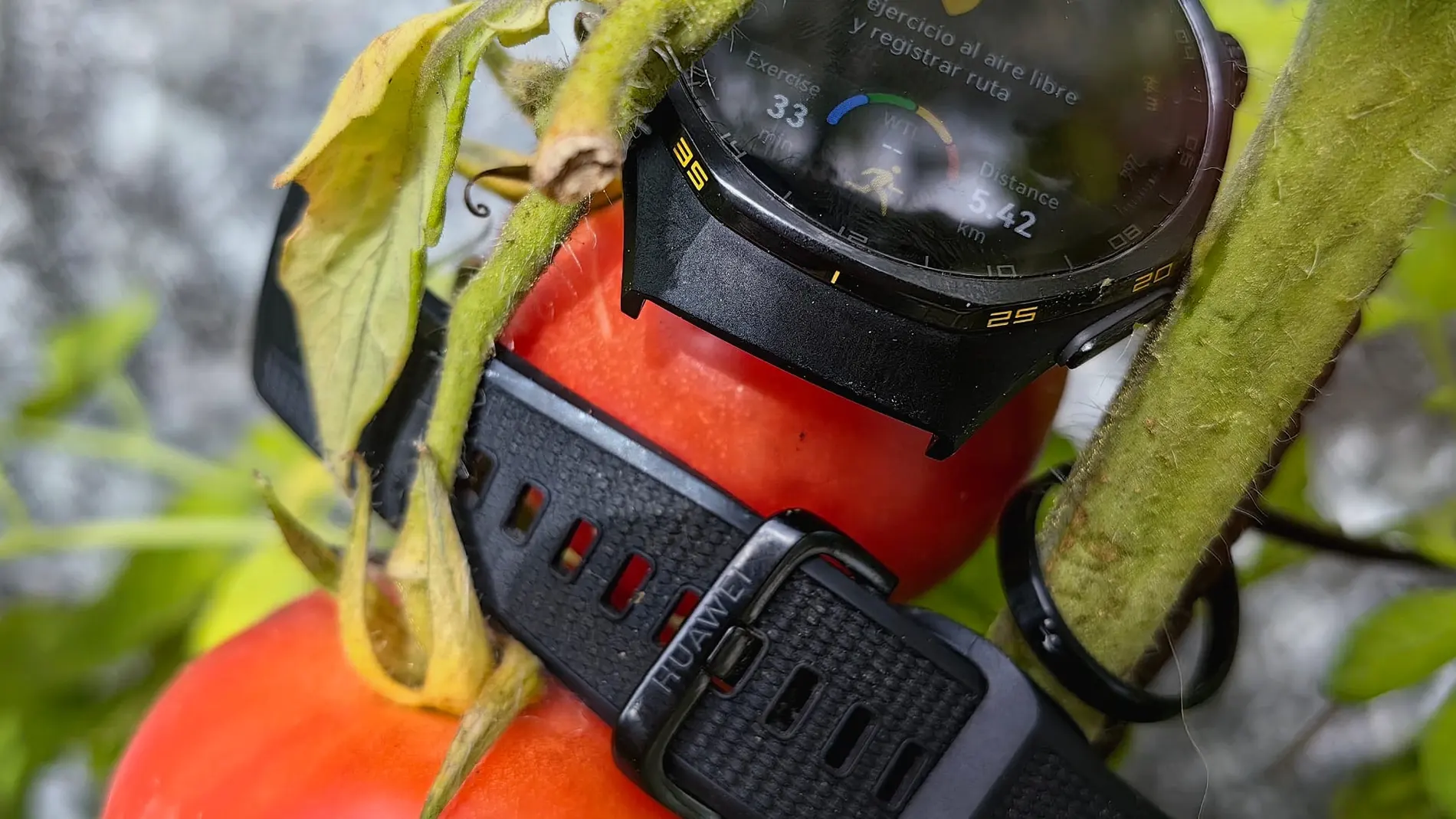
There are innovations that come accompanied by figures that are difficult to ignore: more power, more autonomy, more sensors, more resolution, more memory. And then there are others that barely occupy a few lines in the technical sheet and that, however, say much more about where the technology is evolving. The new EasyCross strap that Huawei incorporates into its next Watch GT 7 belongs to this second category. At first glance it seems like an almost trivial modification. A watch strap is still a watch strap. It has to do exactly the same thing it has done since 1810, When Abraham-Louis Breguet designed the first wristwatch for Queen Caroline Bonapartesister of the famous Napoleon: attach the device to your wrist.
But there is something that Huawei has changed in the way of doing it. Instead of the excess end of the strap being on the outside, as is usually the case, the system collects it inside, hiding it against the wrist. It does not change, therefore, the essential form of the object. Change its function through design. And this difference is much more important than it seems.
We are used to identifying technological innovation with the incorporation of new capabilities. A smart watch has more sensors than a conventional one; a phone has more lenses; A computer incorporates a faster processor. It is a perfectly valid form of progress and also easy to measure. but it exists another kind of much less visible innovation: one that does not necessarily add a function, but rather eliminates a small friction between the technology and the person who uses it.
A conventional strap works. There is no serious problem to solve. But the excess end is left outside, it can move, occasionally get caught on clothing and become more noticeable when we exercise. It’s one of those little imperfections that we get used to until they stop looking like imperfections to us. The interesting question that a design like EasyCross raises is precisely this: Why does something that has been working like this for decades have to continue working like this? That question is at the heart of much modern design.
Dieter Rams, one of the fundamental figures of industrial design of the 20th century, argued that good design should make a product useful, understandable and, above all, avoid unnecessary elements. His philosophy was summed up in an idea that ended up becoming one of the maxims of design: less, but better. The Huawei strap is not intended to turn the watch into something radically different. It does something much more discreet: it eliminates an element that until now we took for granted. In the words of Rams: less, but better.
And here another fundamental figure appears, the professor and designer Donald Norman. In his work on the relationship between people and objects he introduced concepts such as affordance: the characteristics of an object that allow us to intuitively understand how to interact with it. A truly successful design shouldn’t force us to think too much about how to use it. That also explains why the best innovations can be strangely invisible. In fact, Norman himself pointed out that design is an act of communication.
Therefore, When a technology works well, we stop perceiving it as a technology, because we speak the same language, so to speak.. A touchscreen phone eliminated much of the physical buttons. Wireless headphones made the cable disappear. Navigation systems replaced maps and memorized roads with instructions that appear in front of us.
In all of these cases something similar happened: the technology did not necessarily become more visible; It became less intrusive and more intuitive. The EasyCross belongs to that same logic on a tiny scale. You don’t have to learn a new language. There is no need to open an app or activate a function. The user simply puts on the watch and the strap behaves in a different way. Technological change is perceived as a physical sensation: something that was previously left out now disappears.
And this becomes even more important when we talk about devices that we wear almost permanently. For years we have evaluated smartwatches mainly by their specifications: heart rate, GPS, autonomy, water resistance, sensors, screen. But a wearables maintains constant contact with the body. Your success depends not only on what you are able to measure, but also on how you feel while doing it.
A split-second improvement in a processor can be invisible to a user. A small change in the way a watch fits on the wrist can be felt each time it is worn. Therefore, in this class of devices, Ergonomics stops being an aesthetic detail and becomes part of the technology.
The question is especially interesting because it comes at a time when electronic devices are reaching enormous maturity. Adding functions is becoming easier, but Getting all of them to coexist without increasing complexity for the user is much more difficult.. Perhaps that is why the next great stage of technology is not only about making our devices do more things, it would actually be that they bother us less while they do them.
It is the logical evolution. First we teach machines to do things that we used to do. Then we try to get them done faster, with greater precision and more efficiently. Now another objective is beginning to gain importance: that this technology be integrated into our lives to the point that we barely have to think about it. Innovation, then, stops consisting exclusively of adding and begins to become serving. We went from necessity to usefulness. That’s what makes EasyCross especially interesting. Huawei hasn’t invented a new way to wear a watch. It has questioned a small part of the traditional way of doing it and used design to change the experience. Something that until now was only achieved with specifications.